The short answer
Buy the Breville Joule Turbo if your reason is size: it is the most compact circulator on this site, it stands in a pan on a magnetic foot instead of clamping to the side, it is rated IPX7 so you can rinse it under the tap, and its Turbo mode genuinely shortens a cook. Buy the Inkbird ISV-100Wif your reason is price and you refuse to give up the specification: Inkbird publishes 1,000 W, a 25–99 °C range, ±0.1 °C— the same accuracy figure Anova quotes — 15 L of bath, WiFi and an on-device screen, for well under half the money. Buy the Greater Goods Sous Vide if your reason is the app: no WiFi, no account, no phone, a dial and a screen, and a silent brushless motor rated to run 99 hours straight. The budget pick is the Wancle 820, the cheapest sous vide machine on this site, at 1,100 W with a published range, timer and bath size.
Read the next section first, because Anova wins three things outright and two of them are the reason it is our overall pick in the sous vide machine ranking.
What Anova is actually good at
Worth stating precisely rather than as a feeling, because all three of these are published facts and all three are reasons to buy the Anova instead of anything below.
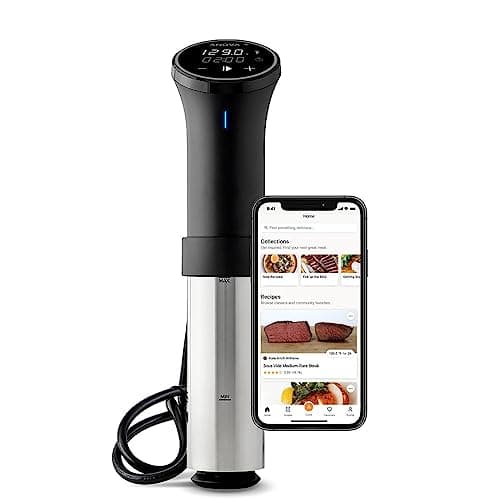
It publishes the whole specification.Anova's own Precision Cooker 3.0 page prints the rated power (1,100 W), the temperature range (0–92 °C / 32–197 °F), the accuracy (±0.1 °C) and the pump flow (8 L/min). That last figure is the one almost nobody else gives, and the range is the widest here. On a site whose entire authority claim is traceability to a manufacturer document, the brand that documents the most starts ahead.
A two-year warranty. The longest on any sous vide machine in this catalog. Breville gives one year, Inkbird gives one, Greater Goods does not publish a warranty term at all and nor does Wancle. If the thing you are buying is a promise rather than a feature, Anova sells the best one in the category.
An on-device touchscreen.It works completely without a phone. That sounds minor until you compare it with the Joule, which has no buttons and no screen and cannot be operated any other way — so a dead phone or an app outage stops the machine.
What it is not good at:at 325 mm tall it is the most awkward of these to store, the clamp-and-skirt body is bulkier than a magnetic foot, and 1,100 W is a real draw. It is also, by a wide margin, not the cheapest way to hold water at a temperature — which is the honest start of every section below.
How we ranked these
By the reason you are looking past Anova, not by an overall score, because the four reasons point at four different machines and a single league table would bury three of them. Within each reason the test is the same one we apply everywhere:
- Does the maker publish the specification that matters? Rated power, temperature range, stated accuracy, bath capacity. A circulator sold on precision that will not print an accuracy figure has told you something.
- Can it be operated without a phone? This is the single largest usability split in the category, and it is binary.
- Then the body: how it mounts, how it stores, whether it is sealed against the water it spends its life in.
- Then the warranty, then the price. In that order, which is why the cheapest machine here is last rather than first.
We have cooked nothing in any of these.Every figure below is quoted from the manufacturer's own page or manual, cited on each card, and every pick carries a real disqualifying reason to skip it. One warning about accuracy claims in particular: three of these five machines state ±0.1 °C, and not one of those figures has been independently verified by anyone, including us — we report them as manufacturer claims because that is what they are. The full rubric is in our methodology. Prices move, so none is printed in this prose; the live price sits on each card with the date of the last refresh.
What each one gives you instead
Published rated power, temperature range, stated accuracy, interface and warranty. Every cell is the manufacturer's own statement; a dash means the maker publishes no figure.| Circulator | Power | Range | Stated accuracy | Runs without a phone | Warranty |
|---|
| Anova Precision Cooker 3.0 | 1,100 W | 0–92 °C | ±0.1 °C | Yes, touchscreen | 2 years |
|---|
| Breville Joule Turbo | 1,100 W | — | — | No, app only | 1 year |
|---|
| Inkbird ISV-100W | 1,000 W | 25–99 °C | ±0.1 °C | Yes, dot-matrix screen | 1 year |
|---|
| Greater Goods Sous Vide | 1,100 W | 20–95 °C | — | Yes, no connectivity at all | — |
|---|
| Wancle 820 | 1,100 W | 25–90 °C | ±0.1 °C (claim) | Yes, on-device only | — |
|---|
1. Breville Joule Turbo — if the reason is size
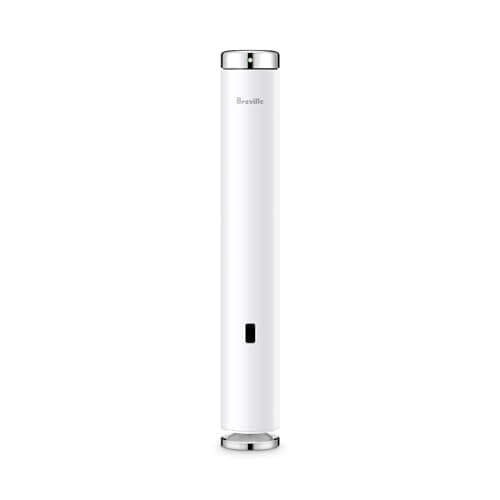
The Anova's real-world problem is that it is 325 mm of clamp-and-skirt to store, and the Joule is the answer to exactly that. It is the most compact circulator on this site, and the reason is a design decision rather than a trim: it has no buttons and no screen, so there is no interface taking up body. It stands in a pan on a magnetic foot rather than clamping to the rim, which means it will work in a stockpot you already own without a lip to grip. Breville publishes 1,100 W at 120 V — matching the Anova — a vessel capacity up to 10 gallons, WiFi and Bluetooth, and IPX7 water resistance, so it can go under a running tap rather than being wiped around. Turbo mode is the other genuine gain: Breville claims it shortens cook times materially, and no other machine here offers anything like it.
Two honest costs, and the first one is disqualifying for some people. It is app-only. There is no way to set a temperature on the device, so a dead phone, a lost password or an app outage is a machine that does nothing — the exact dependency the Anova's touchscreen exists to avoid. Second, for a device sold on precision, Breville publishes no temperature range and no accuracy figurein any manual we could reach. That is a real documentation gap and it is why this machine does not win our main ranking despite the better body. The warranty is one year against Anova's two. The head-to-head is Anova vs Breville Joule.
2. Inkbird ISV-100W — if the reason is price
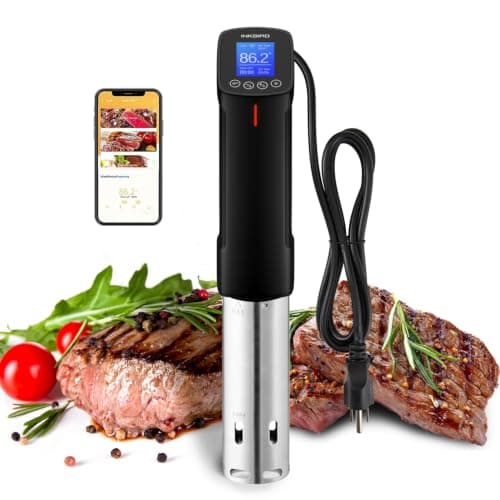
This is the pick that makes the Anova's price hardest to defend, and it is the one we recommend most often to people who balk at it. For well under half the money, Inkbird publishes the complete specification: 1,000 W, a 25–99 °C (77–210 °F) range, ±0.1 °Cstated accuracy — the same figure Anova quotes — a 15 L bath capacity, and WiFi on 2.4 GHz. Crucially it also has an on-device dot-matrix screen, so unlike the Joule it works with the app or without it.
Read that against the Anova row in the table above and the gap is 100 W of heating, a slightly narrower low end you will never use, and a year of warranty. That is the whole of it, on paper. For most people buying a first circulator, this is the rational purchase and we say so in the budget sous vide ranking, where it also wins.
Where it gives ground.A one-year warranty against two is the real cost. The app is functional rather than good, and the WiFi is 2.4 GHz only, which is a genuine annoyance on a mesh network that hides the band. And the listed weight figure on Inkbird's own page is internally inconsistent — a small thing, but a tell that the documentation is less carefully maintained than Anova's, which matters when the documentation is what you are trusting. The direct comparison is Anova vs Inkbird.
3. Greater Goods Sous Vide — if the reason is the app
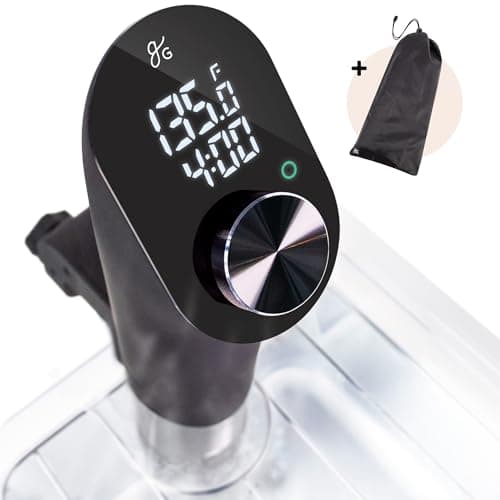
A real and growing reason to leave Anova has nothing to do with the hardware: people do not want a cooking appliance behind an account. This is the machine for that. It has no WiFi, no app and no connectivity of any kind— a dial, a screen, and nothing to pair, update or log into. Greater Goods publishes 1,100 W, a 20–95 °C (68–203 °F) range, and a silent brushless motor rated for 99 hours of continuous running, which is the one specification here that no other machine offers at all. On an overnight cook the noise difference against a geared pump is the kind of thing you notice from the next room.
The costs are documentation and the shape of the trade. Greater Goods publishes no temperature-accuracy figure and no warranty durationon its product page, which is two blanks in the column where Anova has its strongest numbers — and on a site that ranks by what makers publish, blanks cost. The absent connectivity is also a genuine loss if you ever wanted to start a bath from the office; the Inkbird gives you WiFi for a similar price, and the WiFi sous vide ranking is the page for that. Choose this one because you want the phone out of the kitchen, not because you are saving money.
4. Wancle 820 — the floor of the category
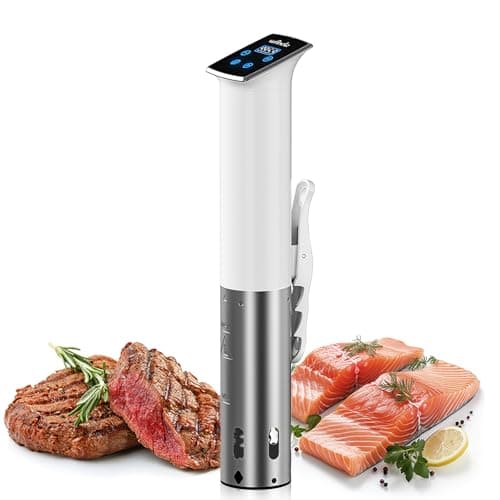
The budget pick, and the honest framing is that it is the cheapest way to find out whether you like sous vide at all before committing real money. Wancle publishes more than its price suggests: 1,100 W — the same heating power as the Anova — a 25–90 °C (77–194 °F) range, a timer from one minute to 99 hours 59 minutes, a 20 L maximum bath with a published 4.5 cm minimum water depth, and IPX7 water resistance so the body rinses under a tap.
Three real limits, and the third is the one that matters most.It tops out at 90 °C, below every other machine here — fine for everything sous vide actually asks for, but it will not hold a near-boiling bath for the odd non-sous-vide job. Its ±0.1 °Cis Wancle's own claim with no third-party verification behind it, and at this price we would treat it as a claim rather than a measurement. And Wancle publishes no warranty term anywhere: you are buying on the retailer's return window and nothing else, from a brand with no service network. That is precisely the thing Anova's two years is charging you for, and whether the gap is worth the money is the real decision on this page.
What we would buy
You want the Anova's spec for less:the Inkbird ISV-100W, which publishes the same accuracy figure, adds WiFi and a screen, and costs well under half — accepting one year of warranty instead of two. You want the smallest machine: the Breville Joule Turbo, if and only if you are genuinely happy cooking from a phone. You want no app at all: the Greater Goods, for the silent motor and the dial. You want to try the technique cheaply: the Wancle 820, understanding that there is no warranty behind it.
And if what you actually wanted was the complete published specification, the longest warranty in the category and a screen on the device, then the honest answer is that no machine on this page gives you all three — the Anova is still the one, and our review of it explains why it is our default. There is a live buy link for it below the picks rather than buried, because a page about alternatives that hides the original is not being straight with you.