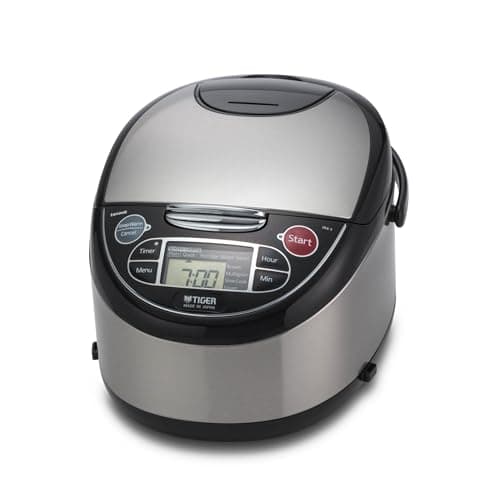
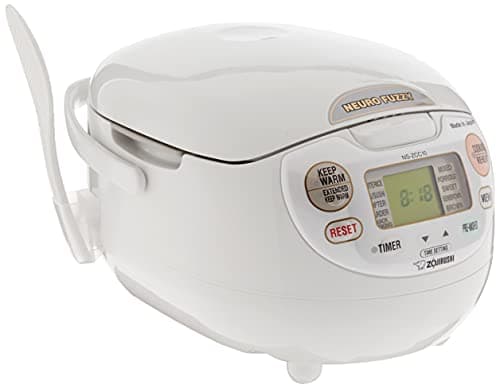
Two Japanese Micom cookers, one big difference
This is the closest matchup in the category, because both cookers start from the same place. The Zojirushi NS-ZCC10 Neuro Fuzzy and the Tiger JAX-T10U are both made-in-Japan Micom cookers — each uses a microcomputer to adjust the heat through the cook rather than running a fixed timer, and each is a 5.5-cup cooker drawing well under 700 W. Neither is induction, so neither is quite the best grain on this site; both are very good. The real question is not which cooks rice better — they are close — but whether you value Zojirushi's menu depth and documentation or Tiger's one extra trick.
The rice itself: Zojirushi sets the benchmark
On the rice alone, the Zojirushi is the reference. Its Neuro Fuzzy logic is the standard the whole category is measured against, and Zojirushi backs it with the settings people actually reach for — white, sushi, softer, harder, mixed, porridge, brown and rinse-free — a genuinely deep menu for tuning the grain to the rice you are cooking. It draws 680 W and is made in Japan. The Tiger is a very good Micom cooker in its own right, with 10 named auto-cook settings and its own published 641 Wdraw, and on plain white rice the two are hard to tell apart. But if your only question is “which makes the best rice for the widest range of styles,” the deeper, benchmark-setting menu is the Zojirushi's.
Tiger's trick: the tacook synchronous tray
The Tiger's reason to exist is the one thing the Zojirushi cannot do. Its tacook (synchronous cooking) tray sits above the rice and steams a dish while the rice cooks below — fish, chicken, dumplings, vegetables — from the same 641 W, in one machine, with a sealed tray that prevents flavor crossover. It is a real weeknight shortcut, not a preset with a fancy name: a main and the rice done together, hands-off, in the time the rice takes anyway. If that fits how you cook on a Tuesday, it is genuinely useful and it is unique to the Tiger here. The honest limit:the tray is portion-sized — a couple of fish fillets or a handful of dumplings for one or two, not a full second course for a family. Treat it as “rice plus a side” and it delivers; expect a whole family dinner from it and you will be disappointed.
Documentation and build
Zojirushi wins on paper trail. It publishes the wattage, the capacity, the technology and the origin plainly on its own product page, which is why it scores a clean sweep on our Documentation metric. Tiger publishes its wattage and its 10 auto-cook settings, but its US documentation is thinner overall — the inner-pot material, for instance, is not clearly stated, so we do not score the pot the way we can on a cooker that publishes it. Both are made in Japan and both are well-built Micom cookers; the difference is that the Zojirushi asks you to take less on faith. If having every spec traceable to a manufacturer document matters to you, that is a point for Zojirushi.
Running cost and everyday use
The two are neck and neck on running cost. At 680 W the Zojirushi and at 641 W the Tiger are both among the most efficient full-size cookers here to run, and the per-cook figures on each card are close enough that electricity should not decide it — a pot of rice on either is a rounding error next to the price of the cooker. Both offer the delay timer and keep-warm that make a rice cooker worth owning. So the choice really does come down to menu depth versus the tacook tray, not to the cost of running one over the other.
Capacity and everyday footprint
On size the two are level: both are 5.5-cupcookers, the standard household capacity, which makes a large family bowl of rice with leftovers once you remember that the “cup” is an uncooked 180 ml rice cup and the finished rice is roughly double. Neither is the biggest cooker on the site — the 6-cup Cuckoos hold more — but 5.5 cups is the right size for most homes, and it means capacity does not separate these two at all. If you need to feed more than a 5.5-cup pot covers, that is an argument for a different cooker entirely, such as one of the 6-cup models in our Japanese rice-cookerlineup's larger cousins; between the Zojirushi and the Tiger, size is a wash and the decision stays on features.
Menus and settings, compared
This is where the Zojirushi's depth shows. The NS-ZCC10 publishes a full set of named programs — white, sushi, softer, harder, mixed, porridge, brown and rinse-free — so you can tune the cook to the exact rice in the pot, which is a real advantage if you cook several styles. The Tiger answers with 10 named auto-cook settingsof its own, so it is far from bare, but the two are aimed differently: Zojirushi at the person who wants to dial in each rice type, Tiger at the person who wants the rice handled competently while the tacook tray does the second job. If you are the sort of cook who reaches for a “harder” setting or a porridge program, the Zojirushi's menu is the more expressive; if you mostly cook white rice and want the synchronous tray, the Tiger's set is plenty.
Keep-warm, reheat and the delay timer
Both cookers do the two things that turn a rice cooker into a daily habit: a delay timer, so you can load rice in the morning and have it ready when you get home, and an extended keep-warmthat holds the finished rice hot without drying it out for the length of a normal dinner. These are table stakes at this level and neither pulls dramatically ahead — the premium Zojirushi keep-warm is well regarded for holding rice a long time gracefully, and the Tiger's is perfectly good. If you rely on the timer to come home to fresh rice, either delivers; it is not a deciding factor between them.
Styling and living with them
Aesthetically neither is trying to be a design object. The Zojirushi wears a retro 1990s look that has not changed in years and shows its age on the counter, though many owners find the simple, legible controls a virtue rather than a flaw. The Tiger is a plainer, more utilitarian box. Both are ordinary in build where it does not matter and solid where it does; you are buying either for how it cooks, not how it looks. If a dated appearance would bother you daily, that is a small mark against the Zojirushi; if you just want the controls to be obvious, both pass.
Build, the inner pot and warranty
Both are made-in-Japan cookers with a one-year warranty, so on the fundamentals they are matched. The one documentation gap worth flagging is on the Tiger: its US materials do not clearly state the inner-pot construction, where Zojirushi is more forthcoming across its spec page. That does not make the Tiger's pot worse — it simply means there is a little less published to check, which is consistent with the broader pattern that Zojirushi documents itself more completely. For a buyer who wants every detail traceable to a manufacturer page, that tilts things toward the Zojirushi; for a buyer who trusts a made-in-Japan Tiger on its reputation, it is a non-issue.
Who should not buy either
Be honest about the ceiling: both are Micom cookers, not induction, so if what you want is the single best grain a home cooker makes regardless of features, neither is it — that is the induction Zojirushi NP-HCC10, which cooks a step above both on pure rice quality for considerably more money. And if your rice is mostly sticky short-grain or sushi rice, a Korean pressure cooker will out-texture either of these Japanese Micom models. The Zojirushi-versus-Tiger question only makes sense once you have decided that a mid-tier, made-in-Japan fuzzy-logic cooker is the right class for you; if it is not, the wider field is the place to look first.
The decision rule
Buy the Zojirushi NS-ZCC10 if you want the best plain rice, the deepest menu of settings, and the cleanest documentation — it is the benchmark for a reason, and if you only ever cook rice it is the more complete rice cooker. Buy the Tiger JAX-T10U if the tacook two-in-one weeknight trick genuinely fits your cooking — rice and a protein together, hands-off — and you are happy with a very good Micom cooker and slightly thinner documentation to get it. If you want the single best grain regardless of either, note that the induction Zojirushi NP-HCC10 outranks both, and to add the Korean pressure option see the three-way Zojirushi vs Tiger vs Cuckoo.