Skip to content
DD

HUB 01 · Multicookers

The best multicooker for rice

Every multicooker here has a Rice button. What separates them for rice is pot capacity, how much power is behind the boil, and whether you can cook rice above something else in the same pot. The Duo wins on the arithmetic — and there is an honest case, below, for not buying a multicooker for this at all.

By Stephen V.Updated How we rank
#ad

We earn a commission if you buy through our links. It does not change the price you pay, and it does not decide our picks — the scoring rubric is published in full, including what disqualifies a pick. How this works.

The short answer

Quick picks

#CookerBest forScorePrice
011,000 W
8.6
$69.99Amazon
02
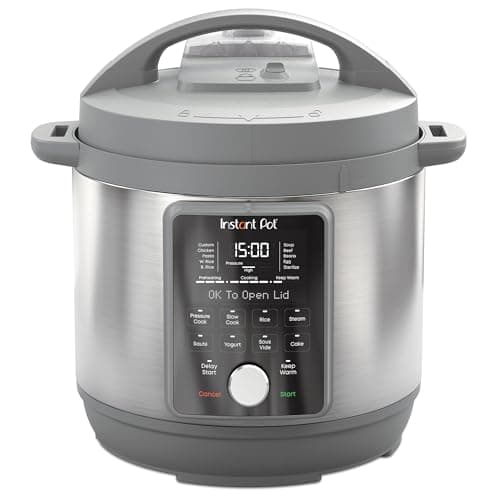
Instant Pot Instant Pot Duo Plus 9-in-1 Multicooker, 6 Quart
Instant Pot Duo Plus 9-in-1 Multicooker, 6 Quart

Sous vide and sterilize without stepping up to the Pro

1,000 W
8.1
$74.79Amazon
031,200 W
8.5
$159.99Amazon
041,200 W
7.7
$139.99Amazon
05700 W
7.3
$70.00Amazon

#ad · Prices pulled live from the Amazon Product API, last checked October 6, 2026. Where we have no verified live price we show none — we would rather leave a gap than print a number that has gone stale. The wattage column is what the manufacturer publishes; “not published” means exactly that, and we have not estimated one. Scores are ours, compiled from published specifications, and are not test results.

The verdict, first

For rice, buy the Instant Pot Duo. It is the cheapest cooker here with a Rice program, its 18/8 stainless tri-ply base is the right surface for the brief sauté that makes pilaf and biryani work, and at a published 1,000 W into a 6-quart pot it has the power-to-volume ratio that gets a batch of rice to pressure quickly. That is who it is for: one to four people cooking rice a few times a week alongside everything else the pot does. If you batch-cook, the 8-quart Duo Plus; if you cook single portions, the 3-quart Duo Mini; if you want Ninja's current machine, the HyperHeat names Rice among its functions. And read the last section before you buy any of them, because for some people the right answer is a rice cooker.

What actually decides rice in a multicooker

The Rice button on every one of these machines is a preset: a fixed low-pressure cook and a fixed release behavior. It is not a sensor-driven program that reads the grain the way a fuzzy-logic rice cooker does. So the preset is not the differentiator. Three published things are:

  1. Pot capacity against your batch size. Rice roughly triples in volume, and a pressure cooker should not be filled past half for foaming food like rice. A 6-quart pot is therefore comfortable to about 3 dry cups; a 3-quart Mini suits 1–1.5; an 8-quart handles a genuine meal-prep batch. Undersized is the mistake people actually make.
  2. Watts per quart.More power into less volume means a faster come-to-pressure, which is where almost all the elapsed time in “10-minute rice” actually goes. The Duo's 1,000 W into 6 quarts and the Mini's 700 W into 3 are the two best ratios here.
  3. Whether the pot is bare metal. Pilaf, biryani and jeera rice all start by frying aromatics or toasting the grain. A stainless pot takes that heat and gives you fond to deglaze; a coated pot is easier to clean but you lose some of that browning. Every Instant Pot here is stainless; the HyperHeat is ceramic-coated aluminum.

The specs that matter for rice, side by side

Published figures only — rated power, capacity and whether the maker names a rice program. Sources are cited on each product card below.
CookerCapacityRated powerRice program named by maker?Inner pot
Instant Pot Duo6 Qt / 5.7 L1000 WYes — among the 13 programs18/8 stainless
Instant Pot Duo Plus6 Qt1000 WYes — one of the nine functions18/8 stainless
Instant Pot Duo Plus, 8 Qt8.0 Qt1200 WYes — one of the nine functions18/8 stainless
Ninja HyperHeat6.5 Qt1200 WYes — SharkNinja names RiceCeramic-coated aluminum
Instant Pot Duo Mini3 Qt700 WYes — among the 11 programs18/8 stainless

Notice what the table does notcontain: a “cups of rice” rating. Multicooker makers quote pot volume in quarts, rice-cooker makers quote capacity in 180 ml rice cups, and converting between them is where most of the bad advice in this niche comes from. Our rice-cooker cup explainer sets out the real relationship, and the how much rice per person page turns it into portions.

Who each pick is for

  • Instant Pot Duo— one to four people, rice a few times a week, and the whole rest of the pot's repertoire the rest of the time.
  • Instant Pot Duo Plus — the same buyer who wants sous vide and the quieter release; identical rice, more machine.
  • Instant Pot Duo Plus, 8 Qt — meal-preppers and households of four or more cooking a week of rice at once.
  • Ninja HyperHeat— the buyer who wants Ninja's current pressure cooker and does not mind a coated pot; its ceramic pot is the easiest of these to clean after sticky rice.
  • Instant Pot Duo Mini — one or two people, or a second pot that does rice while the big one does the curry.

The trick that changes the answer: pot-in-pot

A multicooker can cook rice and a main at the same time, which no rice cooker on this site can do. You put the rice and its water in a heatproof bowl on a trivet above whatever is in the main pot, and both cook in the same pressure cycle. It is the single best reason to buy a multicooker for rice rather than a rice cooker, it works in every model on this page, and the technique is worth getting right — our pot-in-pot guide covers the bowl, the trivet and the water adjustment. The 6-quart and 8-quart pots have the headroom for it comfortably; the 3-quart Mini is tight.

What a multicooker is genuinely worse at

Three things, stated plainly, because a page that pretends otherwise is no use to you. Texture consistency across grains: a fuzzy-logic cooker adjusts heat through soaking, boiling and steaming and has separate menus for white, brown, sushi and porridge; a pressure preset applies one profile to everything, so brown rice and jasmine both come out acceptable rather than dialed-in. Keep-warm quality:rice cookers are built to hold rice for hours without drying it; a multicooker's keep-warm is a generic low setting. Unattended repeatability:same cup, same button, same result every day is the rice cooker's entire design brief. If rice is a daily staple in your house, read do you need a rice cooker if you have an Instant Pot before spending anything — the honest answer there is sometimes yes.

Getting it right in the machine you buy

Two details do more for your rice than the model choice. Rinse the rice until the water runs clear unless the bag says rinse-free; the surface starch you wash away is the difference between separate grains and a sticky mass, and it also reduces foaming, which matters in a sealed pot. Use less water than the stovetop ratio — a pressure cooker loses almost nothing to evaporation, so stovetop ratios overshoot and give you mush. The exact ratios and times per grain are in how to cook rice in an Instant Pot, and if your first attempt comes out wet, the mushy-rice fix applies to pressure cookers too.

In detail

The picks, in full

01
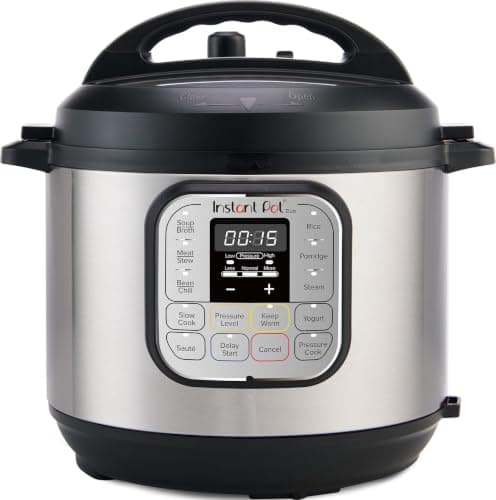
Instant Pot Instant Pot Duo 7-in-1 Electric Pressure Cooker, 6 Quart

The one to buy if you are not sure

Instant Pot Duo 7-in-1 Electric Pressure Cooker, 6 Quart

Stainless inner potWattage & pressure published
8.6/10

The multicooker that made the category, and still the right default. Instant Brands publishes the wattage, the working pressure range and a stainless (not nonstick) inner pot, which is more than most of the field manages — and it costs less than almost all of them.

Capability
7.5
Capacity
8
Documentation
9.5
Build
8.5
Value
9.5

What it gets right

  • Instant Brands publishes the wattage, the working-pressure range and the pot material — the full set, which most of the field does not
  • The 18/8 stainless inner pot has no coating to scratch off, so it outlives the nonstick pots in cookers costing more
  • At the current price it is the cheapest genuinely well-documented multicooker on this site

What it doesn't

  • No sous vide or air-fry program — this is the plain pressure-and-slow-cook model, by design
  • The steam release is a manual toggle, not the quiet auto-release of the Duo Plus or Pro
  • Seven functions is fewer than the sticker-count leaders, though most of those are the same element at different set points

What it costs to run

About 18.8¢ an hour at full rated draw, at the US average of 18.83¢ per kWh.

1,000 W ÷ 1000 × 1 h × 18.83¢ = 18.8¢

1000 W at 120 V / 60 Hz, published on the Instant Pot Duo product page and confirmed on the IP-DUO60 manual specification page. This is an upper bound: the element only draws full power while it is heating up or pressurizing, then cycles off to hold temperature, and no manufacturer publishes a duty cycle — so we compute at full rated draw rather than invent a correction factor. The full method is published.

Skip this if…

…you specifically want sous vide, a quieter steam release, or an air-fry lid — the Duo has none of those, and reaching for it and then wishing it did more is the most common Instant Pot regret. Step up to the Pro or Duo Crisp instead.

$69.99on Amazon

$109.9936% off

Price last checked October 6, 2026. Prices move constantly — Amazon's at checkout is the one that counts.

#ad · we may earn a commission from this link to Instant Pot Duo 7-in-1 Electric Pressure Cooker, 6 Quart

02
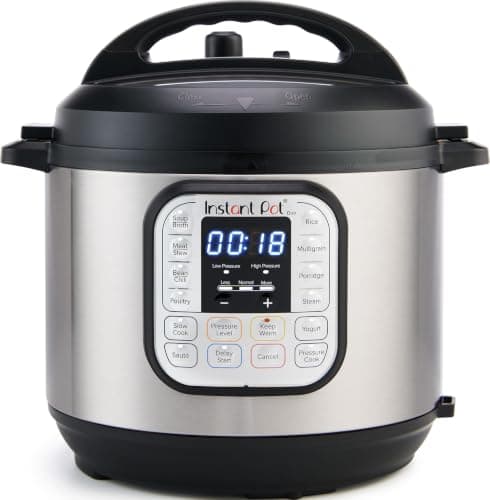
Instant Pot Instant Pot Duo Plus 9-in-1 Multicooker, 6 Quart

Sous vide and sterilize without stepping up to the Pro

Instant Pot Duo Plus 9-in-1 Multicooker, 6 Quart

Sous vide + sterilizeStainless inner pot
8.1/10

The Duo with two functions added that people genuinely use — sous vide and sterilize — plus a quieter WhisperQuiet steam release. Same 1,000 W, same stainless pot, same published working pressure, at a price between the Duo and the Pro.

Capability
8
Capacity
8
Documentation
9
Build
8
Value
7.5

What it gets right

  • Sous vide and sterilize on top of the Duo's core set, for meaningfully less than the Pro
  • The WhisperQuiet steam release is a real quality-of-life change if the kitchen is near a bedroom
  • Ships with a steam rack and two spare sealing rings, which is the accessory you always end up buying anyway

What it doesn't

  • The blue backlit LCD and button interface is dated next to the Pro's dial, and there is no auto-sealing lid
  • Sous vide on a pressure cooker holds temperature less tightly than a dedicated circulator with a pump
  • It sits in an awkward middle — close enough to the Pro's price that the Pro is often the better buy

What it costs to run

About 18.8¢ an hour at full rated draw, at the US average of 18.83¢ per kWh.

1,000 W ÷ 1000 × 1 h × 18.83¢ = 18.8¢

1000 W at 120 V / 60 Hz, published on the Duo Plus product page and confirmed on the Duo Plus manual specifications page 7. This is an upper bound: the element only draws full power while it is heating up or pressurizing, then cycles off to hold temperature, and no manufacturer publishes a duty cycle — so we compute at full rated draw rather than invent a correction factor. The full method is published.

Skip this if…

…the Pro is only a little more where you are shopping — the Pro's auto-sealing lid and programmable buttons are worth the gap, and the Duo Plus's one advantage over it is a lower list price that discounts often erase.

$74.79on Amazon

Price last checked October 6, 2026. Prices move constantly — Amazon's at checkout is the one that counts.

#ad · we may earn a commission from this link to Instant Pot Duo Plus 9-in-1 Multicooker, 6 Quart

03
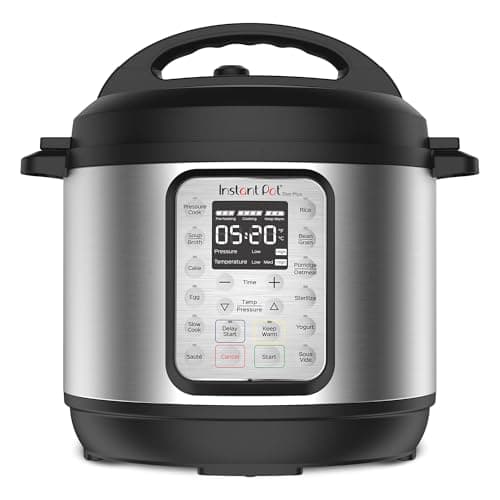
Instant Pot Instant Pot Duo Plus 9-in-1 Multicooker, 8 Quart

Pressure cooking for a crowd

Instant Pot Duo Plus 9-in-1 Multicooker, 8 Quart

Biggest pressure pot hereStainless inner pot
8.5/10

The largest pressure cooker Instant Brands currently lists on Amazon, and the big-batch pick here now the RIO Wide line has gone. Eight quarts — Instant Brands says up to 8 servings — with the full nine-function Duo Plus set including sous vide and cake, a WhisperQuiet one-touch steam release, and the same 18/8 stainless tri-ply pot as the 6-quart. It draws 1,200 W, which is 200 less than the Wide Plus it replaces.

Capability
8
Capacity
9.5
Documentation
9
Build
8.5
Value
7.5

What it gets right

  • Eight quarts is the largest pressure-cooking capacity on this site — Instant Brands rates it for up to 8 servings, which is a genuine batch-cooking and big-roast pot
  • The full nine-function Duo Plus set, sous vide and cake included, on an 18/8 stainless tri-ply pot with no coating to fail
  • At 1,200 W it draws 200 less than the 1,400 W RIO Wide Plus it replaces, and Instant Brands publishes the figure on its own product page

What it doesn't

  • No wide searing base — this is a conventional tall pot, so browning a big batch before you pressurize means doing it in rounds, which is exactly what the discontinued RIO Wide was built to avoid
  • An 8-quart body is tall and takes real cupboard space, and the same nine functions come in a 6-quart Duo Plus for roughly half the money
  • Its sous vide program heats a still pot with no pump, so it holds temperature far more loosely than a circulator

What it costs to run

About 22.6¢ an hour at full rated draw, at the US average of 18.83¢ per kWh.

1,200 W ÷ 1000 × 1 h × 18.83¢ = 22.6¢

1200 watts at 120 V~ 60 Hz, published on Instant Brands' own Duo Plus 8qt WhisperQuiet product page. This is an upper bound: the element only draws full power while it is heating up or pressurizing, then cycles off to hold temperature, and no manufacturer publishes a duty cycle — so we compute at full rated draw rather than invent a correction factor. The full method is published.

Skip this if…

…you cook for fewer than four. Eight quarts is the entire reason to buy this one, and a half-full pressure cooker is just a bigger thing to store and preheat — the 6-quart Duo Plus has identical functions for roughly half the price. And if a wide searing floor was what you wanted, no current Instant Pot has one.

$159.99on Amazon

Price last checked October 6, 2026. Prices move constantly — Amazon's at checkout is the one that counts.

#ad · we may earn a commission from this link to Instant Pot Duo Plus 9-in-1 Multicooker, 8 Quart

04
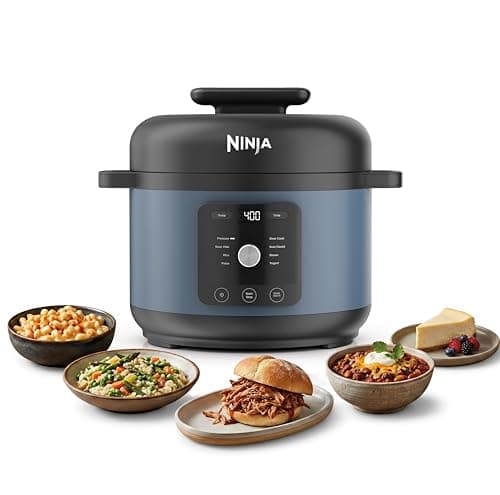
Ninja Ninja HyperHeat 9-in-1 Pressure Cooker, 6.5-Quart (PC201)

Ninja's current pressure cooker

Ninja HyperHeat 9-in-1 Pressure Cooker, 6.5-Quart (PC201)

PFAS-free ceramic potNo air fry / crisping lid
7.7/10

Ninja's replacement for the Foodi pressure line, and a plainer machine than the one it replaces: 1,200 W, 6.5 quarts, sous vide and yogurt programs, a PFAS-free ceramic-coated pot — and no crisping lid. If you want a Ninja pressure cooker you can buy today, this is it. If you wanted the air fryer, this is not the one.

Capability
7.5
Capacity
8.5
Documentation
7.5
Build
7
Value
8

What it gets right

  • It is the Ninja pressure cooker that is actually in stock — the Foodi pressure line it replaces is gone, and the PossibleCooker does not pressure cook at all
  • Sous vide and yogurt are built-in programs, which the Foodi OS300 did not offer
  • SharkNinja publishes the wattage, the voltage and the pot material plainly, including that the ceramic coating is PFAS-free

What it doesn't

  • No crisping lid and no air fry function — the single feature that made the Foodi worth choosing over an Instant Pot is not on this machine
  • SharkNinja markets it as 9-in-1 but only itemizes seven of the nine functions on its own spec page, so the count is doing some work
  • The pot is ceramic-coated aluminum rather than the bare 18/8 stainless Instant Pot uses; a coating is a thing that can eventually fail, and stainless is not

What it costs to run

About 22.6¢ an hour at full rated draw, at the US average of 18.83¢ per kWh.

1,200 W ÷ 1000 × 1 h × 18.83¢ = 22.6¢

1,200 watts at 120 volts, published in SharkNinja's own specification table for the HyperHeat PC201. This is an upper bound: the element only draws full power while it is heating up or pressurizing, then cycles off to hold temperature, and no manufacturer publishes a duty cycle — so we compute at full rated draw rather than invent a correction factor. The full method is published.

Skip this if…

…you want to pressure-cook and then crisp in the same pot. This machine does not air fry, full stop — buy the Instant Pot Duo Crisp for that, and do not let the Ninja badge talk you into thinking it is the Foodi with a new name.

$139.99on Amazon

$169.9918% off

Price last checked October 6, 2026. Prices move constantly — Amazon's at checkout is the one that counts.

#ad · we may earn a commission from this link to Ninja HyperHeat 9-in-1 Pressure Cooker, 6.5-Quart (PC201)

05
Instant Pot Instant Pot Duo Mini 7-in-1, 3 Quart Electric Pressure Cooker

One or two people, or a second pot

Instant Pot Duo Mini 7-in-1, 3 Quart Electric Pressure Cooker

Smallest footprintLowest-draw Instant Pot here
7.3/10

The Duo shrunk to 3 quarts. It is the right size for one or two people, for a dorm or an RV, or as a second pot for a side dish while the big one does the main. The same 7-in-1 function set, the same stainless pot, in a footprint that actually fits a small kitchen.

Capability
7
Capacity
4.5
Documentation
9
Build
8
Value
8

What it gets right

  • Three quarts is genuinely one-or-two-person sized — you are not heating a six-quart pot to cook a cup of rice
  • At 700 W it is the lowest-draw Instant Pot on this site, and small and light enough to live in a cupboard
  • The same 18/8 stainless inner pot and 7-in-1 set as the full Duo, so nothing about the cooking is compromised

What it doesn't

  • Three quarts is a hard ceiling — it will not cook for a family, and doubling a recipe means two rounds
  • The smaller pot pressurizes fast but the tight interior makes searing in batches fiddly
  • No sous vide or air fry — it is the plain Duo feature set, scaled down

What it costs to run

About 13.2¢ an hour at full rated draw, at the US average of 18.83¢ per kWh.

700 W ÷ 1000 × 1 h × 18.83¢ = 13.2¢

700 W at 120 V / 60 Hz, published on Instant Brands' own Duo Mini product page and confirmed in the Duo Mini user manual specification table. This is an upper bound: the element only draws full power while it is heating up or pressurizing, then cycles off to hold temperature, and no manufacturer publishes a duty cycle — so we compute at full rated draw rather than invent a correction factor. The full method is published.

Skip this if…

…you ever cook for more than two, or you batch-cook. The Mini's size is its whole point and also its whole limit; a 6-quart Duo is only a little more money and vastly more useful for a household.

$70.00on Amazon

$89.9922% off

Price last checked October 6, 2026. Prices move constantly — Amazon's at checkout is the one that counts.

#ad · we may earn a commission from this link to Instant Pot Duo Mini 7-in-1, 3 Quart Electric Pressure Cooker

Which one to buy

Buy the Instant Pot Duo unless your batch size pushes you elsewhere. It has the rice program, the stainless pot that handles the sauté step, the best power-to-volume ratio of the full-size cookers here, and the lowest price of any of them — and rice is a job where the extra functions on the pricier models change nothing at all. That is the rare case on this site where the cheapest pick is also the right one on the merits.

Size is the only thing worth paying for here. Go to the 8-quart Duo Plus if you cook a week of rice at a time or feed four-plus; drop to the 3-quart Duo Mini if you cook for one and want rice in twenty minutes without heating a big pot. Both decisions are about volume, not rice quality.

And buy a rice cooker instead if rice is daily. If you eat rice most days, care about texture, and want the same result every time with no thought, the money is better spent on a fuzzy-logic cooker — start at the best rice cookers. A multicooker is the right buy when rice is one of fifteen things you need the pot to do. As ever, no price appears in this paragraph: the live, dated figure is on each card above.

How we picked

Machines we claim to have tested: 0

Everyone in this category tells you they tested twenty cookers. We have tested none, and we say so. Here is what we do instead: read the manufacturer's manual and spec page, record the published wattage, capacity, pressure or temperature figure and warranty term, work out what the machine costs to run per hour, show the arithmetic so you can redo it with your own electricity rate, and cite all of it. Where a brand publishes no wattage, we print no running cost rather than borrowing a number from a similar model. Prices come live from Amazon's API and disappear rather than go stale.

The scores above are judgments from that documented research — not test results. One of the five metrics is Documentation: whether the manufacturer will tell you what its cooker draws at all. The full rubric, including what disqualifies a pick, is published in full.
Questions

Frequently asked

Which Instant Pot is best for rice?
The Duo, for most people. It has a Rice program, a bare 18/8 stainless tri-ply pot that handles the sauté step pilaf and biryani need, and a published 1,000 W into a 6-quart pot - the best power-to-volume ratio of the full-size models here. The pricier Instant Pots cook rice identically; what they add is sous vide, a quieter release and a better interface, none of which touches the rice.
Is a multicooker as good at rice as a rice cooker?
No, and the gap is about consistency rather than a single bad batch. A fuzzy-logic rice cooker adjusts heat through the cook and has separate programs for white, brown, sushi and porridge; a multicooker applies one pressure preset to every grain. A multicooker makes good rice and does fifteen other jobs. A rice cooker makes better rice, every time, and does one.
How much rice fits in a 6-quart multicooker?
About 3 dry cups comfortably. Rice roughly triples in volume as it cooks, and a pressure cooker should not be filled past the half mark with foaming food like rice, so the practical ceiling is well below the pot volume. A 3-quart Mini handles 1 to 1.5 dry cups; an 8-quart takes a genuine meal-prep batch.
Can you cook rice and a main course at the same time in a multicooker?
Yes - it is called pot-in-pot, and it is the best reason to choose a multicooker over a rice cooker. The rice and its water go in a heatproof bowl on a trivet above the main dish, and one pressure cycle cooks both. It works in every cooker on this page; the 6-quart and 8-quart models have the most comfortable headroom for it.
Does the Ninja HyperHeat cook rice?
Yes. SharkNinja names Rice among the HyperHeat's functions on its own specification page, alongside pressure cook, slow cook, sous vide, steam, sear/sauté and yogurt. Its pot is ceramic-coated aluminum rather than the Instant Pots' bare stainless, which makes it the easiest of these to clean after sticky rice and the one with a wear surface — the trade is laid out in our Instant Pot vs Ninja HyperHeat comparison.
Why is my multicooker rice mushy?
Almost always too much water. A sealed pressure cooker loses virtually nothing to evaporation, so the stovetop ratio you are used to overshoots badly. Cut the water, rinse the rice until the water runs clear to remove surface starch, and use a natural release rather than venting immediately - a quick release boils off liquid at the wrong moment and agitates the grains.

Keep reading

Receipts

Sources

We have not tested these machines in a lab and we do not pretend to have. Specifications come from the manufacturer's own published documents; electricity rates come from the US Energy Information Administration; prices come from the live Amazon API. Where a figure is not published, the page says “not published” rather than guessing. Read the full method.