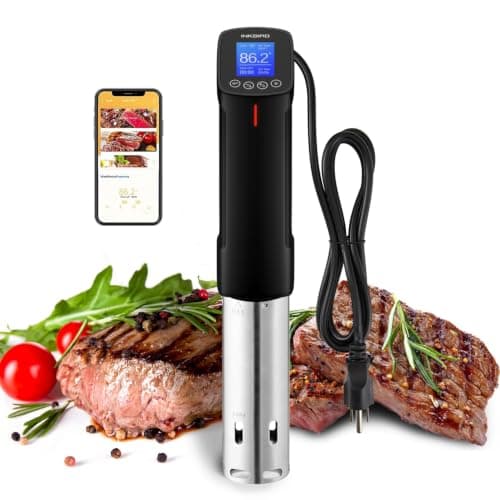
Two budget circulators, one small step apart
Neither of these is a premium machine, and that is exactly why the choice is close. The Inkbird ISV-100Wis the value pick that does not feel like one — a full spec sheet, WiFi and an on-device screen for under $100 — and the Monoprice Strata is the floor of the whole category, the cheapest way in there is. We have cooked on neither; this reads the published specs and the design, per our methodology. The fork is simple: spend a little more for WiFi and tighter ±0.1°C control, or spend the absolute least and still cook properly. Both are honest buys; here is which is which.
What the Inkbird gives you for a little more
The Inkbird's whole argument is that it hands you the numbers a budget machine usually hides. On its own page it publishes the complete specification — 1,000 W, a 25–99°C (77–210°F) range, ±0.1°C accuracy and a 15 Lwater capacity — at a price where most rivals publish almost nothing. That ±0.1°C figure is the one that defines a precision cooker, and on paper it matches the far pricier Anova for a fraction of the money. You also get both an on-device dot-matrix screen and WiFi, so it works fully at the machine and lets you start or check a cook from your phone. It is a remarkable amount of capability for the money.
What the Monoprice gives up to be cheapest
The Monoprice trades some of that away to sit at the floor, and does it more gracefully than you would expect. It draws 800 W, quotes a looser ±1% temperature stabilityrather than a ±0.1°C accuracy figure, and has physical controls with no WiFiat all. What it keeps is genuinely good: it still publishes a full specification in its manual — including a user recalibration procedure — and its 8.5 L/min directional pump cap, which lets you aim the flow or run a gentle side-jet for delicate food, is a real, thoughtful feature at this price. It is the cheapest machine here and it does not feel like a cheap trick.
The control gap: ±0.1°C vs ±1%
This is the fork's sharp edge. The Inkbird publishes ±0.1°C accuracy; the Monoprice quotes ±1% stability— a looser spec of a different kind. For steak and chicken held for a couple of hours, the two are effectively indistinguishable, and the Monoprice is genuinely fine. The difference surfaces on long, low cooks and delicate foods — eggsat a set point, a very long tough-cut cook — where a small, sustained drift changes the result. If those precise cooks are on your list, the Inkbird's tighter control is worth the modest step up. If you mostly cook forgiving cuts, it is a spec you may never cash in.
Capacity, connectivity and warranty
Three practical lines round it out. On capacity, the Inkbird publishes a 15 L figure, useful if you cook in a big container; the Monoprice publishes none, though its higher-rated pump flow moves water well. On connectivity, the Inkbird has WiFi (2.4 GHz) for remote start and monitoring, and the Monoprice has none— a real difference if you would ever kick off a cook from another room, and no loss if you would not. On warranty, the Inkbird carries a one-year term and Monoprice publishes no warranty term at all, which is a genuine gap when you are weighing how long each should last. None of these is decisive alone; together they lean toward the Inkbird for anyone who thinks they will keep cooking this way.
Which budget machine to buy
Both machines have an on-device screen and both let you cook without a phone, so this is not the app-only debate the Joule provokes — it is purely about how little you want to spend and whether WiFi and tighter control are worth a small premium. The Monoprice is the least you can spend and still do sous vide honestly; the Inkbird is barely more and gives you a screen, WiFi, a tighter accuracy figure and a warranty. For most people willing to spend a touch more, the Inkbird is the smarter budget buy; the Monoprice is the pick when the lowest possible price is the whole point.
The key rule: the ±0.1°C Inkbird, with WiFi, an on-device screen, a published 15 L capacity and a one-year warranty for under $100, is the smarter budget buy for anyone who expects to keep cooking sous vide. The 800 W Monoprice, with looser ±1% stability, no connectivity and no published warranty, wins only when the absolute lowest price is the deciding factor. Remember that sous vide safety comes from time and temperature together, not the accuracy number — hold food long enough at temperature to pasteurize it, and see the temperature guide for targets.
The decision rule
One question decides it: is the lowest possible price the whole point, or just part of it?If you want the least you can spend and still cook sous vide properly — and you do not care about WiFi or a tighter accuracy figure — the Monoprice Strata is the honest floor, and its directional pump cap is a real bonus at the price. If you are willing to spend a little more for a machine you are more likely to keep, the Inkbird ISV-100Wadds WiFi, a published 15 L capacity, a ±0.1°C accuracy figure and a warranty, all still under $100.
Buy the Inkbirdif you want the most capable budget circulator — precision, WiFi and a screen — without leaving the budget tier, and it is the right pick for most people here. The Monoprice is discontinued— it was the pick if the single lowest price was what mattered and looser control and no warranty are acceptable trades. If you find yourself wanting more than either — the longest warranty and the most refined app — that is the premium Anova, weighed against the Monoprice in Anova vs Monoprice. Both machines here also feature in the best budget sous vide machines.
How we picked
Machines we claim to have tested: 0
Everyone in this category tells you they tested twenty cookers. We have tested none, and we say so. Here is what we do instead: read the manufacturer's manual and spec page, record the published wattage, capacity, pressure or temperature figure and warranty term, work out what the machine costs to run per hour, show the arithmetic so you can redo it with your own electricity rate, and cite all of it. Where a brand publishes no wattage, we print no running cost rather than borrowing a number from a similar model. Prices come live from Amazon's API and disappear rather than go stale.
The scores above are judgments from that documented research — not test results. One of the five metrics is Documentation: whether the manufacturer will tell you what its cooker draws at all. The full rubric, including what disqualifies a pick, is published in full.