The verdict
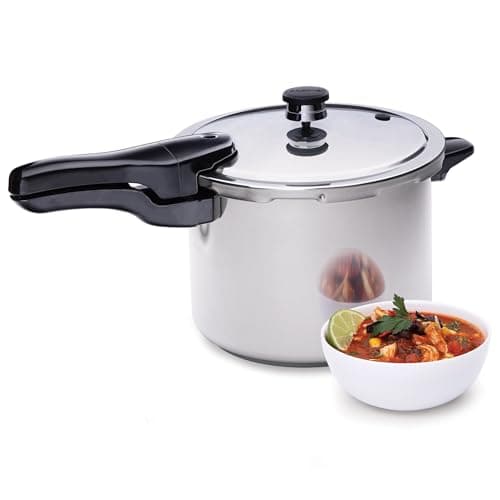
This is the stovetop pressure cooker to buy, and it is the right buy for anyone who will actually stand at a stove. Presto publishes a 6-quart liquid capacity, a stainless body on a tri-clad base, a range list that includes induction, and an extended 12-year limited warranty; its separate pressure-regulator explainer states that the regulator holds the ideal cooking pressure — usually 15 pounds, half again what any electric cooker on this site reaches. For roughly what a mid-range Instant Pot costs you get a faster, simpler, far more durable pressure cooker. What you do not get is automation of any kind, and that is the entire decision.
What Presto publishes
More than most, and in the right places. The 6-quart figure is a liquid capacity (5.7 litres), the body is described as stainless steel construction, and the base is tri-clad — aluminum sandwiched between two layers of stainless, which is what lets a stainless pot brown evenly instead of developing a hot ring over the burner. The range list is explicit: gas, electric, smooth-top and induction. That last word is the one that separates this model from the cheaper aluminum Prestos, which Presto lists for electric, smooth-top and gas only — aluminum is not magnetic and will not heat on induction at all.
The pressure figure is the one piece of documentation that is not on the product page. It comes from Presto's own pressure-cooking explainer, which describes the regulator as maintaining the ideal cooking pressure, usually 15 pounds. We cite it separately rather than implying Presto prints a psi number on the box, because it does not — and a cooker whose headline advantage is its pressure ought to state the pressure where you are shopping.
What 15 pounds actually changes
Pressure sets the boiling point, and the boiling point sets the cooking temperature. At roughly 15 pounds a sealed pot of water boils around 250 °F; at the 10.2–11.6 psi Instant Brands publishes for the Duo, closer to 240. That gap looks small and behaves large on long cooks, because cooking reactions accelerate steeply with temperature. Expect ten to twenty percent off a dried-bean, shank, oxtail or stock cook. Expect nothing on a chicken breast, which was never time-limited.
The practical consequence is that recipes do not cross over. A recipe written for an electric cooker will overcook here, and your grandmother's whistle-counting method will under-cook in an Instant Pot. The conversion guide handles the arithmetic, and how to use a pressure cooker covers the technique a stovetop pot actually needs.
Living with it
The routine is: fill, lock the lid, put it on high heat, wait for the regulator to start rocking, then drop the burner to the lowest setting that keeps it rocking gently every few seconds, and start timing from there. That last step is the skill, and it takes two or three cooks to learn. The feedback loop is excellent once you have it — a rocking weight is an unambiguous instrument — but you cannot leave the kitchen, and if the burner drifts too low the pressure falls out of band and the cook silently stops happening.
Induction makes this noticeably easier, which is worth knowing if you have it: an induction hob changes power almost instantly, so finding and holding the right level is far less fiddly than on gas or radiant electric. That is covered in full on the induction pressure-cooker page.
Cleaning is simple and the one maintenance caveat is published: the pot is dishwasher safe, but the sealing ring and the over-pressure plug must be hand washed. Both are inexpensive consumables and both are the parts that actually wear — which is most of why Presto can warrant the whole cooker for twelve years.
The warranty, in context
Twelve years is not a rounding-up of an industry norm; it is more than ten times the one-year limited warranty Instant Brands offers on every electric cooker in our catalog, and two years longer than Kuhn Rikon's ten on a pot costing roughly three times as much. The reason is structural rather than generous: there is no element, no pressure sensor, no circuit board and no control panel in here to fail. A stovetop pressure cooker is a pot, a lid, a gasket and a weight.
Who should not buy it
Anyone who wanted an appliance. There is no timer, no program, no keep-warm, no delay start, no slow-cook mode, no yogurt function and no display. You cannot set this and go out. If the reason you are shopping for a pressure cooker is that weeknight dinners need to happen without supervision, buy an Instant Pot Duo and accept the lower pressure — that is the honest trade, and Presto vs Instant Pot is the side-by-side.
Two narrower exclusions. If you want eight quarts, this is not it — the 8-quart Presto 01282 is aluminum, which means no induction, and there is no large stainless Presto in our catalog. And if you are looking for a pressure canner, this is the wrong tool entirely: a 6-quart cooker is not a tested canner, and our pressure-canning page explains why the distinction is a safety one rather than a capacity one.
Where it sits on this site
It is our pick on the stovetop roundup, the induction answer on the induction page, a pick on the beans roundup because beans are where the pressure gap shows most, and the Presto side of both Kuhn Rikon vs Presto and Presto vs Instant Pot. Presto as a brand is assessed on the pressure cooker brands page, where the 12-year warranty is the longest on the site.