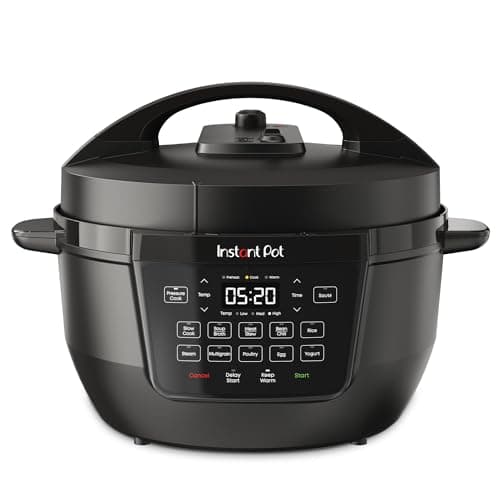
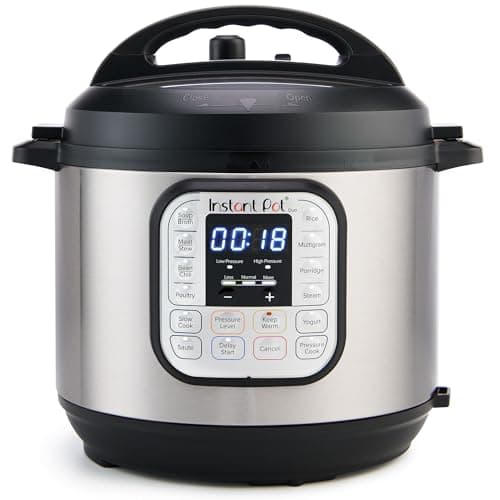
The same cooker in two shapes
This is one of the easier Instant Pot comparisons to reason about, because the two machines are fundamentally the same 7-in-1 cooker in two different bodies. The Duo is the original 6-quart pot; the RIO Wideis the Instant Pot rebranded RIO and widened to 7.5 quarts. Both run the same pressure, slow cook, sauté, rice, steam, yogurt and keep-warm program set, and both use an 18/8 stainless, tri-ply-base inner pot with no coating to scratch off. So the decision is not about what they cook — it is about capacity, shape, running cost and how much counter you are willing to give up. That narrows a confusing choice down to four honest variables.
Capacity: 6 quarts vs 7.5
The headline difference is size. The Duo holds 6 quarts; the RIO Wide holds 7.5. On paper a quart and a half sounds minor, but it is the difference between comfortably cooking for a couple with leftovers and cooking for a full household or a batch-cooking weekend without a second round. Six quarts is the size most single people and couples should default to — it is the classic Instant Pot capacity for a reason, big enough for a whole chicken or a double batch of chili, small enough to come to pressure quickly. The 7.5-quart Wide starts to make sense when you are regularly feeding four or more, cooking a big pot of stock, or prepping a week of beans and braises at once. If you are unsure where you land, we walk through sizing in full in what size Instant Pot should I buy.
The wide searing base — the RIO's one real advantage
Capacity aside, the RIO Wide's genuine ergonomic improvement is its wider base. A standard 6-quart Instant Pot is tall and relatively narrow, so when you sauté before pressurizing, only a modest amount of the pot bottom touches the heating element — you brown meat in small batches, working in shifts. The Wide spreads the same volume across a broader bottom; Instant Brands claims about 35% more searing surface. More of the pot floor sits over the element, so browning is more even and you fit more food in one layer before you seal the lid. For anyone whose Instant Pot routine leans on the sear-then-pressure workflow — the backbone of a good braise, laid out in how to use a pressure cooker — that wider floor is the most tangible reason to pick the RIO over the Duo. On the tall Duo, searing a lot of meat is simply slower.
Wattage and running cost
The two draw different power. The Duo is rated 1,000 W; the RIO Wide is rated 1,200 W, both figures published by Instant Brands. That 200-watt gap means the Wide costs marginally more per minute to run — the exact per-hour numbers are computed on each product card below at the US average electricity rate, so you can compare them directly and redo the sum with your own rate. Two things keep this from being a real deciding factor. First, the difference is small over a year of normal cooking. Second, a bigger pot of food holds more heat and can take a little longer to come to pressure, so the arithmetic is closer than the raw wattage suggests. The honest summary: neither is expensive to run, and running cost should be a tiebreaker at most, not the reason you choose.
Counter and cupboard footprint
Here is where the Wide gives something back. Because it spreads its extra capacity sideways rather than up, it takes more counter space than the tall 6-quart Duo for the same feature set. If your kitchen is tight — a small counter, a shared apartment, an RV — the Duo's narrower footprint is a genuine advantage, and going wide to gain a searing area you rarely use is giving up counter for nothing. This is the flip side of the searing benefit: the Wide is better if you cook big and sear a lot, and worse if space is your constraint. If a small kitchen is the real issue, the small-kitchen picks weigh footprint across the whole catalog, and the compact Duo Mini exists for exactly that reason.
The feature set is identical — and so are the limits
It is worth stating plainly so nobody buys the Wide expecting more machine: both are 7-in-1 cookers, and neither has sous vide or an air-fry lid. If you want those, the model that matters is the Pro (sous vide) or the Duo Crisp (air fry), not either of these. Both also use the same manual steam-release toggle — the source of the classic beginner mistake of leaving the valve on Venting so the pot never pressurizes — and both share the same stainless pot that outlives the coated pots in cookers costing more. In other words, choosing between them changes size and shape, not capability. That is the whole point of this comparison: you are picking a footprint, not a feature list.
How we picked
Machines we claim to have tested: 0
Everyone in this category tells you they tested twenty cookers. We have tested none, and we say so. Here is what we do instead: read the manufacturer's manual and spec page, record the published wattage, capacity, pressure or temperature figure and warranty term, work out what the machine costs to run per hour, show the arithmetic so you can redo it with your own electricity rate, and cite all of it. Where a brand publishes no wattage, we print no running cost rather than borrowing a number from a similar model. Prices come live from Amazon's API and disappear rather than go stale.
The scores above are judgments from that documented research — not test results. One of the five metrics is Documentation: whether the manufacturer will tell you what its cooker draws at all. The full rubric, including what disqualifies a pick, is published in full.