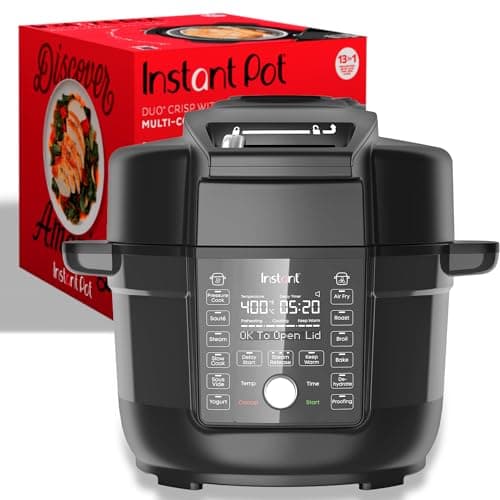
Two ways to solve the same problem
Both of these machines exist to answer the same question: why own a pressure cooker and an air fryer separately? Each pressure-cooks a roast tender and then browns the top without moving the food to a second appliance — they just take different routes to it. The Instant Pot Duo Crisp uses a single convertible Ultimate Lid that does both pressure and air fry. The Ninja Foodi OS300 uses two separate lids — a pressure lid that stays on the pot and a hinged crisping lid Ninja calls TenderCrisp. On raw capability the two are close, and both are honest picks in the air-fryer multicooker field. The separation between them is less about cooking and more about hardware design and how each is being sold right now.
The lids: one convertible vs two separate
This is the core hardware difference. The Duo Crisp's single Ultimate Lid is tidier day to day — one lid to handle, one thing to store. The Foodi's two-lid design splits the jobs: a dedicated pressure lid and a dedicated crisping lid, which some people find mechanically simpler to reason about even though it means two pieces of hardware to keep track of. Neither approach is clearly better. The single lid wins on storage and swap convenience; the twin lids win on the idea that each lid does exactly one job. Neither switch is free: on the Foodi, the crisping lid you are not using has to live somewhere while you pressure-cook; on the Duo Crisp, the protective pressure cooking cover has to come out before you air-fry, and Instant Brands warns it will be hot.
Crisping and power draw
Both crisp for real. The Foodi's convection element runs up to 500°F, which is genuine high-heat browning rather than the same pressure element pushed harder, and its TenderCrisp finish is honestly good — this is not a machine you buy for pressure and merely tolerate for crisping. The Duo Crisp's Ultimate Lid delivers the same class of result through its air-fry function. On power, the two are the most demanding multicookers on this site: the Duo Crisp is rated 1,500 W and the Foodi 1,460 W, both published by their makers. That higher draw is the crisping element doing real work, not a spec-sheet flourish — but it does make both of these the most expensive per minute to run of any cooker here, and the exact figures are on the cards below at the US average rate. If you never crisp, you are paying to run a heater you do not use; the plain Pro does the pressure half for less power and less money.
Documentation and capacity
On paper they are evenly matched. The Duo Crisp is 6.5 quarts and the Foodi 6.5 quarts— both genuine family sizes — and both makers publish the wattage, which a surprising number of combo units do not. Instant Brands additionally publishes a stainless inner pot and a full 13-in-1 function list (pressure, air fry, bake, dehydrate, sous vide and proof) for the Duo Crisp in its own manual, which is unusually complete documentation for a combo machine. The Foodi's wattage is published in the OS300 owner's guide Technical Specifications; a couple of its other figures come from the manufacturer's Amazon listing copy rather than a manual, which we flag rather than hide. Neither is under-documented, but the Duo Crisp has the edge on traceable specs.
Living with two lids vs one
Beyond the spec sheet, the day-to-day experience differs in small ways that add up. With the Duo Crisp you handle and store a single Ultimate Lid — one lid to find a home for — but that lid is heavier and more mechanically involved, because it has to do two jobs, so there is arguably more to eventually go wrong. With the Foodi you swap between two purpose-built lids: the pressure lid lifts off and the crisping lid hinges down, which some cooks find more intuitive because each lid does exactly one thing, at the cost of a second bulky item to store and wash. Cleanup is broadly similar on both — a pot, a crisping basket or tray, and the lid or lids — and neither is fully dishwasher-friendly. If a tidy single-lid workflow matters most, the Duo Crisp; if you would rather each function have its own dedicated hardware, the Foodi.
The caveat that decides it today
Here is the honest tiebreaker, and it is about how the Foodi is being sold rather than how it cooks: the Amazon listing for this exact OS300 model is currently a certified-renewed unit. New stock of the Foodi pressure-cooker line has become intermittent as Ninja shifts attention to its SmartLid and PossibleCooker ranges. A renewed unit can be a perfectly good buy — it is inspected and warranted — but it is not the same as a brand-new, first-hand cooker with a full manufacturer warranty on the exact SKU, and you should know that is what you are clicking on. The Duo Crisp, by contrast, ships newwith full documentation. That is the single biggest reason the Duo Crisp is the safer buy right now, and it has nothing to do with the Foodi's crisping being anything less than genuinely good.
How we picked
Machines we claim to have tested: 0
Everyone in this category tells you they tested twenty cookers. We have tested none, and we say so. Here is what we do instead: read the manufacturer's manual and spec page, record the published wattage, capacity, pressure or temperature figure and warranty term, work out what the machine costs to run per hour, show the arithmetic so you can redo it with your own electricity rate, and cite all of it. Where a brand publishes no wattage, we print no running cost rather than borrowing a number from a similar model. Prices come live from Amazon's API and disappear rather than go stale.
The scores above are judgments from that documented research — not test results. One of the five metrics is Documentation: whether the manufacturer will tell you what its cooker draws at all. The full rubric, including what disqualifies a pick, is published in full.