Skip to content
DD

HUB 03 · Sous Vide

Greater Goods vs Monoprice Sous Vide

Both of these skip the WiFi, the app and the phone entirely — a dial, a screen, and done. But they are aimed at different buyers: one is a quiet, capable, run-it-for-days machine, the other is the cheapest honest way to try sous vide at all. Here is how the two no-app circulators compare.

By Stephen V.Updated How we rank
#ad

We earn a commission if you buy through our links. It does not change the price you pay, and it does not decide our picks — the scoring rubric is published in full, including what disqualifies a pick. How this works.

The short answer

Quick picks

#CookerBest forScorePrice
011,100 W
8.1
$89.99Amazon
02800 W
7.7
$44.99Amazon

#ad · Prices pulled live from the Amazon Product API, last checked Aug 5, 2026. Where we have no verified live price we show none — we would rather leave a gap than print a number that has gone stale. The wattage column is what the manufacturer publishes; “not published” means exactly that, and we have not estimated one. Scores are ours, compiled from published specifications, and are not test results.

Two machines that agree on skipping the phone

Most sous vide comparisons on this site turn on connectivity — WiFi versus not, app versus screen. These two settle that question the same way: neither has WiFi and neither has an app. Both the Greater Goods Precision Cooker and the Monoprice Strata Home are run entirely from the device — a dial, a screen, done — with nothing to pair, update or fail. If you want your cooking free of your phone, both are honest picks, and this comparison is about what separates them once connectivity is off the table: power, quietness, precision and price.

Power: 1,100 W vs 800 W

The clearest spec difference is the element. The Greater Goods draws 1,100 W; the Monoprice draws 800 W. More power means it heats a bath faster and holds temperature more easily in a larger or deeper container, so the Greater Goods is the stronger choice if you cook big batches in a lot of water. The Monoprice's 800 W is perfectly adequate for a normal pot and a steak or two, but it will take longer to bring a large volume up to temperature and has less headroom in a big container. For most home cooks working in a stockpot, both are fine; if you routinely fill a large tub, the extra 300 watts is worth having.

Precision: the real gap

Here is where they genuinely diverge. The Greater Goods publishes a 20–95°C range and is built around a silent brushless motor rated to run 99 hours straight, which covers the longest sous vide cooks there are — a real advantage for tough cuts held for a day or more. The Monoprice, by contrast, quotes ±1% temperature stabilityrather than the tight ±0.1°C the premium machines claim — looser control that matters most on long, low, delicate cooks like eggs, where a fraction of a degree changes the texture. Both are honest about what they publish, and for a steak neither difference is visible; but if you care about precise, repeatable results on delicate food, the Greater Goods is the tighter, more serious instrument, and the Monoprice is explicitly the learn-on-it machine. One caveat cuts the other way: Greater Goods does not publish a warranty duration or an accuracy figure on its page, and Monoprice at least documents a user recalibration procedure in its manual.

Quietness and build

The Greater Goods' standout is its silent brushless motor, which is genuinely quieter than the geared pumps in most rivals — a real, noticeable benefit on a long overnight cook in a kitchen that opens onto living space. The Monoprice has a more basic build and a plainer control panel, but it earns a point back with its directional pump cap, which lets you aim the water flow or run a gentle side-jet for delicate food — a thoughtful, practical feature at the lowest price in the category. So the build story splits: the Greater Goods is the quieter, more refined machine for long-haul cooking; the Monoprice is simpler but cleverer than its price suggests.

Price, and who each is for

Price is the tiebreaker for many buyers, and it points clearly. The Monoprice is the cheapest sous vide machine on this site — the honest floor of the category and the least you can spend to find out whether you like the technique. The Greater Goods sits above it, and what the extra money buys is the higher power, the quieter motor, the longer continuous-run rating and the tighter feel of a machine meant to be kept. We do not print live prices in prose because each card below pulls the current Amazon price, but the shape holds: budget Monoprice, mid-tier Greater Goods. So the split is clean. Buy the Monoprice to try sous vide cheaply, or if you value the directional cap and only cook the occasional steak. Buy the Greater Goods if you want a quiet, capable, no-app machine you will keep — one that will run for days and hold temperature in a big container without complaint.

Buy the Greater Goods if you want a quiet, higher-powered no-app machine to keep — 1,100 W, a silent motor and a 99-hour run rating make it the better long-haul and big-batch cooker. Buy the Monoprice ifyou want the cheapest honest way into sous vide, you like the directional pump cap, and looser ±1% control is fine because you are mostly cooking steaks. Both skip the phone entirely; the question is whether you are buying a keeper or a try-it-first machine. If connectivity actually matters to you after all, the WiFi roundup is the other direction.

In detail

The picks, in full

01
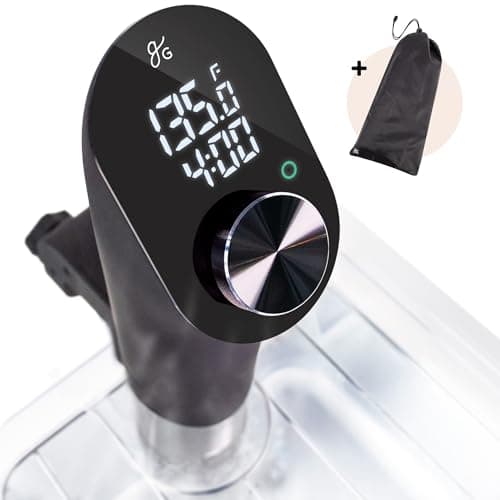
Greater Goods Greater Goods Sous Vide Precision Cooker, 1100 W

Quiet, simple, no app

Greater Goods Sous Vide Precision Cooker, 1100 W

Silent brushless motorWarranty length not published
8.1/10

The circulator for people who want none of the connectivity. No WiFi, no app, no phone — a dial, a screen and a silent brushless motor rated to run 99 hours straight. 1,100 W, a 20–95°C range, and a build that is quieter than anything else here.

Capability
8
Capacity
8.5
Documentation
7
Build
8.5
Value
8.5

What it gets right

  • A silent brushless motor genuinely is quieter than the geared pumps in most rivals — noticeable on a long overnight cook
  • No app and no WiFi to set up, fail or update: a dial, a screen, done
  • Rated for 99 hours of continuous running, which covers the longest sous vide cooks there are

What it doesn't

  • Greater Goods does not publish a temperature-accuracy figure or a warranty duration on its product page
  • No connectivity at all, which is a genuine loss if you wanted to start a cook from work
  • The specification is otherwise thinner than the Anova's or Inkbird's

What it costs to run

About 20.7¢ an hour at full rated draw, at the US average of 18.83¢ per kWh.

1,100 W ÷ 1000 × 1 h × 18.83¢ = 20.7¢

1100 W, published on Greater Goods' own product page alongside the temperature range and motor rating. This is an upper bound: the element only draws full power while it is heating up or pressurizing, then cycles off to hold temperature, and no manufacturer publishes a duty cycle — so we compute at full rated draw rather than invent a correction factor. The full method is published.

Skip this if…

you want to control or monitor a cook from your phone — this model has no connectivity by design. If remote start matters, the Inkbird gives you WiFi for a similar price.

$89.99on Amazon

Price last checked Aug 5, 2026. Prices move constantly — Amazon's at checkout is the one that counts.

#ad · we may earn a commission from this link to Greater Goods Sous Vide Precision Cooker, 1100 W

02
Monoprice Monoprice Strata Home Sous Vide Immersion Cooker, 800 W

The floor of the category

Monoprice Strata Home Sous Vide Immersion Cooker, 800 W

Cheapest here±1% stability, not ±0.1°C
7.7/10

The cheapest way to find out whether you actually like sous vide. Physical controls only, an 800 W element, a factory-calibrated sensor you can recalibrate yourself, and a directional pump cap that is a genuinely thoughtful touch at the price. Monoprice publishes the full spec in the manual, which the price does not lead you to expect.

Capability
7
Capacity
7.5
Documentation
8.5
Build
6.5
Value
9

What it gets right

  • The lowest price of any sous vide machine on this site, and enough to learn the technique on
  • The directional pump cap — aim the flow, or run a gentle side-jet for delicate food — is a real feature at this price
  • Monoprice publishes the full specification in the manual, including a user recalibration procedure

What it doesn't

  • It quotes ±1% temperature stability rather than the ±0.1°C the Anova and Inkbird publish — looser control, which matters most on long, low cooks
  • No connectivity and a basic control panel
  • Monoprice does not publish a warranty term in the manual

What it costs to run

About 15.1¢ an hour at full rated draw, at the US average of 18.83¢ per kWh.

800 W ÷ 1000 × 1 h × 18.83¢ = 15.1¢

800 W (110–120 VAC, 60 Hz), published in Monoprice's own Strata Home 21594 user manual specifications table. This is an upper bound: the element only draws full power while it is heating up or pressurizing, then cycles off to hold temperature, and no manufacturer publishes a duty cycle — so we compute at full rated draw rather than invent a correction factor. The full method is published.

Skip this if…

you already know you love sous vide and cook it often — the tighter ±0.1°C control of the Inkbird or Anova is worth the step up for eggs and long low cooks. This is the try-it-first machine, not the keep-it-forever one.

$44.99on Amazon

$72.7138% off

Price last checked Aug 5, 2026. Prices move constantly — Amazon's at checkout is the one that counts.

#ad · we may earn a commission from this link to Monoprice Strata Home Sous Vide Immersion Cooker, 800 W

How we picked

Machines we claim to have tested: 0

Everyone in this category tells you they tested twenty cookers. We have tested none, and we say so. Here is what we do instead: read the manufacturer's manual and spec page, record the published wattage, capacity, pressure or temperature figure and warranty term, work out what the machine costs to run per hour, show the arithmetic so you can redo it with your own electricity rate, and cite all of it. Where a brand publishes no wattage, we print no running cost rather than borrowing a number from a similar model. Prices come live from Amazon's API and disappear rather than go stale.

The scores above are judgments from that documented research — not test results. One of the five metrics is Documentation: whether the manufacturer will tell you what its cooker draws at all. The full rubric, including what disqualifies a pick, is published in full.
Questions

Frequently asked

Does the Greater Goods or Monoprice sous vide have an app?
Neither. Both are run entirely from the device — a dial and a screen, no WiFi and no app to pair, update or fail. If you specifically want to start or monitor a cook from your phone, look at a WiFi model like the Inkbird or Anova instead.
Which is more accurate, Greater Goods or Monoprice?
The Greater Goods is the tighter instrument in practice — it is higher-powered (1,100 W vs 800 W) and rated for 99 hours of continuous running. The Monoprice quotes plus-or-minus 1% temperature stability rather than the plus-or-minus 0.1 C the premium machines claim, which matters most on long, delicate cooks like eggs. For steaks, neither difference is visible.
Is the Monoprice sous vide good enough to start with?
Yes — it is the cheapest machine on this site and enough to learn the technique on, with a thoughtful directional pump cap and a full published spec. It is explicitly the try-it-first machine; if you already know you love sous vide, the Greater Goods or a tighter ±0.1°C model is the better keeper. See the Monoprice review.

Keep reading

Receipts

Sources

We have not tested these machines in a lab and we do not pretend to have. Specifications come from the manufacturer's own published documents; electricity rates come from the US Energy Information Administration; prices come from the live Amazon API. Where a figure is not published, the page says “not published” rather than guessing. Read the full method.