Skip to content
DD

HUB 02 · Rice Cookers

The best rice cookers with a steamer basket

Almost every rice cooker claims a steam function. Far fewer actually include the tray, and fewer still document how to steam a dish above the rice while the rice cooks below - which is the only version of this feature that saves you a pan. Here is the field ranked on what the manufacturers actually publish.

By Stephen V.Updated How we rank
#ad

We earn a commission if you buy through our links. It does not change the price you pay, and it does not decide our picks — the scoring rubric is published in full, including what disqualifies a pick. How this works.

The short answer

Quick picks

#CookerBest forScorePrice
01610 W
8.0
$225.00Amazon
02641 W
7.9
$184.99Amazon
03
Aroma Housewares Aroma Professional ARC-994SG Digital Rice Cooker & Multicooker
Aroma Professional ARC-994SG Digital Rice Cooker & Multicooker

The cheapest cooker that does more than rice

450 W
6.9
$49.99Amazon
041,000 W
8.6
$87.05Amazon

#ad· Prices pulled live from Amazon's official Creators API, last checked October 22, 2026. Where we have no verified live price we show none — we would rather leave a gap than print a number that has gone stale. The wattage column is what the manufacturer publishes; “not published” means exactly that, and we have not estimated one. Scores are ours, compiled from published specifications, and are not test results.

The short answer

Buy the Zojirushi NS-TSC10 if you want the best rice of any cooker that ships a basket. Zojirushi lists a steaming basketin the box alongside the measuring cup, spatula and spatula holder, the cooker has a Steam setting on the panel, and it is a Micom fuzzy-logic machine at 610 W — so the rice is not a compromise you accepted to get the tray. Buy the Tiger JAX-T10U if the point is to cook dinner and the rice in one appliance at the same time: its tacookplate is the only tray here that was designed for synchronous cooking rather than retrofitted onto a rice cooker, and it is made in Japan at 641 W. Buy the Aroma ARC-994SGif you want the steam function that is actually documented — Aroma is the only maker of the four that prints a step-by-step “Steam & Cook” procedure in its own manual, and the only one honest enough to publish the limit that comes with it. It is also the cheapest machine here by a wide margin. Buy the Instant Pot Duo if you would rather have a stainless steamer rack in a pressure cooker that also makes rice, and you are willing to give up fuzzy-logic rice to get seven other functions.

Why “has a steam function” is the wrong thing to shop on

Nearly every rice cooker sold today has the word Steam somewhere on the panel or the box, and the word on its own tells you almost nothing. A rice cooker is a steam appliance: it boils water in a sealed pot. Pressing Steam usually just runs the element for a time you set instead of stopping when the water is gone. So the question that decides a purchase is not whether the machine can steam. It is whether the manufacturer gives you the three things that make steaming useful.

  1. Is the tray actually in the box?This is the one buyers get caught by, because listings describe the function and photograph the accessory without ever saying it is included. All four cookers here ship a tray or rack — that is the entry requirement for this page, and it is why the field is four machines rather than fourteen.
  2. Can it steam and cook rice at the same time? This is the feature worth paying for and the one least often documented. Steaming broccoli in a rice cooker instead of a saucepan saves you a pan. Steaming chicken and broccoli above rice that is cooking underneath itsaves you a pan, a burner and a timing problem — it is a whole weeknight dinner from one appliance. Two of the four cookers here document that procedure. The other two document the tray and leave you to work it out.
  3. How much does the tray actually hold, and what is it made of? Here the documentation runs out across the board. Not one of these four manufacturers publishes a tray volume or a tray material on its product page, so this page does not print one either. That gap is the finding, and a page that filled it with estimates would be making up the single number you most wanted.

How we ranked them

Entry requirement: the manufacturer states that a tray, basket or rack comes with the cooker. Then, in order: whether the maker documents steaming and cooking simultaneously, then how good the rice is underneath it (because a steamer tray does not change the fact that you bought a rice cooker), then what the published documentation supports, then price. As everywhere on this site, we have cooked in none of these machines— every figure comes from the manufacturer's own product page or manual, cited on each card, and every pick carries a real disqualifying con. The full rubric is in our methodology. Prices move, so we do not print them in prose; the live price sits on each card.

What ships in each box

Reproduced from each manufacturer's own wording rather than from listings. Where a maker does not publish a figure, the cell says so.

Published in-box steaming accessory, documented simultaneous cooking, and rated power. Every cell is the manufacturer's own statement.
CookerSteaming accessory includedSteam + cook rice documentedRated power
Zojirushi NS-TSC10Steaming basketNot documented as a procedure610 W
Tiger JAX-T10Utacook cooking plateYes — synchronous cooking is the feature641 W
Aroma ARC-994SGSteam trayYes — a numbered “Steam & Cook” procedure450 W
Instant Pot Duo 6 QtStainless steel steamer rackNot documented as a procedure1,000 W
Tray volume / tray materialNot published by any of the four

1. Zojirushi NS-TSC10 — the best rice that comes with a basket

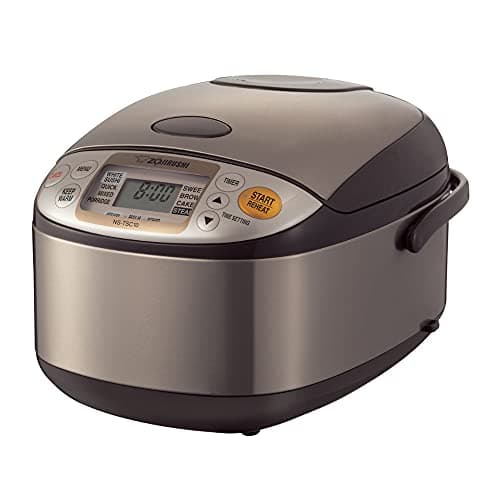
The Zojirushi NS-TSC10wins because it is the only cooker here where the tray is an addition to a genuinely excellent rice cooker rather than the reason you tolerated a mediocre one. Zojirushi's own product page lists the accessories as a steaming basket, a rice measuring cup, a nonstick rice spatula and a spatula holder, and the panel carries Steam and cake settings that the otherwise-superior NS-ZCC10 Neuro Fuzzy does not have. Underneath that it is a Micom fuzzy-logic machine: the microcomputer adjusts heat through the cook instead of running a fixed timer, which is the whole reason a $200 rice cooker beats a $30 one. It draws 610 W, the lowest of any Zojirushi we cover, and holds 5.5 cups uncooked.

Two honest limits. First, Zojirushi does not publish a numbered procedure for steaming a dish while rice cooks beneath it — the basket and the Steam setting are both documented, the combination is not, so treat simultaneous cooking here as something you will work out rather than something the manual walks you through. Second, this is the made-in-China Zojirushi, not the made-in-Japan one: if Japanese manufacturing is specifically why you are buying the brand, the NS-ZCC10 is the model that has it and it does not come with a basket. That is the trade this page exists to surface. The interior pot is nonstick and will wear before a stainless multicooker pot does.

2. Tiger JAX-T10U — the only tray built for the job

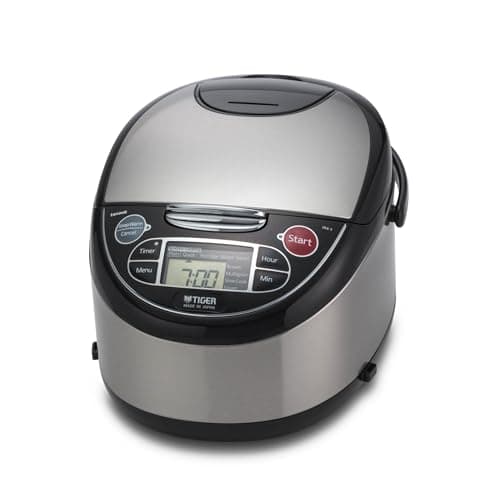
Every other tray on this page is a steamer that happens to sit in a rice cooker. Tiger's tacook plate is the opposite: the JAX-T10Uwas designed around synchronous cooking, where a dish steams on the plate while rice cooks in the pot below from the same 641 W element. Tiger publishes the wattage, the 1.0 L / 5.5-cup capacity, ten named auto-cook settings and that the cooker is made in Japan. If the reason you searched for a rice cooker with a steamer basket is “I want one appliance to make dinner,” this is the machine that was actually engineered for that sentence, and it is the one we would pick for it.

The limit is capacity, and it is a real one. The tacook plate steams a portion of protein or vegetables, not a second course— think two chicken thighs or a bowl of broccoli, not dinner for four. Tiger's US documentation is also thinner than Zojirushi's: the inner pot material is not clearly published, which on a machine at this price is a fair thing to want. And it is Micom rather than induction, so the rice is very good without being the best on this site — induction against fuzzy logic is where that difference gets argued properly.

3. Aroma ARC-994SG — the documented one, and the cheap one

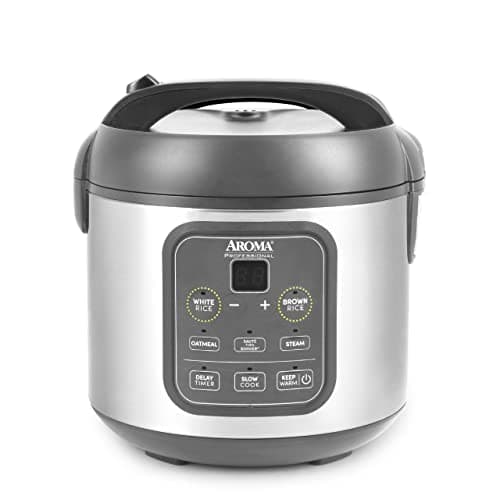
The Aroma ARC-994SG is third on rice quality and first on honesty, and if your budget is tight it is the pick. Aroma lists a Steam Trayin the manual's parts identification, describes the Steam program as steaming “healthy sides and main courses using the included steam tray,” and then does the thing none of the others do: it prints a numbered Steam & Cookprocedure — measure and rinse the rice, add it to the inner pot, load the tray, lower it in, close the lid, select White Rice, Brown Rice or Steam — and attaches a published caution to it:

“Do not attempt to cook more than 2 cups of uncooked rice when steaming and cooking simultaneously.”

That single sentence is worth more than any marketing claim on this page. It tells you the feature is real, it tells you the machine was tested doing it, and it tells you the constraint — on a 4-cup cooker, simultaneous steaming costs you half your rice capacity. Nobody else publishes a number like that, which is why the cheapest machine here ranks third rather than fourth. It also adds Slow Cook (2 to 10 hours), Sauté-then-Simmer, Oatmeal and a 15-hour delay timer, on a ceramic-coated nonstick pot, at 450 W — the lowest draw of anything on this page.

The cons are the ones you would expect at the price. It is sensor logic rather than true fuzzy logic, so the rice is good rather than excellent; the pot is coated and will eventually wear; and 4 cups uncooked (8 cooked) is the smallest capacity here before you even apply the 2-cup simultaneous-cooking limit. If you cook for more than two people and want to steam at the same time, this is the wrong machine and the Tiger or the Zojirushi is the right one.

4. Instant Pot Duo — the stainless rack, and the other seven functions

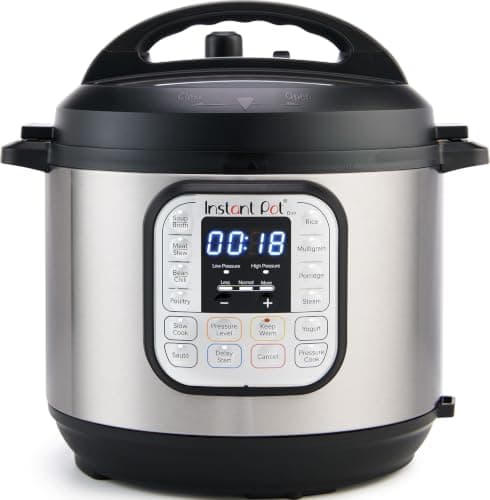
The Instant Pot Duo earns a place here on a technicality that turns out to matter: Instant Brands states that it “includes a stainless steel steamer rack,” and it is the only stainlesssteaming accessory on this page — nothing to scratch, nothing to flake, dishwasher-safe like the 18/8 tri-ply pot it sits in. Steam is one of the seven named functions, and the Duo also publishes the figures almost nobody else does: 1,000 W, 6 qt / 5.7 L, and a 10.2–11.6 psi high working pressure on the manual. If what you want is one machine that steams, pressure-cooks, slow-cooks, sautés and makes rice, this is the cheapest well-documented way to get it.

It is fourth because of the rice, not the rack. A multicooker makes good rice; a fuzzy-logic cooker makes better rice, and that gap is the honest center of rice cooker versus Instant Pot. A rack is also not a basket: it is a trivet designed to lift a dish or a bowl out of the water, so loose vegetables need a heatproof dish or a bowl on top of it rather than going straight on. And at 1,000 W it draws more than twice the Aroma, which only matters if you steam most days — what a rice cooker actually costs to run does that arithmetic.

Steaming above cooking rice: what actually happens in the pot

Worth understanding before you buy, because it explains both why the feature works and why the makers attach limits to it. A rice cooker holds its pot at boiling until the free water is gone. The steam that would otherwise condense on the lid and drip back is, when you put a tray in the path, condensing on your food instead — which is why steaming above rice costs you no extra energy and barely any extra time. The two constraints follow directly from that.

First, the drip goes down. Whatever you steam above rice will drip onto it: chicken juices, fish, anything marinated. Sometimes that is the point and sometimes it ruins a pot of plain rice, so the rule of thumb is to steam things you would happily have flavored the rice with, and to steam the rest in a separate run. Second, the tray steals headroom. Rice expands to roughly double its dry volume and needs space above it to boil without the lid; a tray sitting in that space is why Aroma caps simultaneous cooking at 2 cups of uncooked rice in a 4-cup machine. Expect roughly half the rated rice capacity when the tray is in, on any cooker, whether or not the maker prints the number.

Third, and this one is not in any manual: steamed food is done when it is done, and rice is done when the cooker says so. They are rarely the same moment. Vegetables want five to ten minutes and a white-rice cycle wants thirty-something, so the practical technique is to start the rice, let it run, and add the tray partway through — which is exactly the sequencing how to steam vegetables in a rice cooker works through step by step for a cooker you already own.

Who should skip this category entirely

If steaming is the main event rather than a bonus, a rice cooker is the wrong appliance and we would rather say so than sell you one. A dedicated stacking steamer gives you two or three tiers and far more volume than any tray on this page, and a pressure cooker steams faster and holds more. Steaming vegetables in an Instant Pot covers that route, and which kitchen appliance you need is the honest starting point if you have not settled on a category. If what you would put on the rack is meat rather than vegetables, the best pressure cookers for meat is the page to read instead — pressure, not steam, is what makes a cheap cut tender.

If what you actually want is the best rice and you will never use a tray, buy the outright best rice cookerand ignore this page — the top of that list does not include a basket and does not need to. And if you are cooking for one or two in a small kitchen, the best small rice cookers ranks the same field on footprint, where the Aroma also does well.

What we would buy

Best rice, basket included: the Zojirushi NS-TSC10. One-appliance weeknight dinners: the Tiger JAX-T10U, for the tacook plate and the documentation behind it. Tight budget, or you want the procedure in writing: the Aroma ARC-994SG, remembering the published 2-cup ceiling when the tray is in. You would rather have a pressure cooker: the Instant Pot Duo, with a stainless rack and seven functions, accepting that the rice is a step down.
In detail

The picks, in full

01
Zojirushi Zojirushi NS-TSC10 Micom Rice Cooker & Warmer, 5.5 Cup

Zojirushi's logic at a lower price

Zojirushi NS-TSC10 Micom Rice Cooker & Warmer, 5.5 Cup

Fuzzy-logic heat control
8.0/10

A Micom fuzzy-logic Zojirushi at meaningfully less than the Neuro Fuzzy, with a couple of trades: it is made in China rather than Japan, and it adds a steam and cake function the NS-ZCC10 lacks. Same fundamental advantage — the microcomputer adjusts heat as it cooks — at 610 W.

Capability
8
Capacity
7.5
Documentation
9
Build
7.5
Value
8

What it gets right

  • The same Micom fuzzy-logic advantage as the Neuro Fuzzy, for less money
  • Adds steam and cake functions the NS-ZCC10 does not have
  • The lowest draw of any Zojirushi here at 610 W — among full-size cookers on this site, only the 580 W Cuckoo CR-0631F draws less

What it doesn't

  • Made in China, not Japan — a real distinction for buyers who value Zojirushi specifically for its Japanese manufacturing
  • Fewer specialized rice menus than the Neuro Fuzzy or the induction model
  • The interior nonstick pot will wear before the stainless pots in the multicooker section do

What it costs to run

About 11.5¢ an hour at full rated draw, at the US average of 18.83¢ per kWh.

610 W ÷ 1000 × 1 h × 18.83¢ = 11.5¢

610 W at 120 V, published on Zojirushi's own NS-TSC10 product page. This is an upper bound: the element only draws full power while it is heating up or pressurizing, then cycles off to hold temperature, and no manufacturer publishes a duty cycle — so we compute at full rated draw rather than invent a correction factor. The full method is published.

Skip this if…

…Japanese manufacturing is why you are buying Zojirushi — this model is made in China, and the NS-ZCC10 is the one made in Japan. If that distinction matters to you, pay the difference for the Neuro Fuzzy.

$225.00on Amazon

Price last checked October 22, 2026. Prices move constantly — Amazon's at checkout is the one that counts.

#ad · we may earn a commission from this link to Zojirushi NS-TSC10 Micom Rice Cooker & Warmer, 5.5 Cup

02
Tiger Tiger JAX-T10U Micom Rice Cooker & Warmer with tacook, 5.5 Cup

Cook rice and a dish at once

Tiger JAX-T10U Micom Rice Cooker & Warmer with tacook, 5.5 Cup

tacook synchro-cookingMade in Japan
7.9/10

Tiger's answer to Zojirushi, with one trick the Zojirushis do not have: the tacook synchronous-cooking tray steams a dish above the rice while it cooks below, from the same 641 W. A Micom fuzzy-logic cooker made in Japan, with a genuinely useful feature the marketing did not invent.

Capability
8.5
Capacity
7.5
Documentation
8
Build
7.5
Value
8

What it gets right

  • The tacook tray genuinely cooks a main and the rice at the same time — a real weeknight shortcut, not a preset
  • Tiger publishes the wattage and 10 named auto-cook settings, and it is made in Japan
  • 641 W keeps it among the most efficient full-size cookers here to run

What it doesn't

  • The tacook tray's capacity is small — it steams a portion of protein or vegetables, not a full second course
  • Tiger's US documentation is thinner than Zojirushi's; the pot material is not clearly published
  • Micom, not induction — the rice is very good but not the best on this site

What it costs to run

About 12.1¢ an hour at full rated draw, at the US average of 18.83¢ per kWh.

641 W ÷ 1000 × 1 h × 18.83¢ = 12.1¢

641 W, published on Tiger Corporation's own JAX-T10U product page. This is an upper bound: the element only draws full power while it is heating up or pressurizing, then cycles off to hold temperature, and no manufacturer publishes a duty cycle — so we compute at full rated draw rather than invent a correction factor. The full method is published.

Skip this if…

…you only ever cook plain rice. The tacook tray is the reason to pick this over a Zojirushi, and if you will never use it you are paying for a feature you do not want — a Zojirushi Micom cooks the rice itself just as well.

$184.99on Amazon

Price last checked October 22, 2026. Prices move constantly — Amazon's at checkout is the one that counts.

#ad · we may earn a commission from this link to Tiger JAX-T10U Micom Rice Cooker & Warmer with tacook, 5.5 Cup

03
Aroma Housewares Aroma Professional ARC-994SG Digital Rice Cooker & Multicooker

The cheapest cooker that does more than rice

Aroma Professional ARC-994SG Digital Rice Cooker & Multicooker

Sauté-then-Simmer + slow cookOnly white & brown rice programs
6.9/10

The budget pick now, and an honest one. For around forty dollars it cooks white and brown rice, sautés then simmers, slow-cooks for 2 to 10 hours and steams — a genuine little multicooker in a small pot — and Aroma publishes its 450 W draw. What Aroma does not publish is how its 'Sensor Logic' works, and there are only two rice programs, so this is the versatility pick, not the rice-quality one.

Capability
6.5
Capacity
6.5
Documentation
7
Build
5.5
Value
9

What it gets right

  • Rice, Sauté-then-Simmer, a 2-to-10-hour slow cook and a steam tray in one small pot for around forty dollars — a real multicooker, not just a rice pot
  • Aroma publishes the draw — 450 W on its own product page — so, unlike the ARC-954SBD it replaces, it gets a real running-cost figure, and it is the lowest published draw of any rice cooker on this site
  • A 15-hour delay timer and automatic Keep Warm, so rice or oatmeal can be ready when you walk in

What it doesn't

  • Only two rice programs, White and Brown (plus Oatmeal) — no sushi, porridge or texture settings, and fewer than the ARC-954SBD it replaces, which added Quick Rice and Quinoa
  • Aroma says its Sensor Logic 'automatically controls the internal temperature' but explains nothing more, never calls it fuzzy logic, and the manual does not mention it — so we cannot tell you how it compares with a Zojirushi's
  • The ceramic-coated pot is the part that wears: Aroma recommends hand-washing it to lengthen its lifespan and warns the dishwasher can discolor it

What it costs to run

About 8.5¢ an hour at full rated draw, at the US average of 18.83¢ per kWh.

450 W ÷ 1000 × 1 h × 18.83¢ = 8.5¢

450W at 120V 60Hz, listed under Power Consumption on Aroma's own ARC-994SG product page. The instruction manual itself gives only the 120V AC requirement. This is an upper bound: the element only draws full power while it is heating up or pressurizing, then cycles off to hold temperature, and no manufacturer publishes a duty cycle — so we compute at full rated draw rather than invent a correction factor. The full method is published.

Skip this if…

…rice quality is the whole point of the purchase. It gives you two rice buttons and a sensor Aroma does not explain; if you want dedicated sushi, porridge and texture settings from a documented fuzzy-logic cooker, the Zojirushi Neuro Fuzzy is the one — this is the value and versatility pick, not the rice-quality pick.

$49.99on Amazon

Price last checked October 22, 2026. Prices move constantly — Amazon's at checkout is the one that counts.

#ad · we may earn a commission from this link to Aroma Professional ARC-994SG Digital Rice Cooker & Multicooker

04
Instant Pot Instant Pot Duo 7-in-1 Electric Pressure Cooker, 6 Quart

The one to buy if you are not sure

Instant Pot Duo 7-in-1 Electric Pressure Cooker, 6 Quart

Stainless inner potWattage & pressure published
8.6/10

The multicooker that made the category, and still the right default. Instant Brands publishes the wattage, the working pressure range and a stainless (not nonstick) inner pot, which is more than most of the field manages — and it costs less than almost all of them.

Capability
7.5
Capacity
8
Documentation
9.5
Build
8.5
Value
9.5

What it gets right

  • Instant Brands publishes the wattage, the working-pressure range and the pot material — the full set, which most of the field does not
  • The 18/8 stainless inner pot has no coating to scratch off, so it outlives the nonstick pots in cookers costing more
  • At the current price it is the cheapest genuinely well-documented multicooker on this site

What it doesn't

  • No sous vide or air-fry program — this is the plain pressure-and-slow-cook model, by design
  • The steam release is a manual toggle, not the quiet auto-release of the Duo Plus or Pro
  • Seven functions is fewer than the sticker-count leaders, though most of those are the same element at different set points

What it costs to run

About 18.8¢ an hour at full rated draw, at the US average of 18.83¢ per kWh.

1,000 W ÷ 1000 × 1 h × 18.83¢ = 18.8¢

1000 W at 120 V / 60 Hz, published on the Instant Pot Duo product page and confirmed on the IP-DUO60 manual specification page. This is an upper bound: the element only draws full power while it is heating up or pressurizing, then cycles off to hold temperature, and no manufacturer publishes a duty cycle — so we compute at full rated draw rather than invent a correction factor. The full method is published.

Skip this if…

…you specifically want sous vide, a quieter steam release, or an air-fry lid — the Duo has none of those, and reaching for it and then wishing it did more is the most common Instant Pot regret. Step up to the Pro or Duo Crisp instead.

$87.05on Amazon

$109.9921% off

Price last checked October 22, 2026. Prices move constantly — Amazon's at checkout is the one that counts.

#ad · we may earn a commission from this link to Instant Pot Duo 7-in-1 Electric Pressure Cooker, 6 Quart

The four questions to ask before you buy

Does the listing say the tray is included, or only that the cooker steams? This is the single most common disappointment in this category. “Steam function” is a program; a steamer basket is an object. Check the manufacturer's own accessory list, not the retailer bullet points — all four cookers on this page are here because the maker states the accessory in writing.

Do you want to steam instead of the rice, or at the same time as it? If instead, any of the four works and you should buy on rice quality and price. If at the same time, buy the Tiger or the Aroma, which are the two whose makers document the combination.

How much rice do you actually need with the tray in? Halve the rated capacity and judge from there. A 5.5-cup Zojirushi or Tiger gives you a realistic two to three cups of uncooked rice with a tray above it, which feeds a family. A 4-cup Aroma gives you a published maximum of two, which feeds two or three people. How much rice per person turns that into portions, and what a rice cooker cup is matters here because it is not a US cup.

Will you actually use it? The honest answer for a lot of buyers is no, and the tray ends up in a drawer. If you are not fairly sure you will steam at least weekly, buy the cooker that makes the best rice for your money and treat any tray as a bonus rather than a criterion.

How we picked

Machines we claim to have tested: 0

Everyone in this category tells you they tested twenty cookers. We have tested none, and we say so. Here is what we do instead: read the manufacturer's manual and spec page, record the published wattage, capacity, pressure or temperature figure and warranty term, work out what the machine costs to run per hour, show the arithmetic so you can redo it with your own electricity rate, and cite all of it. Where a brand publishes no wattage, we print no running cost rather than borrowing a number from a similar model. Prices come live from Amazon's API and disappear rather than go stale.

The scores above are judgments from that documented research — not test results. One of the five metrics is Documentation: whether the manufacturer will tell you what its cooker draws at all. The full rubric, including what disqualifies a pick, is published in full.

Questions

Frequently asked

Which rice cookers come with a steamer basket?
Of the cookers we cover, four state a steaming accessory in the box on the manufacturer's own pages: the Zojirushi NS-TSC10 (a steaming basket, listed alongside the measuring cup, spatula and spatula holder), the Tiger JAX-T10U (the tacook cooking plate), the Aroma ARC-994SG (a steam tray, shown in the manual's parts identification) and the Instant Pot Duo (a stainless steel steamer rack). Many other cookers have a Steam program with no tray included - the program and the accessory are different things.
Can you steam food and cook rice at the same time in a rice cooker?
Yes, on the machines whose makers document it. Aroma prints a numbered Steam & Cook procedure for the ARC-994SG and attaches a published limit: do not cook more than 2 cups of uncooked rice while steaming simultaneously. Tiger's tacook system on the JAX-T10U is built specifically for cooking a dish and the rice together. Zojirushi and Instant Brands document the accessory and the Steam program but not the combination, so on those two it is something you work out rather than something the manual walks you through.
How much rice can you cook with the steamer tray in?
Expect roughly half the rated capacity. Rice roughly doubles in volume and needs headroom above it to boil, and a tray occupies that headroom - which is why Aroma caps simultaneous cooking at 2 cups of uncooked rice in a 4-cup machine. On a 5.5-cup Zojirushi or Tiger that works out to a realistic two to three cups of uncooked rice with a tray above it.
Will the food you steam drip into the rice?
Yes, and that is unavoidable rather than a fault. Condensation and juices from whatever sits on the tray run down into the pot below. Steam things you would happily have flavored the rice with - chicken, aromatics, vegetables - and run anything else as a separate steam cycle with water in the pot instead of rice.
What is a rice cooker steamer tray made of, and how much does it hold?
Not published, in every case we checked. None of Zojirushi, Tiger, Aroma or Instant Brands prints a tray volume or tray material on its product page or in the manual sections covering the accessory, so we do not print one either. The one exception on material is the Instant Pot Duo, where Instant Brands describes the included rack as stainless steel.
Is a rice cooker with a steamer basket better than a dedicated steamer?
Only if steaming is the bonus rather than the point. A stacking steamer has two or three tiers and far more volume than any rice cooker tray, and a pressure cooker steams faster and holds more. The rice cooker's advantage is narrow and real: it steams using heat it was already using for the rice, in an appliance you already have out, with no extra pan to wash.
Does steaming in a rice cooker use more electricity?
Barely, if you steam above rice that is already cooking - the element is heating the pot either way and the steam is already being produced. Steaming on its own is a separate cycle, so it costs whatever that run costs: the cookers here draw between 450 W (Aroma) and 1,000 W (Instant Pot Duo), and a steam cycle is minutes rather than hours.

Keep reading

Receipts

Sources

We have not tested these machines in a lab and we do not pretend to have. Specifications come from the manufacturer's own published documents; electricity rates come from the US Energy Information Administration; prices come from the live Amazon API. Where a figure is not published, the page says “not published” rather than guessing. Read the full method.