The verdict
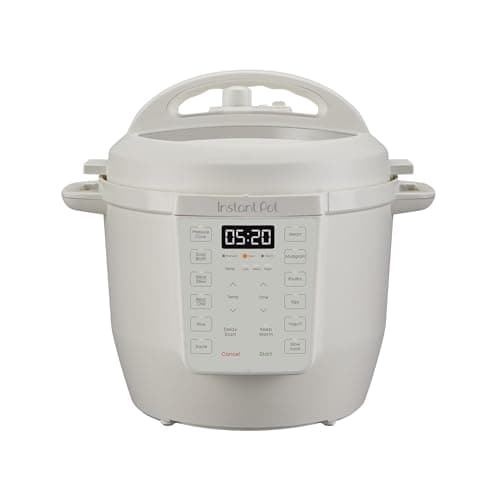
A good cooker, and the one to buy only when the Duo is out of stock or the prices have crossed. Instant Brands publishes 1,000 watts at 120 V~ 60 Hz, a 6.0-quart capacity, seven cooking functions with thirteen one-touch options, a stainless steel (18/8) inner pot with a tri-ply bottom, and a one-year limited warranty. Every one of those numbers either matches or restates the Duo. What you are paying extra for is the newer RIO body and a flat control panel that wipes clean. Nothing load-bearing was cheapened to get there — which is the real compliment — and nothing was improved either.
What is actually new
The body and the panel. The RIO housing replaces the Duo's raised rubber buttons with a flat printed panel, which is genuinely easier to wipe down after a sauté that spat, and looks less like a 2016 appliance. Thirteen one-touch options are printed on it against the Duo's thirteen programs — the same count, differently laid out.
That is the list. The element is the same published 1,000 W. The pot is the same 18/8 stainless with a tri-ply bottom — the specification that genuinely matters, because an uncoated stainless pot has nothing to wear off and will outlive the nonstick pots in cookers costing more. The warranty is the same one year. Instant Brands did not quietly substitute a coated pot or a smaller element when it rebranded the line, and given how often exactly that happens in this category, it is worth saying plainly.
What is missing compared with the Duo's documentation
One thing, and it is the sort of omission this site is built to notice: Instant Brands does not publish a working-pressure range for the RIO the way it does in the Duo and Duo Plus manuals. We know the Duo runs 10.2–11.6 psi (70–80 kPa) on high because the IP-DUO60 manual says so. For the RIO 6-quart there is no equivalent published figure, so we do not print one — not even by inference from a machine with the same element and the same capacity, because an inferred spec is a fabricated spec.
Practically, that means recipe timings written for a Duo should be treated as a close starting point rather than a guarantee. If working pressure is a figure you want published before you buy, the cooker in the catalog that documents it best is the Cosori 6-quart, which prints both bands in psi and kPa.
What it does not have
No sous vide, no air fry, and no auto-sealing lid. This is the entry model in the current range, exactly as the Duo was in the old one, and the omissions are the same ones — which is also the most common Instant Pot regret. If you want sous vide and a quieter steam release, that is the Duo Plus. If you want the auto-sealing lid and the full program set, that is the Pro. If you want air frying under the same lid, that is the Duo Crisp, and it is the only cooker on this site that does both. Which Instant Pot to buy lays the whole range out in one table.
Sizing and running cost
Six quarts is the right default for two to four people, and it is the size that handles a whole chicken, a pot roast or two pounds of dried beans under the half-full rule. The size guide covers 3 against 6 against 8 quarts properly, and the beans page explains why the half-full rule makes six quarts smaller than it sounds for legumes.
At 1,000 W the RIO is the joint-lowest-draw full-size electric cooker we rank, tied with the Duo and the 6-quart Duo Plus — and the element only works hard while the pot comes up to pressure, cycling at a fraction of its rating to hold it afterwards. What an electric pressure cooker costs to run does the arithmetic with the published EIA residential rate, and you can redo it with your own.
Should you buy it?
Buy it if the Duo is unavailable, if the RIO is on offer below the Duo, or if you simply prefer the look and the flat panel and the difference is small enough not to matter. Those are all legitimate. Do not buy it expecting a better cooker than the Duo, because on everything that reaches the food it is the same cooker — same published wattage, same uncoated stainless pot, same warranty — and on this site paying more for a control panel is not a reason to spend more. For the alternative at the opposite end of the philosophy, a stovetop Presto 01362 costs about the same, holds half again the pressure and is warranted for twelve years instead of one, if you are willing to stand at the stove.
How we picked
Machines we claim to have tested: 0
Everyone in this category tells you they tested twenty cookers. We have tested none, and we say so. Here is what we do instead: read the manufacturer's manual and spec page, record the published wattage, capacity, pressure or temperature figure and warranty term, work out what the machine costs to run per hour, show the arithmetic so you can redo it with your own electricity rate, and cite all of it. Where a brand publishes no wattage, we print no running cost rather than borrowing a number from a similar model. Prices come live from Amazon's API and disappear rather than go stale.
The scores above are judgments from that documented research — not test results. One of the five metrics is Documentation: whether the manufacturer will tell you what its cooker draws at all. The full rubric, including what disqualifies a pick, is published in full.