Skip to content
DD

HUB 01 · Multicookers

Instant Pot Pro vs Duo Plus

Both step up from the base Duo by adding sous vide, and both are honest mid-range buys, so this is a close one. The Pro brings the better interface — an auto-sealing lid and a programmable dial — for more power and money. The Duo Plus is cheaper, quieter, ships with spare rings, and publishes its working pressure. Here is which fits how you actually cook.

By Stephen V.Updated How we rank
#ad

We earn a commission if you buy through our links. It does not change the price you pay, and it does not decide our picks — the scoring rubric is published in full, including what disqualifies a pick. How this works.

The short answer

Quick picks

#CookerBest forScorePrice
011,200 W
8.4
$164.99Amazon
02
Instant Pot Instant Pot Duo Plus 9-in-1 Multicooker, 6 Quart
Instant Pot Duo Plus 9-in-1 Multicooker, 6 Quart

Sous vide and sterilize without stepping up to the Pro

1,000 W
8.1
$139.99Amazon

#ad · Prices pulled live from the Amazon Product API, last checked Aug 5, 2026. Where we have no verified live price we show none — we would rather leave a gap than print a number that has gone stale. The wattage column is what the manufacturer publishes; “not published” means exactly that, and we have not estimated one. Scores are ours, compiled from published specifications, and are not test results.

Two ways up from the base Duo

The Pro and the Duo Plus solve the same problem: you want more than the plain Duo, specifically sous vide, without jumping to an air-fry combo. Both deliver that. The Duo Plus is a 9-in-1 that adds sous vide and sterilize to the Duo's core set, rated 1,000 W. The Pro is a 10-in-1 that adds sous vide as well but pairs it with a genuinely upgraded interface, rated 1,200 W. Both use a stainless inner pot, both carry the same one-year warranty, and both sit in the sensible middle of the range. So this is not a capability blowout — it is a close call between a cheaper, quieter machine and a better-controlled, slightly pricier one. The right answer depends on whether interface polish or value matters more to you, and a couple of smaller details tip it either way.

The interface gap: dial and auto-seal vs LCD and buttons

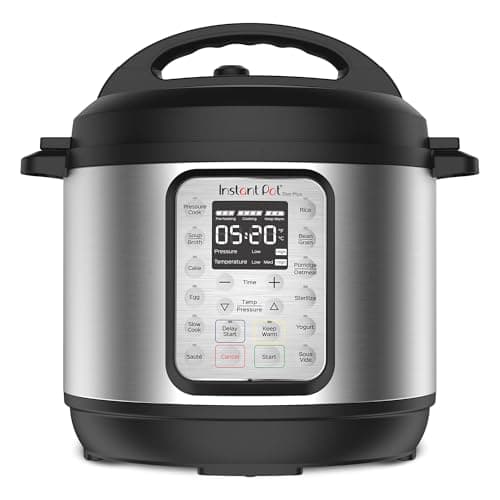
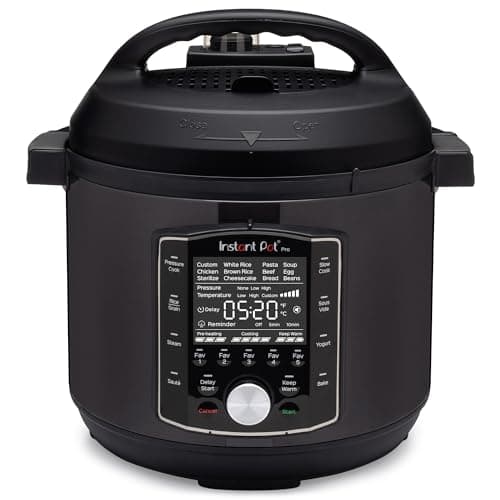
This is the Pro's biggest advantage, and it is a real one. The Pro has an auto-sealing lid that seals itself when you close it, which eliminates the most common Instant Pot mistake — leaving the steam valve on Venting so the pot never pressurizes. It is driven by a dial with five programmable Fav buttons, so you can save the handful of dishes you actually cook and reach them in one press, across 28 one-touch options. The Duo Plus, by contrast, uses an older blue backlit LCD and a button interface with 25 presets, and it has no auto-sealing lid— you still set the valve to Sealing yourself. The Duo Plus's controls work perfectly well, but next to the Pro's dial they feel dated, and the manual seal is the exact step new owners forget. If a nicer, more forgiving interface is worth money to you, this is where the Pro earns it.

Power and running cost: 1,200 W vs 1,000 W

The two draw different power. The Duo Plus is rated 1,000 W; the Pro is rated 1,200 W, both published by Instant Brands. That 200-watt gap means the Pro costs marginally more per minute to run — the exact per-hour numbers are on each product card below at the US average electricity rate, so you can compare them and redo the math with your own rate. This is not a deciding factor on its own: the difference is small over a year of normal cooking, and a fuller, colder pot narrows it further because it takes a little longer to come to pressure regardless of wattage. But it does line up with the rest of the Duo Plus's pitch — it is the cheaper machine to buy and the slightly cheaper one to run, and if lowest ownership cost is your priority, both of those point the same way.

Documentation: the Duo Plus publishes its pressure, the Pro doesn't

Here the value machine has the edge. The Duo Plus's manual publishes a working-pressure range of 10.2 to 11.6 psi (70 to 80 kPa) at high pressure — a traceable figure you can check. Instant Brands publishes no working-pressure figure for the Proat all; the number is on the Duo and Duo Plus manuals but not the Pro's, which for a premium model is a genuine gap and one we flag rather than gloss over. It does not mean the Pro cooks at a different or worse pressure — it almost certainly sits in the same range as its siblings — but you cannot point to a document for it, and on a site whose whole authority claim is that every figure is sourced, that matters. If you like to know exactly what your cooker does, the Duo Plus tells you and the Pro does not.

Quiet, accessories, and the little things

The Duo Plus has two more small advantages that add up. Its WhisperQuiet steam release is a real quality-of-life change if the kitchen is open-plan or near a bedroom — a natural or quick release on a standard Duo is not quiet, and the Duo Plus deliberately softens it. And it ships with a steam rack and two spare sealing rings, which are exactly the accessories most owners end up buying separately anyway — the spare rings alone are worth having, since the ring is a consumable that absorbs odors and should be swapped periodically. The Pro answers with grab-and-go pot handles and its dishwasher-safe stainless pot. None of these decides the comparison by itself, but the pattern is consistent: the Duo Plus quietly gives you more in the box and a quieter machine; the Pro gives you the better controls and the auto-seal. That is the whole trade in miniature.

The awkward middle, and how to break the tie

The one caution on the Duo Plus is that it sits in an awkward spot: it is often close enough to the Pro's street price that the Pro's auto-sealing lid and programmable dial become the better buy for only a little more — and its one clear advantage over the Pro, a lower list price, is exactly the thing that discounts erase. So the tiebreaker is genuinely about the gap where you are shopping. If the Pro is only a little more, take the Pro for the interface. If the Duo Plus is meaningfully cheaper, quieter matters to you, or you value the published pressure figure and the in-box spares, the Duo Plus is the honest value pick and gives up little that you will feel day to day. Both are good; this is a preference-and-price decision, not a capability one, and either will serve for years.

In detail

The picks, in full

01
Instant Pot Instant Pot Pro 10-in-1 Pressure Cooker, 6 Quart

The one to keep for a decade

Instant Pot Pro 10-in-1 Pressure Cooker, 6 Quart

Sous vide programNo published pressure figure
8.4/10

The Duo's mechanicals with the interface fixed: a genuine sous vide program, an auto-sealing lid, grab-and-go pot handles and five programmable buttons. It draws 1,200 W rather than the Duo's 1,000, and Instant Brands does not publish a working-pressure figure for it — the one gap in an otherwise well-documented cooker.

Capability
9
Capacity
8
Documentation
8
Build
9
Value
8

What it gets right

  • A real sous vide program plus sterilize, on a stainless pot with grab-and-go handles — the most complete Instant Pot without the air-fry lid
  • The auto-sealing lid removes the single most common Instant Pot mistake: leaving the valve on Venting and wondering why it will not pressurize
  • Five programmable Fav buttons make it the only model here you can genuinely set up around the three things you actually cook

What it doesn't

  • Instant Brands publishes no working-pressure figure for the Pro — the number is on the Duo's manual but not this one, which for a premium model is a fair thing to want
  • 1,200 W draws more than the Duo's 1,000, so it costs marginally more per minute to run
  • You are paying for interface and lid engineering, not for better cooking — the pot and heating are the Duo's

What it costs to run

About 22.6¢ an hour at full rated draw, at the US average of 18.83¢ per kWh.

1,200 W ÷ 1000 × 1 h × 18.83¢ = 22.6¢

1200 W at 120 V / 60 Hz, published on the Instant Pot Pro product page and confirmed on the Pro manual specification page 51. This is an upper bound: the element only draws full power while it is heating up or pressurizing, then cycles off to hold temperature, and no manufacturer publishes a duty cycle — so we compute at full rated draw rather than invent a correction factor. The full method is published.

Skip this if…

you want air frying. The Pro has no crisping lid and never will; if a crisp finish is on your list, the Duo Crisp is the model in the range that does it.

$164.99on Amazon

Price last checked Aug 5, 2026. Prices move constantly — Amazon's at checkout is the one that counts.

#ad · we may earn a commission from this link to Instant Pot Pro 10-in-1 Pressure Cooker, 6 Quart

02
Instant Pot Instant Pot Duo Plus 9-in-1 Multicooker, 6 Quart

Sous vide and sterilize without stepping up to the Pro

Instant Pot Duo Plus 9-in-1 Multicooker, 6 Quart

Sous vide + sterilizeStainless inner pot
8.1/10

The Duo with two functions added that people genuinely use — sous vide and sterilize — plus a quieter WhisperQuiet steam release. Same 1,000 W, same stainless pot, same published working pressure, at a price between the Duo and the Pro.

Capability
8
Capacity
8
Documentation
9
Build
8
Value
7.5

What it gets right

  • Sous vide and sterilize on top of the Duo's core set, for meaningfully less than the Pro
  • The WhisperQuiet steam release is a real quality-of-life change if the kitchen is near a bedroom
  • Ships with a steam rack and two spare sealing rings, which is the accessory you always end up buying anyway

What it doesn't

  • The blue backlit LCD and button interface is dated next to the Pro's dial, and there is no auto-sealing lid
  • Sous vide on a pressure cooker holds temperature less tightly than a dedicated circulator with a pump
  • It sits in an awkward middle — close enough to the Pro's price that the Pro is often the better buy

What it costs to run

About 18.8¢ an hour at full rated draw, at the US average of 18.83¢ per kWh.

1,000 W ÷ 1000 × 1 h × 18.83¢ = 18.8¢

1000 W at 120 V / 60 Hz, published on the Duo Plus product page and confirmed on the Duo Plus manual specifications page 7. This is an upper bound: the element only draws full power while it is heating up or pressurizing, then cycles off to hold temperature, and no manufacturer publishes a duty cycle — so we compute at full rated draw rather than invent a correction factor. The full method is published.

Skip this if…

the Pro is only a little more where you are shopping — the Pro's auto-sealing lid and programmable buttons are worth the gap, and the Duo Plus's one advantage over it is a lower list price that discounts often erase.

$139.99on Amazon

Price last checked Aug 5, 2026. Prices move constantly — Amazon's at checkout is the one that counts.

#ad · we may earn a commission from this link to Instant Pot Duo Plus 9-in-1 Multicooker, 6 Quart

Which one to buy

Buy the Pro if the better interface is worth the money where you are shopping — the auto-sealing lid that removes the forgotten-valve mistake, the dial with five programmable buttons, and grab-and-go handles — and the Pro is only a little more than the Duo Plus. Buy the Duo Plus if you want the same sous vide upgrade for less, a quieter WhisperQuiet steam release, a published working-pressure figure, and a steam rack plus two spare sealing rings in the box. The rule: Pro for the interface and auto-seal, Duo Plus for value and quiet.Watch the gap, though — discounts often close the price difference to the point where the Pro's controls win. We have cooked in neither; this is reasoned from Instant Brands' own documents, including the Pro's one gap: it publishes no working-pressure figure, while the Duo Plus does. Prices are pulled live from Amazon and dated on each card. Still deciding across the whole line? See which Instant Pot to buy.

How we picked

Machines we claim to have tested: 0

Everyone in this category tells you they tested twenty cookers. We have tested none, and we say so. Here is what we do instead: read the manufacturer's manual and spec page, record the published wattage, capacity, pressure or temperature figure and warranty term, work out what the machine costs to run per hour, show the arithmetic so you can redo it with your own electricity rate, and cite all of it. Where a brand publishes no wattage, we print no running cost rather than borrowing a number from a similar model. Prices come live from Amazon's API and disappear rather than go stale.

The scores above are judgments from that documented research — not test results. One of the five metrics is Documentation: whether the manufacturer will tell you what its cooker draws at all. The full rubric, including what disqualifies a pick, is published in full.
Questions

Frequently asked

What is the difference between the Instant Pot Pro and the Duo Plus?
Both add sous vide over the base Duo. The Pro, at 1,200 W, has an auto-sealing lid and a programmable dial with five Fav buttons — the better interface. The Duo Plus, at 1,000 W, is cheaper and quieter (WhisperQuiet steam release), ships with a steam rack and two spare sealing rings, and publishes a 10.2 to 11.6 psi working range, which the Pro does not. The Pro wins on controls; the Duo Plus is the value pick.
Is the Pro worth it over the Duo Plus?
It depends on the price gap where you are shopping. The Pro's auto-sealing lid and programmable dial are genuinely worth a little more, and discounts often shrink the difference to the point where the Pro is the smarter buy. But if the Duo Plus is meaningfully cheaper, or you value its quieter release and published pressure figure, it gives up little you will feel day to day.
Which is quieter, the Pro or the Duo Plus?
The Duo Plus. Its WhisperQuiet steam release is designed to soften the noise of venting, which is a real advantage if the kitchen is open-plan or near a bedroom. The Pro has no equivalent quiet-release feature, so a standard release on it is louder. If noise matters to you, that is a point in the Duo Plus's favor.

Keep reading

Receipts

Sources

We have not tested these machines in a lab and we do not pretend to have. Specifications come from the manufacturer's own published documents; electricity rates come from the US Energy Information Administration; prices come from the live Amazon API. Where a figure is not published, the page says “not published” rather than guessing. Read the full method.