What this machine is, and what it deliberately is not
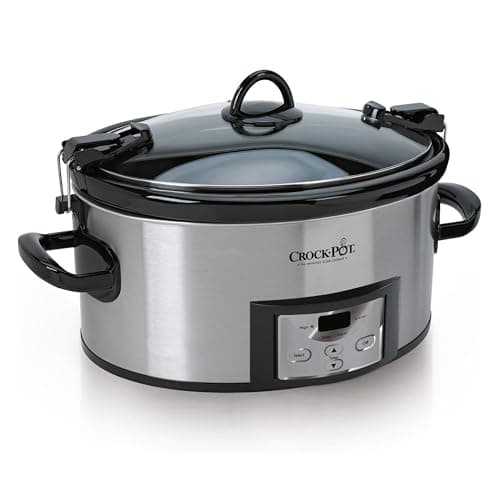
Almost everything else on this site does several jobs; the Crock-Pot Cook & Carry does exactly one, and reviewing it honestly means starting there. It is a plain 6-quart programmable slow cooker — not a pressure cooker, not a multicooker, not an air fryer. It has a removable oval stoneware crock, a timer, and a locking lid, and that is the whole machine. There is no sear function, no rice program, no sous vide, no pressure. If you came looking for a do-everything countertop cooker, this is not it, and the rest of the site is where you should be — start with the best multicookers. But if what you actually want is the simplest, cheapest way to cook all day and come home to dinner, this is one of the best-considered objects in the kitchen, and it earns a review precisely because its restraint is the point.
240 watts: the lowest draw on the whole site
The single most striking number here is the power draw. Crock-Pot publishes a 240 W rating for this model, and that is by far the lowest of any cooker on this site— a fraction of the 1,000–1,500 W the Instant Pots and the crisping combos pull. That matters more than it looks. A slow cooker's entire method is long, gentle, low heat held over many hours, and a low-wattage element is exactly the right tool for it: a full day's braise here sips power in a way a hungry 1,500 W countertop unit never could. We compute the cost-to-run figure on the product card below at the US average electricity rate so you can see it directly and redo the sum with your own utility rate, but the shape is simple — this is the cheapest cooker to run that we cover, and the low draw is a feature, not a compromise. It is also why a slow cooker remains a genuinely economical way to turn a cheap, tough cut into something tender: hours of low heat, very few watts.
The locking lid actually travels
The name is not marketing. The Cook & Carry lid clamps down and latches, so the whole 6-quart pot of chili, pulled pork or a hot dip rides to a potluck, a tailgate or a family dinner without sloshing across the back seat. It is a small, specific, genuinely useful thing that no Instant Pot does — an Instant Pot has a heavy lid, an exposed base and no secure way to carry a full pot of hot liquid anywhere. If you are the person who brings a hot dish to gatherings, that latching lid is, on its own, a real reason this machine exists alongside a multicooker rather than being replaced by one. The removable oval stoneware crock is the classic slow-cooker shape, lifts out for serving and washing, and holds heat well; the trade is that stoneware is heavy and breakable in a way a metal multicooker pot is not.
Dead simple, and almost nothing to fail
The other quiet virtue is durability by simplicity. There is no pressure seal to seat, no gasket that takes on the smell of last week's chili and needs replacing, no valve to set to the right position, and no electronics beyond a programmable timer that counts down and switches to a warm hold. That is a machine with very little to go wrong over years of use, and it is genuinely foolproof to operate: put ingredients in, set the time, walk away for the day. For a first cooker, for a nervous cook, or for anyone who found an Instant Pot's valves and messages intimidating — the kind of thing we untangle in what the Instant Pot buttons mean — the total absence of complexity is a feature you feel every single time you use it.
The honest limitation: it only slow-cooks, and it is slow by design
Now the con that governs the whole verdict, and it is a real one. This machine only slow-cooks. There is no pressure, no sauté in the pot to brown before you braise, no rice program and no sous vide — so it is a single-purpose appliance on a counter where space is precious. And it is slow on purpose: a pot roast is a six- to eight-hour job here, where the same roast finishes in about forty minutes in a pressure cooker. If speed ever matters to you, that gap is enormous, and it is the entire reason to consider a multicooker instead. There is a genuine ownership trap here too — if you buy this and later find yourself wishing it could brown the meat first or turn dinner around on a weeknight you did not plan, you will end up buying an Instant Pot anyway and this becomes redundant. We work through exactly that decision in do you need a slow cooker if you have an Instant Pot and in are slow cookers worth it.
Documentation and build
Crock-Pot publishes the wattage and the capacity plainly on its own product page, which — as we say across the site — is more than a surprising number of budget cookers manage, and it is why this model scores respectably on our Documentation metric despite being the simplest machine here. What Crock-Pot does not put its money into is materials: the stoneware crock and the plastic housing are ordinary, budget-tier build, and the crock is breakable. That is the correct trade at this price. You are buying a cheap, low-draw, foolproof pot that does one job well and travels, not a heirloom, and it is honest about being exactly that.
Who should buy it — and who should skip it
Buy the Cook & Carry if slow, hands-off, all-day cooking is genuinely how you like to eat — soups, chilis, braises and pulled pork loaded in the morning and forgotten — and you value the lowest running cost on this site, the dead-simple operation, or the latching travel lid, and you do not need speed or a second function. Skip it ifyou would ever reach for a sauté, a rice program, or a weeknight-fast pressure cook: in that case an Instant Pot already includes a slow-cook mode and does far more besides, and this becomes a duplicate. If you simply want more slow-cooking capacity, the 8.5-quart Ninja PossibleCooker PRO holds more and adds searing. But for the cook who wants exactly one thing done cheaply and reliably, this is the honest pick — and the honesty is the whole review.