HUB 03 · Sous Vide
How to Choose a Sous Vide Machine
Every immersion circulator holds a water bath at a set temperature, so on the surface they look alike. The differences that actually matter are accuracy, power, whether it has a screen, whether it publishes its specs at all, and price. Here is what each one means for how you cook, and a rule to land on the right machine.
We earn a commission if you buy through our links. It does not change the price you pay, and it does not decide our picks — the scoring rubric is published in full, including what disqualifies a pick. How this works.
They all do the same core job
Start here, because it saves you money: every immersion circulator on this site does the fundamental job well— it heats a water bath and holds it at a set temperature while a pump keeps the water moving. There is no bad machine in the group. So choosing is not about finding the one that “works” and avoiding the ones that do not; it is about which set of trades fits how you cook and what you want to spend. Below are the things that genuinely differ, in the order they tend to matter, and what each one means in practice.
Temperature accuracy and stability
This is the number that defines a precision cooker, and it is worth understanding rather than just chasing. The Anova and the Inkbird both publish ±0.1°C accuracy; the Monoprice quotes a looser ±1% stability instead. When does the difference actually show up? Mostly on long, low cooks and delicate foods — eggsheld right at a set point, a 12-hour tough cut — where a small, sustained drift changes the result. For a steak at 130°F for a couple of hours, the two are effectively indistinguishable. So buy the tight accuracy if eggs and long precision cooks are your thing; do not overpay for it if you mostly cook steaks and chicken, where the looser machine is genuinely fine.
Wattage and pump flow
Power and water movement decide how quickly and evenly the machine heats a large bath. Wattage ranges from the Monoprice's 800 Wup through the Inkbird's 1,000 W to the 1,100 Wof the Anova, Joule and Greater Goods; more watts heat a big container faster. Pump flow matters alongside it — the Anova moves 8 L/min and the Monoprice a rated 8.5 L/minthrough a clever directional cap — because circulation is what keeps the whole bath at one temperature. The practical read: if you cook big batches in a deep container, favor higher wattage and strong flow; if you cook a steak or two in a pot, even the lower-powered machines have all the muscle you need, and the difference is one you will never notice.
Screen or app-only
This is the single most polarizing choice in the category, so decide it deliberately. Most machines — the Anova, Inkbird, Greater Goods and Monoprice — have an on-device screen, so they work fully at the machine with no phone involved. The Breville Joule is the exception: it is app-only, with no screen and no buttons, so your phone is the entire interface. The upside is the best app in the category and the smallest body; the downside is that a dead phone or an app outage means the machine does nothing. There is no right answer here, only a fit: if a phone-only machine sounds like a convenience, the Joule is a delight; if it sounds like a liability, take anything with a screen and do not look back.
Connectivity
Separate from the screen question is WiFi, which lets you start or check a cook remotely. The Anova (dual-band) and the Inkbird (2.4 GHz) have it; the Greater Goods and Monoprice deliberately have none. Connectivity is genuinely useful if you want to kick off a long cook from work or monitor it from another room — and genuinely pointless friction if you only ever set a cook and wait beside it. It is a preference, not a quality gap: the no-app machines are not worse, they are simpler, with nothing to pair, update or fail. Decide honestly whether you would ever actually use remote control before you pay for it.
Whether the brand publishes its specs at all
This one is unusual and, we think, underrated. Some brands publish a full specification— the Anova lists its wattage, range, accuracy and pump flow, and the Inkbird and Monoprice publish complete specs too — while others leave real gaps: Breville publishes no temperature range or accuracy for the Joule, and Greater Goods publishes no accuracy figure or warranty term. A missing number is not proof a machine is bad, but it is an absence where a figure should be, and a brand that will simply tell you what its precision cooker does has earned some trust. This site scores that directly on its Documentation metric — the reasoning is in our methodology— because it is something you can verify and we can too.
Size, mounting and warranty
A few practical details round it out. Size and mounting: most circulators use a clamp to attach to the side of a pot, while the Joule adds a magnetic footthat lets it stand in a steel pan on its own, and it is also the smallest body here — the Anova, by contrast, is a tall 325 mm device to store. Warranty is a clean line: the Anova leads at two years, the Joule and Inkbird are one year each, and Greater Goods and Monoprice do not publish a warranty termat all — another documentation gap worth weighing. None of these outweighs accuracy or the screen question, but they are real tiebreakers between machines you are otherwise torn on.
The price tiers, floor to ceiling
It helps to see the field as four price tiers, each a sensible stop depending on your budget and how seriously you cook. At the floor is the Monoprice Strata— the cheapest way to find out whether you even like sous vide, with looser ±1% stability but a genuinely capable 800 W machine and a clever directional pump cap. The value tier is the Inkbird ISV-100W, which publishes a full spec — ±0.1°C, a screen and WiFi — for under $100 and gives up remarkably little. The default is the Anova Precision Cooker 3.0: the fullest published spec, an on-device screen, dual-band WiFi and the longest warranty here. And the premium is the Breville Joule Turbo— the smallest, best-built machine with Turbo mode, for the buyer who wants the nicest object and lives in the app.
The decision rule. Want to try sous vide cheaply and are not sure you will stick with it? Monoprice. Want the best cooking spec for the money — precision, a screen and WiFi — without overspending? Inkbird, and it is the right pick for most people. Want the most complete, longest-warranted, works-without-a-phone machine and do not mind paying for it? Anova, the category default. Want the smallest, most polished machine with Turbo mode and are happy running everything from an app? Joule. If a quiet motor for long overnight cooks matters more than any of that, the no-app Greater Goods is the specialist to add to the shortlist. See the whole field ranked in the best sous vide machines, the budget picks, and the WiFi picks.
The hardware
The cookers this page is about
The cookers referred to above, with prices pulled live from Amazon and dated on every card. Full rankings live in the roundups linked from this page.
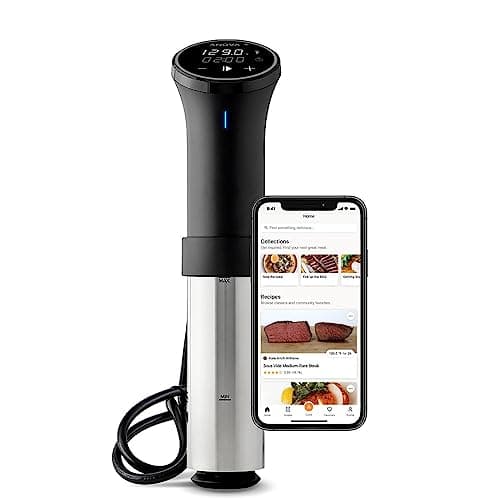
1,100 W
Anova Precision Cooker 3.0 (WiFi), 1100 W
The sous vide circulator most people should buy. Anova publishes the full specification — 1,100 W, a 0–92°C range, ±0.1°C accuracy, an 8 L/min pump — and backs it with a two-year warranty, the longest here. It has an on-device screen so it works without the app, which the Joule does not.
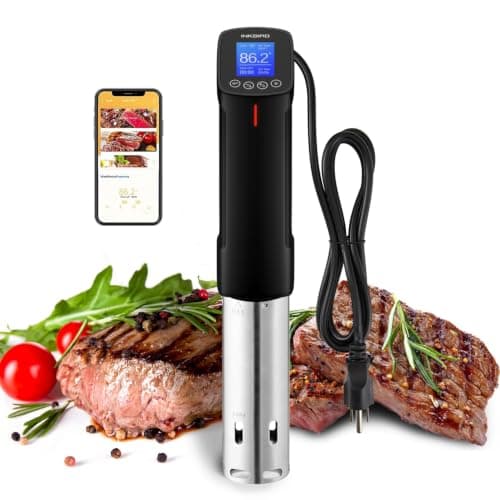
1,000 W
Inkbird ISV-100W WiFi Sous Vide, 1000 W
The value pick that does not feel like one. Under $100, and Inkbird still publishes the full specification: 1,000 W, a 25–99°C range, ±0.1°C accuracy, 15 L capacity, WiFi and an on-device dot-matrix screen. It undercuts the Anova by more than half and gives up remarkably little on paper.
- PickNo image
800 W
Monoprice Strata Home Sous Vide Immersion Cooker, 800 W
The cheapest way to find out whether you actually like sous vide. Physical controls only, an 800 W element, a factory-calibrated sensor you can recalibrate yourself, and a directional pump cap that is a genuinely thoughtful touch at the price. Monoprice publishes the full spec in the manual, which the price does not lead you to expect.
#ad · As an Amazon Associate we earn from qualifying purchases.
Questions
Frequently asked
What should I look for when buying a sous vide machine?
Does temperature accuracy really matter in a sous vide?
Is an app-only sous vide like the Joule a good idea?
Keep reading
Related
Receipts
Sources
- Anova Culinary — Precision Cooker 3.0 product page
- Inkbird — ISV-100W WiFi Sous Vide product page
- Monoprice — Strata Home Sous Vide (21594, 800W) user manual [PDF]
We have not tested these machines in a lab and we do not pretend to have. Specifications come from the manufacturer's own published documents; electricity rates come from the US Energy Information Administration; prices come from the live Amazon API. Where a figure is not published, the page says “not published” rather than guessing. Read the full method.