HUB 02 · Rice Cookers
Why Does My Rice Cooker Boil Over?
A rice cooker boiling over and spitting starchy water onto your counter almost always comes down to one of four things: too much water, unrinsed rice, an overfilled pot, or a dirty lid and steam vent. Here is why the foam climbs, why a fuzzy-logic cooker manages it better, and how to fix each cause.
We earn a commission if you buy through our links. It does not change the price you pay, and it does not decide our picks — the scoring rubric is published in full, including what disqualifies a pick. How this works.
Why rice foams up in the first place
To fix a boil-over, it helps to understand what is climbing the pot. As rice heats in water, the starch on and around the grains dissolves into the water and gets whipped by the boiling into a thick, sticky foam. That starchy foam is far more stable than plain bubbling water — it holds together, traps steam, and climbs. When there is too much of it, or too little room above it, it pushes up past the lid and out through the steam vent, spitting cloudy water onto your counter. So every cause of a boil-over is really a version of the same thing: too much starchy foam, or not enough space for it. Fix the starch and the space, and the boil-over stops.
Cause 1: too much water
The most common culprit is simply too much water in the pot. More water means more volume of boiling, foaming liquid, and less air gap between the surface and the lid for the foam to expand into — so it climbs out instead. The fix is to measure carefully: use the cup that came with the cooker and fill water only to the matching line in the pot, which is calibrated to leave the right headroom. If you have been eyeballing the water or using a US measuring cup instead of the smaller rice-cooker cup, that alone can be the whole problem — the exact figures by rice type live on the rice-to-water ratio guide. When in doubt, a touch less water is safer than a touch more, both for boil-overs and for texture.
Cause 2: not rinsing off the surface starch
The second big cause is skipping the rinse. Unrinsed rice carries a coating of loose surface starch, and that loose starch is exactly what dissolves into the water and foams up. Rinsing the rice before you cook — swirling it in cold water and pouring off the cloudy water two or three times, until the water runs mostly clear — washes that surface starch away before it can foam, which cuts boil-overs dramatically and also gives you cleaner, less gummy rice. This is the fix that surprises people most: a pot that boiled over yesterday often behaves perfectly today with nothing changed but a proper rinse. The one exception is rice explicitly labeled “rinse-free,” which is milled to skip this step.
Cause 3: overfilling past the max line
Third is overfilling the pot. Every rice cooker has a maximum fill line, and it is there precisely because the cooker needs room above the rice and water for the foam and steam to rise without escaping. Load the pot past that line — too much rice, too much water, or both — and you have removed the headroom the design depends on, so even well-rinsed rice at the right ratio can boil over. The fix is straightforward: never fill past the max line, and if you regularly need more rice than the line allows, that is a sign you have outgrown the cooker rather than a reason to overfill it. A bigger cooker is the answer — see the best large rice cookers — not a pot crammed past its limit.
Cause 4: a dirty lid or steam vent
The fourth cause is the sneaky one: a dirty or partly blocked lid and steam vent. The vent is how the cooker releases steam in a controlled way; when starch and residue from past cooks build up in it, or the inner lid and gasket are gunked, the steam cannot escape cleanly, pressure and foam back up inside, and the cooker spits and boils over even when everything else is right. The fix is cleaning: wash the inner lid, the gasket and the steam vent or cap after cooks, many of which detach for exactly this. A clogged vent is also a safety and performance issue, not just a mess, so keep it clear. Our how to clean a rice cooker guide walks through the lid and vent step by step.
Why a fuzzy-logic cooker boils over less
The cooker itself is part of the story. A cheap on/off cooker runs one fixed, full heat until the water boils off — so once the foam starts climbing, the cooker keeps driving the same hard boil and does nothing to calm it, which is why the cheapest cookers are the worst offenders for boil-overs. A fuzzy-logic cooker instead senses the temperature and eases the heat back as the pot comes up to the boil, managing the vigor of the boil rather than blasting through it — so the foam is less violent and less likely to climb out. The Zojirushi Neuro Fuzzy and the Cuckoo CR-0631F both control the heat this way. It does not make rinsing or the fill line optional, but it is one more reason a better cooker is calmer on the counter than a bargain one.
A quick diagnostic order
If your cooker keeps boiling over, work through the causes in order of likelihood. First, rinse the rice properly — this alone fixes a surprising share of cases. Second, check your water: measure with the cooker's own cup to the matching line, and make sure you are not using a larger US cup by mistake. Third, respect the max fill line and cook a smaller batch if you have been near or over it. Fourth, clean the lid and steam vent in case residue is trapping steam. Change one thing at a time and you will find the culprit within a batch or two. In the great majority of kitchens it is the rinse or the water, and both are free to fix. If none of those help and the cooker spits even with rinsed rice, a correct ratio, a modest batch and a clean vent, that points to the machine itself.
The two fixes that solve most boil-overs cost nothing: rinse the rice until the water runs mostly clear to wash off the foaming surface starch, and measure the water with the cooker's cup to the fill line rather than overfilling. Add a clean steam vent and staying under the max line, and a cooker that spat every time will usually run clean. For the exact water figures see the rice-to-water ratio guide, and for the vent and lid, how to clean a rice cooker.
The hardware
The cookers this page is about
The cookers referred to above, with prices pulled live from Amazon and dated on every card. Full rankings live in the roundups linked from this page.
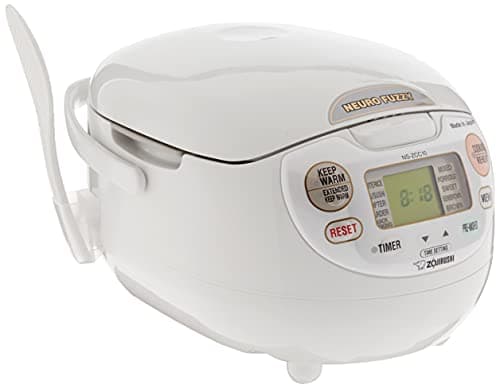
680 W
Zojirushi NS-ZCC10 Neuro Fuzzy Rice Cooker & Warmer, 5.5 Cup
The rice cooker every other one is measured against. Its Neuro Fuzzy microcomputer adjusts heat through the cook rather than running a fixed timer, which is the whole reason a $260 rice cooker cooks rice better than a $30 one. Made in Japan, 680 W, and the settings that matter are all there.
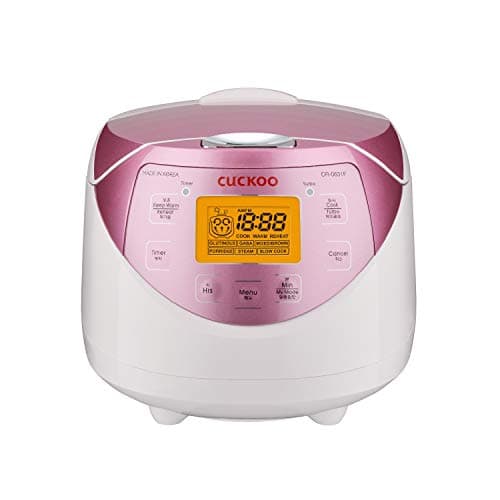
580 W
Cuckoo CR-0631F Micom Rice Cooker, 6 Cup
Cuckoo's non-pressure Micom cooker: the same Korean build and fuzzy-logic control as the CRP, without the pressure mechanism or its price. 580 W, a 6-cup nonstick pot, and a menu set that still covers GABA and brown rice. The sensible Cuckoo if you do not need pressure.
#ad · As an Amazon Associate we earn from qualifying purchases.
Questions
Frequently asked
How do I stop my rice cooker from boiling over?
Why does starchy foam climb out of the pot?
Does a fuzzy-logic rice cooker boil over less than a cheap one?
Keep reading
Related
Receipts
Sources
- Zojirushi — NS-ZCC10 Neuro Fuzzy Rice Cooker product page
- Cuckoo CR-0631F series manual (specification page)
We have not tested these machines in a lab and we do not pretend to have. Specifications come from the manufacturer's own published documents; electricity rates come from the US Energy Information Administration; prices come from the live Amazon API. Where a figure is not published, the page says “not published” rather than guessing. Read the full method.