The cheapest cooker that does more than rice
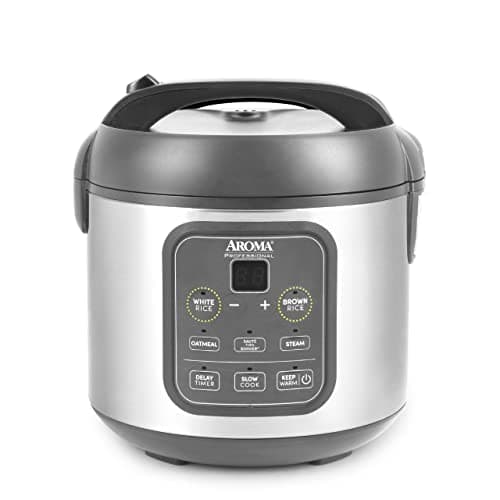
Aroma Professional ARC-994SG Digital Rice Cooker & Multicooker
The budget pick now, and an honest one. For around forty dollars it cooks white and brown rice, sautés then simmers, slow-cooks for 2 to 10 hours and steams — a genuine little multicooker in a small pot — and Aroma publishes its 450 W draw. What Aroma does not publish is how its 'Sensor Logic' works, and there are only two rice programs, so this is the versatility pick, not the rice-quality one.
- Capability
- 6.5
- Capacity
- 6.5
- Documentation
- 7
- Build
- 5.5
- Value
- 9
What it gets right
- Rice, Sauté-then-Simmer, a 2-to-10-hour slow cook and a steam tray in one small pot for around forty dollars — a real multicooker, not just a rice pot
- Aroma publishes the draw — 450 W on its own product page — so, unlike the ARC-954SBD it replaces, it gets a real running-cost figure, and it is the lowest published draw of any rice cooker on this site
- A 15-hour delay timer and automatic Keep Warm, so rice or oatmeal can be ready when you walk in
What it doesn't
- Only two rice programs, White and Brown (plus Oatmeal) — no sushi, porridge or texture settings, and fewer than the ARC-954SBD it replaces, which added Quick Rice and Quinoa
- Aroma says its Sensor Logic 'automatically controls the internal temperature' but explains nothing more, never calls it fuzzy logic, and the manual does not mention it — so we cannot tell you how it compares with a Zojirushi's
- The ceramic-coated pot is the part that wears: Aroma recommends hand-washing it to lengthen its lifespan and warns the dishwasher can discolor it
What it costs to run
About 8.5¢ an hour at full rated draw, at the US average of 18.83¢ per kWh.
450 W ÷ 1000 × 1 h × 18.83¢ = 8.5¢
450W at 120V 60Hz, listed under Power Consumption on Aroma's own ARC-994SG product page. The instruction manual itself gives only the 120V AC requirement. This is an upper bound: the element only draws full power while it is heating up or pressurizing, then cycles off to hold temperature, and no manufacturer publishes a duty cycle — so we compute at full rated draw rather than invent a correction factor. The full method is published.
Skip this if…
…rice quality is the whole point of the purchase. It gives you two rice buttons and a sensor Aroma does not explain; if you want dedicated sushi, porridge and texture settings from a documented fuzzy-logic cooker, the Zojirushi Neuro Fuzzy is the one — this is the value and versatility pick, not the rice-quality pick.
$49.9922% off
Price last checked Sep 23, 2026. Prices move constantly — Amazon's at checkout is the one that counts.
#ad · we may earn a commission from this link to Aroma Professional ARC-994SG Digital Rice Cooker & Multicooker