The short answer
Zojirushi is the brand to buy if you want the most dependable rice and the best documentation: it publishes a wattage for every model we cover, it builds its two best cookers in Japan, and its fuzzy-logic heat control is the thing that genuinely separates a $260 rice cooker from a $30 one. Cuckoo is the interesting alternative and the only brand here that cooks rice under pressure, which gives a distinctly fluffier short-grain result; it is also the only brand in this catalog that publishes a 304 stainless pot body. Tiger earns its place on one feature nobody copied — the tacook tray that cooks a dish above the rice at the same time. Aromais the honest budget floor: a published 450 W, two rice programs, and no pretence of being a fuzzy-logic cooker. Toshiba gets an honourable mention for putting fuzzy logic in a genuinely small cooker, and a mark against it for publishing no wattage at all.
What a brand is actually buying you
In this category, three things, and only three. The sensing. Every rice cooker detects when the free water is gone by watching the temperature climb past boiling. A cheap one then simply switches to keep-warm; a fuzzy-logic cooker runs a microcomputer that adjusts the heat through the whole cook, which is why its brown rice and its sushi rice come out differently from each other. What a fuzzy-logic rice cooker is goes through that properly. The heat delivery. A plate under the pot, or induction heating the whole pot electromagnetically, or pressure raising the boiling point — three different physical answers, and the brands split along them. And the documentation. Which is where this page spends most of its time, because it is the one thing you can check before you buy.
The brands, on what they publish
Published figures for the models in this catalog, taken from each manufacturer's own page or manual. “Not published” means we could not find the figure in any manufacturer document — we do not substitute a retailer's number.| Brand | Technology we cover | Published draw | Made in | Pot material published? |
|---|
| Zojirushi | Micom fuzzy logic; induction on the NW-QAC10 and NP-HCC10 | 610–1,230 W, every model | Japan (NS-ZCC10, NW-QAC10, NP-HCC10); China (NS-TSC10) | No |
|---|
| Cuckoo | Pressure + fuzzy logic; Micom on the CR-0631F | 580–890 W, in the manuals | South Korea | Yes — 304 stainless + nonstick on the CRP |
|---|
| Tiger | Micom fuzzy logic, plus the tacook tray | 641 W | Japan | No |
|---|
| Aroma Housewares | Digital presets with “Sensor Logic” | 450 W on the ARC-994SG | Not published | Yes — ceramic-coated nonstick |
|---|
| Toshiba | Fuzzy logic, 3-cup mini | Not published | Not published | No |
|---|
Two things to take from that table. The first is that Zojirushi is the only brand that publishes a wattage on the retail product page for every model we cover — Cuckoo has the figures but buries them in the manual, Aroma publishes one for its current cooker and published none for the model it replaced, and Toshiba publishes none for the mini at all, which is why that cooker carries no running-cost figure anywhere on this site. The second is that pot material is poorly documented across the whole category: Zojirushi, Tiger and Toshiba publish nothing about it for these models, which is the finding behind our non-toxic rice cooker page and the reason that page is a guide rather than a ranking.
Zojirushi — the default, and the one that publishes
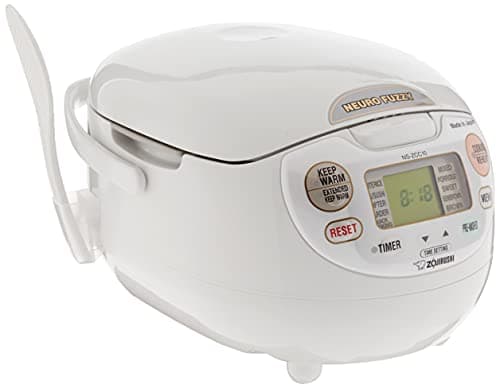
Zojirushi is the brand the others are measured against, and it has earned that rather than inherited it. The NS-ZCC10 Neuro Fuzzy is the benchmark: 680 W, 5.5 cups, Micom plus Neuro Fuzzy logic, made in Japan, and the settings people actually use — white, sushi, softer, harder, mixed, porridge, brown, rinse-free. Step up to the NW-QAC10 and you get induction heating at 1,080 W plus the longest published menu list here, which is the best rice you can currently buy from this brand and the most expensive way to get it. (Zojirushi still publishes the 1,230 W NP-HCC10, with a triple heater the NW-QAC10 does not claim, but it no longer has a buyable Amazon listing.) Step down to the NS-TSC10 and you get the same fuzzy logic at 610 W for less money, with two trades stated plainly on its page: it is made in China, and it adds steam and cake functions the Neuro Fuzzy does not have.
What Zojirushi does not do is publish an inner-pot material for any of them, and its warranty is one year like everyone else's here. Inner pans are available as a replaceable spare part, which matters more than the warranty length in practice. Neuro Fuzzy vs induction is the in-brand decision, and the best Japanese rice cookers is where the Japan-made question is settled.
Cuckoo — the only pressure brand, and the best-documented pot
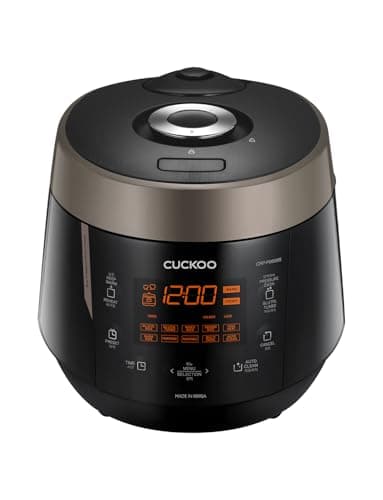
Cuckoo is the Korean answer and a genuinely different one. The CRP-P0609S cooks rice under pressure at 890 W, which raises the boiling point and produces a distinctly fluffier, stickier grain — most noticeable on short-grain, sticky and mixed rice, least noticeable on basmati. It is also the only cooker in this catalog whose maker publishes a 304 stainless pot with the nonstick applied over it, rather than a coating over plain aluminum. If the pot material is something you care about, Cuckoo is the brand that will tell you.
The non-pressure CR-0631F is the same build and fuzzy logic without the pressure mechanism, at 580 W — the lowest draw of any full-size rice cooker here and the cheapest to run. The brand's quirks are real: the wattage is in the manual rather than on the product page, the talking voice guide divides people, and a pressure cooker has a gasket that eventually needs replacing where a plain Micom pot does not. Cuckoo pressure vs Micom is the in-brand choice, and Zojirushi vs Cuckoo is the cross-brand one.
Tiger — one feature, and it is a real one
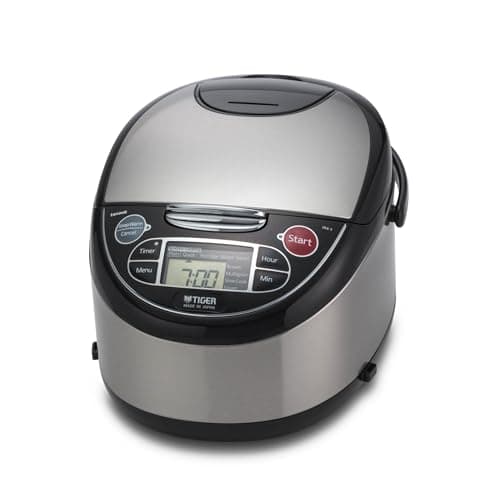
Tiger is the other Japanese brand, and on plain rice it is a Zojirushi competitor rather than a Zojirushi beater: Micom fuzzy logic, 641 W, ten named auto-cook settings, made in Japan. What it has that nobody copied is tacook— a synchronous-cooking tray that sits above the rice and steams a dish while the rice cooks below, off the same element, so a protein and the rice finish together. Tiger's own documentation is clear that the tray is small, a portion rather than a second course, and that honesty is worth something.
Buy Tiger if you will use the tray. If you will not, you are paying for a feature you do not want and a Zojirushi Micom cooks the rice itself just as well — Zojirushi vs Tiger settles it, and Cuckoo vs Tigercovers the other cross-brand pairing. Tiger's US documentation is thinner than Zojirushi's, and the pot material is not clearly published.
Aroma — the honest floor
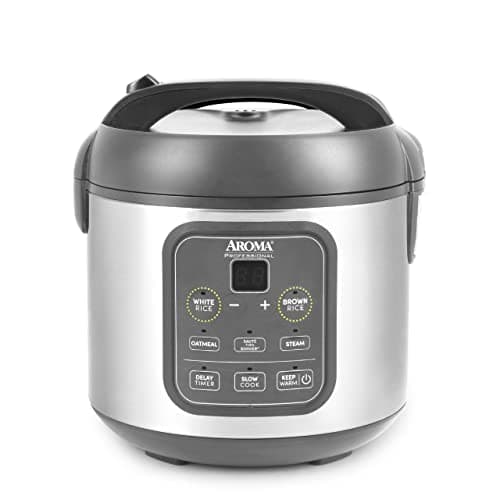
Aroma Housewares is the budget brand, and we rate it because it does not pretend otherwise. The current ARC-994SG cooks white and brown rice, sautés then simmers, slow-cooks for two to ten hours and steams, in a small pot, for around forty dollars — a genuine little multicooker — and Aroma publishes its 450 W draw, which is the lowest of any rice cooker on this site. Two rice programs and no more. Aroma claims “Sensor Logic” temperature control on the product page, explains it nowhere, and never calls it fuzzy logic, so neither do we.
It is the right first rice cooker for a student, a small kitchen or anyone who wants a cheap cooker that also slow-cooks — the budget roundup puts it in context, and Aroma vs Zojirushiis the question most people are really asking when they look at the price gap. Note that Aroma's older ARC-954SBD is discontinued, and that our correction on its warranty — one year in the current manual, not the five an earlier edition stated — is on its review page.
Toshiba, and the brands we do not cover
Toshiba's 3-cup mini is the rare compact cooker that still uses fuzzy logic rather than a dumb thermostat, with a 24-hour delay timer, and it is a good answer for one or two people — which is why it is on the small rice cooker roundup. Toshiba publishes no wattage we could verify for this SKU, so it gets no running-cost figure from us, and that is the reason it is an honourable mention here rather than a ranked pick.
Brands we deliberately do not rank: the supermarket own-labels and the no-name cookers that publish nothing at all. Not because they cannot cook rice — a basic thermostat cooker makes perfectly acceptable rice — but because there is no documented specification to rank, and this site has no test kitchen to substitute for one. Our method is explicit about that, and the honest alternative for a reader on the tightest budget is the Aroma, which does publish.
So which brand, for you
Eat rice most days and want it right: Zojirushi, and the induction model if the budget stretches. Eat mostly short-grain, sticky or mixed rice: Cuckoo, for the pressure. Want one appliance to make a weeknight meal: Tiger, for the tacook tray. Spending under fifty dollars: Aroma, and whether a rice cooker is worth it is worth reading first. Cooking for one: Toshiba's mini, or a small Zojirushi if you want the wattage published. And if you already own a multicooker and are wondering whether you need a rice cooker at all, that question has its own page.