Skip to content
DD

HUB 03 · Sous Vide

The Best Sous Vide Machines for Yogurt

A circulator is the best yogurt incubator most kitchens can own, and the reason is the one thing it is built to do: hold a low temperature steady for hours without drifting. Ranked on the published range, accuracy, timer and rated bath volume - nothing else matters for this job.

By Stephen V.Updated How we rank
#ad

We earn a commission if you buy through our links. It does not change the price you pay, and it does not decide our picks — the scoring rubric is published in full, including what disqualifies a pick. How this works.

The short answer

Quick picks

#CookerBest forScorePrice
01
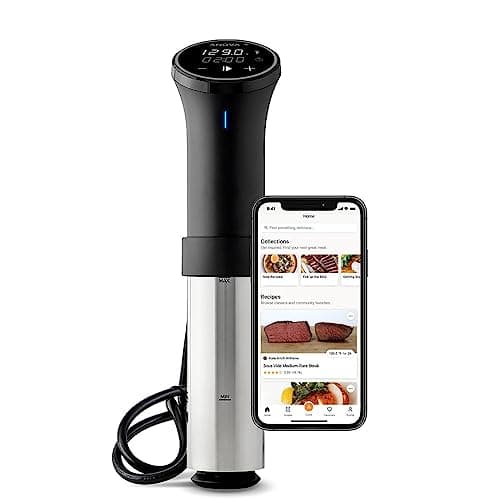
Anova Anova Precision Cooker 3.0 (WiFi), 1100 W
Anova Precision Cooker 3.0 (WiFi), 1100 W

The default, and it earned it

1,100 W
9.0
$123.72Amazon
02
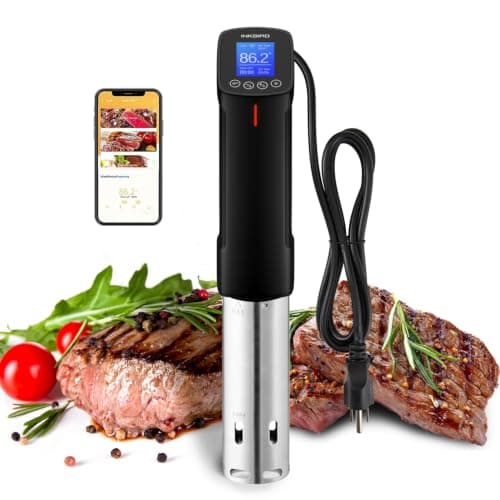
Inkbird Inkbird ISV-100W WiFi Sous Vide, 1000 W
Inkbird ISV-100W WiFi Sous Vide, 1000 W

WiFi and a screen for under $100

1,000 W
8.8
$95.99Amazon
03850 W
8.3
Check priceAmazon

#ad· Prices pulled live from Amazon's official Creators API, last checked October 20, 2026. Where we have no verified live price we show none — we would rather leave a gap than print a number that has gone stale. The wattage column is what the manufacturer publishes; “not published” means exactly that, and we have not estimated one. Scores are ours, compiled from published specifications, and are not test results.

The verdict

Buy the Anova Precision Cooker 3.0. Yogurt asks a circulator to do the easiest version of its job — hold roughly 110 °F (43 °C) dead steady for eight hours — and the machine that does it best is the one with the fullest published specification: Anova states a 0–92 °C range, ±0.1 °C accuracy, an 8 L/min pump and a two-year warranty, which is the longest here. The range is the quietly important part: 92 °C at the top means the same machine can also scald the milk at 82 °C before it incubates it, so the whole process happens in one vessel. Buy the Inkbird ISV-100W if you want to spend half as much: it publishes a 25–99 °C range, the same ±0.1 °C, a 15 L rated bath and an on-device screen. Buy the Anova Nano 3.0 if you incubate a few jars rather than a gallon — 850 W and a 7 L/min pump is plenty for a small bath, and it carries the same two-year warranty.

What this page will not tell you is that one circulator makes better yogurt than another. At this set point they are all operating well inside their published tolerances, and the differences below are about range, bath size, timer and accountability — not flavour.

Why a water bath is the right tool for this

Yogurt is a culture held at a temperature for a length of time. Too cool and it sets slowly and thinly; too warm and the bacteria you want are outcompeted or killed. The window people aim at is around 108–112 °F, and holding it for eight hours is precisely the problem an immersion circulator was designed for: a pump moves water past a heater and a thermistor so the whole bath sits at one temperature instead of stratifying.

Compare the alternatives honestly. An oven with the light on is a guess. A multicooker with a Yogurt program does the job well and is what most people should use if they already own one — our Instant Pot yogurt roundup lists which models actually have the button and the method page has the full sequence — but it heats a still pot from underneath with no circulation. A water bath with jars standing in it is more even than either, and it scales: four jars or twelve, same bath, same hold.

If you are new to the method at all, what sous vide is explains the mechanism and how to choose a sous vide machine is the general buying page this one sits under.

The specs that actually decide it

Published range, at both ends. The bottom end is a non-issue — every machine here reaches 43 °C comfortably. The top end is what matters, because scalding the milk to about 180 °F (82 °C) is the step that makes the finished yogurt thick rather than thin, and a circulator that can reach 82 °C can do that step too. Anova publishes 92 °C, Inkbird 99 °C, Wancle 90 °C — all sufficient. Breville publishes no temperature range for the Joule at all, which is why it is not ranked on this page.

Stated accuracy. Anova, the Nano and Inkbird all state ±0.1 °C. Wancle states the same figure as its own unverified claim. At a 43 °C set point none of those tolerances is the limiting factor; the reason to care about accuracy here is what it implies about the control loop over an eight-hour hold, not about tenths.

Rated bath volume. This one is practical. Inkbird publishes 15 L, Wancle 20 L with a 4.5 cm minimum water depth, and Breville rates the Joule for vessels up to 10 gallons. Anova publishes a pump flow instead — 8 L/min on the full machine, 7 on the Nano — which is the same information from the other direction: more flow moves a bigger bath. Jars take up room, so a dozen half-pint jars needs a larger container than one steak ever will. Our container guide covers what to put the water in.

Timer length. Eight hours is a long hold by the standards of a steak and a short one by the standards of a brisket, so no machine here is troubled by it. Worth noting that Wancle is the only maker in our catalog that publishes a maximum timer figure — one minute to 99 hours 59 minutes — so it is the only one where the number is citable rather than assumed.

The three, on published figures

Manufacturer-published figures only. Price is deliberately absent — see the live figures on the cards above.
Anova Precision 3.0Inkbird ISV-100WAnova Nano 3.0
Rated power1,100 W1,000 W850 W
Temperature range0–92 °C (32–197 °F)25–99 °C (77–210 °F)0–92 °C (32–197 °F)
Stated accuracy±0.1 °C±0.1 °C±0.1 °C
Bath capacity8 L/min pump15 L rated7 L/min pump
Works without a phoneYes — touchscreenYes — dot-matrix screenYes — on-device controls
Published warranty2 years1 year2 years

The “works without a phone” row is the reason the Joule is absent from the ranking despite being an excellent machine. It is app-only — no buttons, no screen — and an eight-hour overnight incubation is exactly the cook where you least want a dead phone or an app outage between you and the set point. That is a design choice rather than a defect, and our Joule review makes the case for it on cooks where it matters less.

The method, in a bath

Scald the milk to about 180 °F, either in a pot on the stove or in jars standing in the bath with the circulator set to 82 °C. Cool it to roughly 110 °F — a sink of cold water is quickest. Stir in a spoonful of live-culture starter per jar. Lid the jars loosely, stand them in the bath, set the circulator to 43 °C and the timer to eight hours, and go to bed. Chill the jars for a few hours before eating, because yogurt firms as it cools.

Two practical notes. The jars need to be weighted or they will float and tip — the same problem as a bag, and the fixes in the floating-bag guide apply. And cover the bath with a lid or a sheet of foil: an eight-hour hold loses real water to evaporation otherwise, which is also the single biggest lever on what the cook costs to run, as the running-cost page works through.

Who should buy what

If you do not already own a circulator or a multicooker and yogurt is a genuine reason you are buying: the Anova Precision Cooker 3.0, which will also do every steak, egg and brisket on this site and carries the longest warranty in the category. If budget is the constraint: the Inkbird, which gives up a year of warranty and 100 W and almost nothing else. If you incubate a few jars at a time: the Nano. If you already own an Instant Pot with a yogurt button: use it, and do not buy anything — the Instant Pot yogurt page tells you which models have it. A circulator is a better incubator; it is not better enough to justify a purchase you would not otherwise make.

And if the broader question is whether a circulator is worth owning at all, is sous vide worth it and the main roundup are the two pages to read.
In detail

The picks, in full

01
Anova Anova Precision Cooker 3.0 (WiFi), 1100 W

The default, and it earned it

Anova Precision Cooker 3.0 (WiFi), 1100 W

Fully specifiedWorks without the app
9.0/10

The sous vide circulator most people should buy. Anova publishes the full specification — 1,100 W, a 0–92°C range, ±0.1°C accuracy, an 8 L/min pump — and backs it with a two-year warranty, the longest here. It has an on-device screen so it works without the app, which the Joule does not.

Capability
9.5
Capacity
8.5
Documentation
10
Build
8.5
Value
8.5

What it gets right

  • Anova publishes the complete specification — wattage, temperature range, accuracy and pump flow — which almost nobody else in this class does
  • An on-device touchscreen means it works fully without a phone, unlike the app-only Joule
  • A two-year warranty, the longest of any sous vide machine on this site

What it doesn't

  • At 325 mm tall it is a large device to store next to the slimmer Nano or Joule
  • The clamp-and-skirt design is bulkier than the Joule's magnetic foot
  • 1,100 W is a real draw — powerful, but the most per hour of the sub-premium circulators here alongside the Joule and Greater Goods

What it costs to run

About 20.7¢ an hour at full rated draw, at the US average of 18.83¢ per kWh.

1,100 W ÷ 1000 × 1 h × 18.83¢ = 20.7¢

1100 W, published on Anova Culinary's own Precision Cooker 3.0 product page alongside the temperature range, accuracy and pump rate. This is an upper bound: the element only draws full power while it is heating up or pressurizing, then cycles off to hold temperature, and no manufacturer publishes a duty cycle — so we compute at full rated draw rather than invent a correction factor. The full method is published.

Skip this if…

…you want the smallest possible device or you cook small portions in shallow water — the slimmer Nano is cheaper, lighter and enough for a single steak, and this is the one to buy only if you want the full power and the longer range.

$123.72on Amazon

$229.0046% off

Price last checked October 20, 2026. Prices move constantly — Amazon's at checkout is the one that counts.

#ad · we may earn a commission from this link to Anova Precision Cooker 3.0 (WiFi), 1100 W

02
Inkbird Inkbird ISV-100W WiFi Sous Vide, 1000 W

WiFi and a screen for under $100

Inkbird ISV-100W WiFi Sous Vide, 1000 W

Fully specified under $100On-device screen + WiFi
8.8/10

The value pick that does not feel like one. Under $100, and Inkbird still publishes the full specification: 1,000 W, a 25–99°C range, ±0.1°C accuracy, 15 L capacity, WiFi and an on-device dot-matrix screen. It undercuts the Anova by more than half and gives up remarkably little on paper.

Capability
9
Capacity
8.5
Documentation
9.5
Build
7.5
Value
9.5

What it gets right

  • Publishes the complete specification — wattage, range, accuracy, capacity — at a price where most rivals publish nothing
  • An on-device dot-matrix screen and WiFi both, so it works with or without the app
  • ±0.1°C accuracy on paper matches the Anova, for less than half the money

What it doesn't

  • A one-year warranty against the Anova's two
  • The listed weight figure on Inkbird's own page is internally inconsistent — a small sign the documentation is less polished than Anova's
  • The app is functional rather than good, and the WiFi is 2.4 GHz only

What it costs to run

About 18.8¢ an hour at full rated draw, at the US average of 18.83¢ per kWh.

1,000 W ÷ 1000 × 1 h × 18.83¢ = 18.8¢

1000 W, published on Inkbird's own ISV-100W product page alongside the range, accuracy and capacity. This is an upper bound: the element only draws full power while it is heating up or pressurizing, then cycles off to hold temperature, and no manufacturer publishes a duty cycle — so we compute at full rated draw rather than invent a correction factor. The full method is published.

Skip this if…

…you want the longest warranty and the most refined app — that is the Anova, and it costs the difference. On the cooking specification itself, this gives up very little.

$95.99on Amazon

Price last checked October 20, 2026. Prices move constantly — Amazon's at checkout is the one that counts.

#ad · we may earn a commission from this link to Inkbird ISV-100W WiFi Sous Vide, 1000 W

03
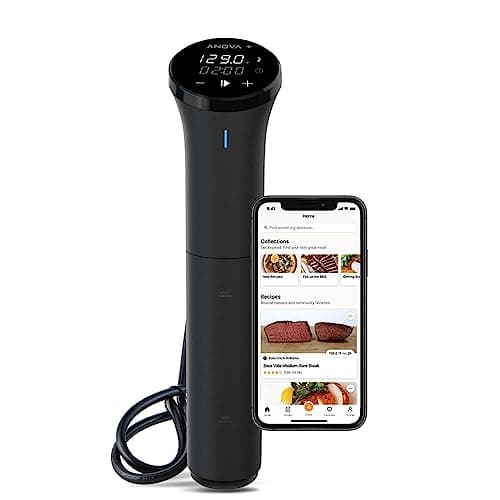
Anova Anova Precision Cooker Nano 3.0 (WiFi), 850 W

The cheapest way into Anova

Anova Precision Cooker Nano 3.0 (WiFi), 850 W

Two-year warrantyWiFi now, not Bluetooth-only
8.3/10

The small Anova, and the sensible entry point. 850 W rather than the full 1,100, in a slimmer, lighter body, now with WiFi where the old Nano was Bluetooth-only. For a single steak or a couple of portions in a modest pot, it is all the circulator most people need — and it carries Anova's two-year warranty.

Capability
8
Capacity
7
Documentation
9.5
Build
8.5
Value
8.5

What it gets right

  • The cheapest route to Anova's build quality, app and two-year warranty
  • 850 W and a 7 L/min pump are plenty for a single steak or a couple of portions in a normal pot
  • The 3.0 generation adds WiFi, fixing the old Nano's Bluetooth-only limitation

What it doesn't

  • Less power than the 1,100 W full model, so it heats a large bath more slowly
  • The 7 L/min pump moves less water, which matters if you cook big batches in a deep container
  • It had no live Amazon price at our last check, which usually means intermittent stock — the button says 'check price' rather than a number

What it costs to run

About 16.0¢ an hour at full rated draw, at the US average of 18.83¢ per kWh.

850 W ÷ 1000 × 1 h × 18.83¢ = 16.0¢

850 W, published on Anova Culinary's own Precision Cooker Nano 3.0 product page. Some third-party retailers list 800 W; we follow the manufacturer's own figure. This is an upper bound: the element only draws full power while it is heating up or pressurizing, then cycles off to hold temperature, and no manufacturer publishes a duty cycle — so we compute at full rated draw rather than invent a correction factor. The full method is published.

Skip this if…

…you regularly cook big batches in a large, deep container — the full Precision Cooker 3.0's extra power and pump flow are worth it there. For everyday portions, the Nano is the smarter spend.

Check price on Amazon →

No buyable offer at the last price check (October 20, 2026). We show nothing rather than a stale number.

#ad · we may earn a commission from this link to Anova Precision Cooker Nano 3.0 (WiFi), 850 W

How we picked

Machines we claim to have tested: 0

Everyone in this category tells you they tested twenty cookers. We have tested none, and we say so. Here is what we do instead: read the manufacturer's manual and spec page, record the published wattage, capacity, pressure or temperature figure and warranty term, work out what the machine costs to run per hour, show the arithmetic so you can redo it with your own electricity rate, and cite all of it. Where a brand publishes no wattage, we print no running cost rather than borrowing a number from a similar model. Prices come live from Amazon's API and disappear rather than go stale.

The scores above are judgments from that documented research — not test results. One of the five metrics is Documentation: whether the manufacturer will tell you what its cooker draws at all. The full rubric, including what disqualifies a pick, is published in full.

Questions

Frequently asked

What is the best sous vide machine for yogurt?
The Anova Precision Cooker 3.0. Anova publishes a 0 to 92C range, plus or minus 0.1C accuracy, an 8 L/min pump and a two-year warranty - the longest in the category. The 92C top end matters more than it looks, because it means the same machine can scald the milk at 82C before it incubates it at 43C, so the whole process happens in one vessel.
What temperature do you set a sous vide for yogurt?
Around 110F (43C) for the incubation, held for about eight hours. Before that, the milk goes up to roughly 180F (82C) to denature the proteins, which is what makes the finished yogurt thick rather than thin, and then comes down to 110F before the starter goes in - hotter than that kills the cultures.
Is a sous vide better than an Instant Pot for yogurt?
Mechanically yes, practically it depends on what you already own. A circulator pumps water past a heater and a thermistor so the whole bath sits at one temperature; a multicooker's yogurt program heats a still pot from underneath with no circulation. The bath is more even and it scales to a dozen jars. But if you already have an Instant Pot with a yogurt button, use it - the circulator is better, not better enough to justify a purchase you would not otherwise make.
Can you make yogurt in jars in a sous vide bath?
Yes, and it is the usual way to do it. Scald, cool, inoculate and lid the jars loosely, then stand them in the bath at 43C for eight hours. Two practical things: weight the jars or they float and tip, exactly like a bag, and cover the bath with a lid or foil because an eight-hour hold loses real water to evaporation.
Does the Breville Joule work for yogurt?
It will hold the temperature, but we do not rank it for this. Breville publishes no temperature range or accuracy figure for the Joule in any manual we could find, and the machine is app-only - no buttons, no screen. An eight-hour overnight incubation is the cook where you least want a dead phone between you and the set point.
How long can a circulator hold an eight-hour cook?
Longer than yogurt needs - eight hours is short by the standards of a brisket. Worth noting that Wancle is the only maker in our catalog that publishes a maximum timer figure, one minute to 99 hours 59 minutes, so it is the only one where the number is citable rather than assumed.

Keep reading

Receipts

Sources

We have not tested these machines in a lab and we do not pretend to have. Specifications come from the manufacturer's own published documents; electricity rates come from the US Energy Information Administration; prices come from the live Amazon API. Where a figure is not published, the page says “not published” rather than guessing. Read the full method.