The verdict
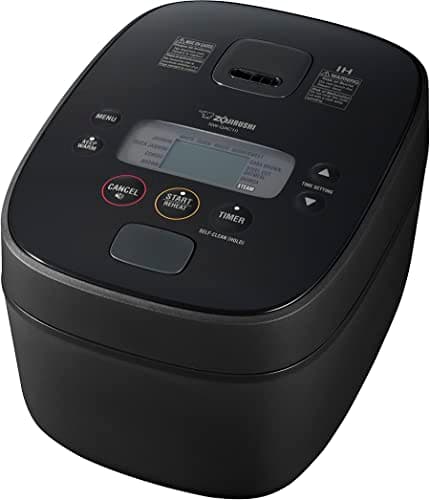
Buy it if you eat rice most days and want the best grain you can actually order. The NW-QAC10 is an induction cooker, which means the metal pan itself becomes the heating element electromagnetically rather than sitting on a hot plate — the most even and most responsive heat available in a domestic rice cooker. Zojirushi publishes 1,080 W at 120 volts, 5.5 cups / 1.0 litre, a 9-1/4 x 12-1/4 x 7-7/8 inch body, and Made in Japan. The two things it gives up against the NP-HCC10 it replaces are a documented triple heater — Zojirushi claims only “superior induction heating” here — and an unstated pan material, because this one is explicitly double-nonstick-coated. What it adds is a materially longer menu list and a genuine steam function with a tray, neither of which the older machine had.
Why this page exists. The Zojirushi NP-HCC10 held the induction slot on this site until its Amazon listing went dead — Zojirushi still makes it and still publishes its specification, but there is no longer a buyable listing, and we will not point a buy button at one. The NW-QAC10 is the same brand, the same 5.5-cup capacity, the same non-pressure induction class and also made in Japan, so it takes the slot. Nothing in this review is carried over from that one.
What induction actually changes
Every cooker below this tier heats the pan from a plate in the base. Heat therefore arrives at the bottom of the rice first and has to work upwards, which is why cheaper cookers can leave a dense layer at the bottom and a drier layer at the top of a full pot. Induction energises the pan itself, so heat comes from the whole surface in contact with the rice at once, and the cooker can change that heat almost instantly rather than waiting for a hot plate to cool.
The practical effect is consistency, especially on a full load and especially on the grains that are hardest to get right — brown rice, GABA brown, mixed rice. It is a real improvement and it is an incremental one: our induction versus fuzzy logic page makes the honest case that the step from a basic timer cooker up to a fuzzy-logic Zojirushi is far bigger than the step from fuzzy logic up to this.
The menu list is the quiet upgrade
This is where the NW-QAC10 is plainly a newer machine. Zojirushi publishes twelve settings: white, quick white, mixed, sushi/sweet, Jasmine, quick Jasmine, congee, brown, GABA brown, steel cut oatmeal, quinoa and steam.
Three of those are worth calling out. The quick variants of white and Jasmine are the setting people actually reach for on a weeknight, and having a dedicated one beats shortening a full cycle by guesswork. Congee is a real program rather than a porridge approximation — our congee guide covers what the setting is doing. And steam, with the tray Zojirushi includes, means the cooker can put a tray of vegetables or fish above the rice, which is the one genuinely useful trick the Tiger JAX-T10U used to have to itself on this site. The steaming guide is the method page for it.
Steel-cut oatmeal and quinoa round it out, and both are things people genuinely cook in these machines rather than marketing filler — see oatmeal and quinoa.
The pan, and the honest caveat
Zojirushi describes this one precisely, which we give it credit for: a black thick spherical inner cooking pan, 1.7 mm, made of aluminum with a durable stainless steel clad layer and a double nonstick coating. The spherical shape is the point — it gives the induction field an even surface to work on with no flat corners to run cool.
The caveat is the coating. A double nonstick layer is a consumable: it is excellent for years and then it is not, and when it goes the pan is the part you replace. That is a genuine difference from the bare 18/8 stainless pots in the multicooker half of this site, and it is worth knowing before you spend several hundred dollars. Our rice-cooker pot-materials page works through what every maker here actually publishes, and the honest headline there is that no rice cooker in this catalog has a bare cooking surface, because rice sticks to hot bare metal.
Zojirushi sells inner pans as a replacement part, which is the reason that matters less here than it would on a cooker from a brand that does not.
What it costs to run
At the published 1,080 W and the US average residential rate of 18.83¢ per kWh, a 50-minute white-rice cycle costs about 17¢ computed at full rated draw, which works out to roughly $44 a year at five cycles a week. Treat both as ceilings rather than measurements: the element draws its rated wattage to bring the water to the boil and then cycles to hold the temperature profile, and no manufacturer publishes a duty cycle, so we compute the maximum and say so.
For context, that is about $16 a year more than the 680 W Neuro Fuzzy — and about $6 a year less than the 1,230 W NP-HCC10 would have cost. Electricity is not the reason to choose between any of them. Our rice-cooker electricity page has every published draw in the catalog and the arithmetic in full, so you can redo it with your own rate.
Against the cookers you are actually choosing between
Published figures only, each from the manufacturer's own specification page. Price is deliberately absent — see the live figure on the card above. | NW-QAC10 | NS-ZCC10 Neuro Fuzzy | Cuckoo CRP-P0609S |
|---|
| Heating | Induction (IH) | Micom + Neuro Fuzzy logic | Heating pressure + fuzzy logic |
|---|
| Rated power | 1,080 W | 680 W | 890 W |
|---|
| Capacity | 5.5 cup / 1.0 L | 5.5 cup / 1.0 L | 6 cup / 12 cup cooked |
|---|
| Published pan material | Aluminum, stainless clad, double nonstick | Not published | 304 stainless + nonstick coating |
|---|
| Steam function | Yes, with tray | No | Not published |
|---|
| Origin | Made in Japan | Made in Japan | Made in South Korea |
|---|
Read that as three different bets. The NW-QAC10 buys the most even heat and the longest menu list. The Neuro Fuzzy buys most of the rice quality for a lot less money and remains the value answer for anyone cooking rice a few times a week. The Cuckoo CRP-P0609S is the genuinely different one: cooking under pressure raises the boiling point and produces a distinctly fluffier, stickier grain that a lot of people prefer blind on short-grain and mixed rice, and it is the only cooker here publishing a stainless pan body.
Living with it
The flat top with an integrated control panel is the headline design change from the older Zojirushi bodies, and the practical benefit is that it wipes clean in one pass. The inner lid detaches and is washable stainless; the steam vent is integrated, which Zojirushi says minimises overflows; and there is a self-cleaning cycle aimed at odour, which is the thing that actually accumulates in a cooker used daily. Our cleaning guide covers the parts that matter.
The LCD panel carries a clock and a two-setting delay timer, so rice can be ready when you walk in. Keep warm is automatic, with an extended keep-warm mode and a reheat function the NP-HCC10 did not have. One caution we would repeat on any cooker: keep warm is for the rest of a meal, not for storage — leaving rice in the cooker works through the food-safety guidance.
It is also a usefully small machine. At 9-1/4 x 12-1/4 x 7-7/8 inches it is nearly two inches shallower and an inch narrower than the NP-HCC10, which on a counter that already holds a kettle and a toaster is a real difference rather than a spec-sheet one.
Who should buy it, and who should not
Buy the NW-QAC10 if rice is a near-daily staple, you want the most even cook available in a domestic machine, and you will use more than two of the twelve programs. Buy the Neuro Fuzzy instead if you cook rice a few times a week — it is the value sweet spot, it is also made in Japan, and you will rarely notice what induction adds. Buy the Cuckoo if you eat short-grain or mixed rice and want the pressurised texture. And if you are starting from the top, the rice-cooker roundup ranks the whole field and how to choose a rice cooker is the page to read before spending anything.