Check one spec before you read any further
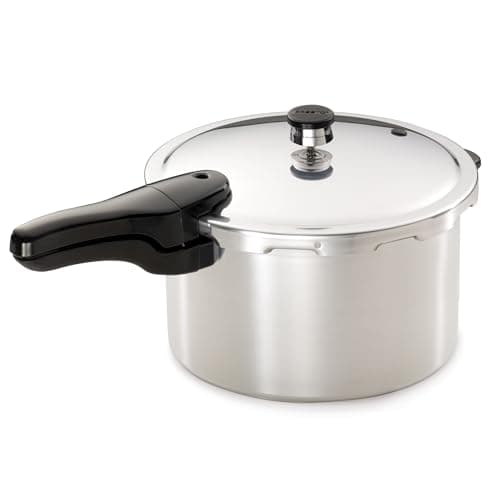
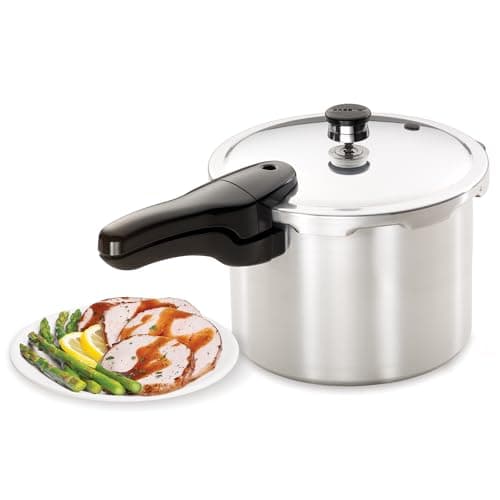
Is your range induction? If it is, two of the four cookers below are not options for you at any price, and that is not a performance judgment — it is physics plus Presto's own published range list. Aluminum is not magnetic, an induction hob heats by inducing a current in the pot, and Presto lists its aluminum 01264 and 01282 for electric, smooth-top and gas ranges only. Induction is absent from that list because the pot will not heat at all. The stainless Presto 01362 and the Kuhn Rikon Duromatic both list induction explicitly.
We are putting this first because it is the one mistake on this page that cannot be recovered from, and because every other consideration here is a trade-off you can weigh. This one is a wall.
Why a stovetop cooker at all, in the Instant Pot era
Three reasons, all of them specs rather than nostalgia.
It reaches higher pressure.Presto's regulator holds the ideal cooking pressure at around 15 pounds. Instant Brands publishes a high working-pressure range of 10.2–11.6 psi (70–80 kPa) for its electric cookers — deliberately lower, because an electric cooker is designed to be left unattended and trades top-end pressure for that. Cook time falls as pressure rises, so a stovetop pot is genuinely faster on the long jobs: tough cuts, dried beans, stock. This is the one category where the old technology outperforms the new one on the headline number.
There is almost nothing in it to break. No circuit board, no display, no heating element, no fan. The sealing ring is the only real wear part, and it costs very little. This is why Presto can put an extended 12-year limited warranty on a pot that costs less than most electric cookers — and why a stovetop cooker is a reasonable thing to expect to outlive several Instant Pots. Every electric cooker on this site carries a one- or two-year warranty by comparison.
It costs less and takes no counter space. It is a pot. It lives in the cupboard with the other pots, and it doubles as a stockpot with the lid off.
And the honest reason not to
You have to be there. A stovetop pressure cooker has no thermostat and no timer: you bring it up until the regulator starts to rock, then adjust the burner down to keep that rock slow and steady, and you keep adjusting it for the whole cook. Walk away and it either drops out of pressure or vents hard. It is a technique, and like any technique it takes a few cooks to get a feel for.
That is the entire trade. An electric cooker is slower and lower-pressure and you can leave the house; a stovetop cooker is faster and higher-pressure and you cannot leave the room. If you want the whole comparison laid out properly, it is in stovetop vs electric pressure cookers. If what you actually want is a machine you can set and forget, the electric roundup is the right page and this one will only sell you a chore.
Stainless or aluminum, and what each one actually costs you
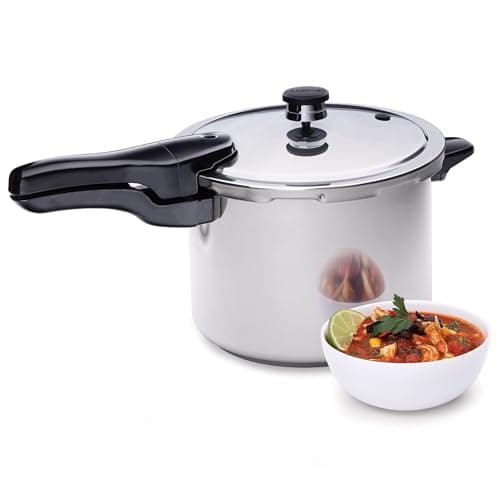
Beyond induction, the body material changes three things. Heat-up speed: aluminum conducts better and comes up to pressure faster on the same burner. Reactivity: aluminum reacts with acidic food over long contact, so a tomato-heavy braise should not be stored in the pot even though cooking in it is fine. Stainless is inert and you can leave anything in it. Evenness:plain stainless is a poor conductor and would scorch, which is why the Presto 01362 uses a tri-clad base — a layer of aluminum sandwiched between two layers of stainless — to get aluminum's conduction with stainless's surface.
That tri-clad construction is why the stainless model wins this roundup rather than simply being the induction-compatible alternative. It browns more evenly than a plain stainless pot and it does not react with your food, and it gives up only a little heat-up speed to the aluminum models.
The rocking regulator versus the spring valve
The two designs here hold pressure in different ways, and it is the clearest build-quality difference on the page.
Presto uses a weighted rocking regulator: a weight sits on the vent pipe, steam lifts it when the pressure is high enough, and the weight rocks and hisses. It is crude, it is loud, and it is wonderfully legible — you can hear your cook from the next room and you know instantly if the heat is too high. Nothing to calibrate and nothing to fail.
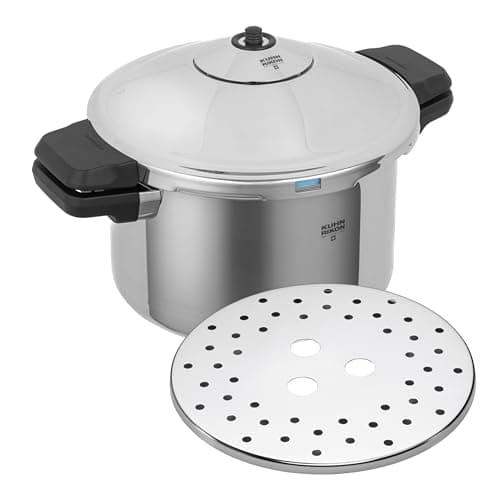
Kuhn Rikon uses a spring-loaded valve, which holds pressure silently and vents far less steam into your kitchen. It is the nicer experience by a distance. It is also a precision mechanism rather than a lump of metal, and Kuhn Rikon publishes no working-pressure figure for it at all — which, on a site that ranks what makers put in writing, is a real mark against a cooker costing roughly three times the stainless Presto while carrying a shorter warranty.
Sizing a stovetop cooker
Stovetop cookers are sized by liquid capacity, and you never fill one more than about two-thirds full — less for foods that foam, like beans and grains. So a 6-quart pot is a 4-quart working volume, which handles a family-sized braise, a whole chicken or a pound of dried beans. The 8-quart aluminum model is the batch-cooking and stock-making size and is the cheapest large pressure cooker on this site by a wide margin. The Kuhn Rikon's 5 liters is the smallest here and the wrong pot if volume is why you are shopping.
One size note that catches people out: a bigger pot takes longer to come up to pressure, because there is more mass and more liquid to heat. The published cook time starts when the regulator starts rocking, not when you light the burner.
Converting recipes, and the thing nobody warns you about
Almost every pressure-cooker recipe published in the last decade was written for an electric cooker at around 11 psi. At 15 psi your food cooks faster than those times, and the usual starting point is to cut the time by roughly a third and check early — then write down what worked, because you cannot un-overcook a piece of meat. Our recipe conversion guide covers the arithmetic in both directions.
The release method matters more on a stovetop cooker too, because you control it manually: taking the pot off the heat and letting pressure fall naturally continues cooking for several minutes, while lifting the regulator drops pressure fast and stops it. Which to use for which food is here.
What we are not claiming
We have not cooked in these pots. The scores on each card are compiled from published manufacturer documents — Presto's product pages and its pressure-regulator explainer, Kuhn Rikon's product specifications — and they are judgments about documentation, build and value, not test results.
None of these cards shows a running cost, and that is deliberate rather than an omission. A stovetop pressure cooker has no element of its own: it draws whatever the burner under it draws, which depends on your range. Any wattage figure we printed here would be invented, so each card says “no published wattage” instead. Where a figure is not published, there is no figure.
How to buy a stovetop pressure cooker
1. Rule out your range first. Induction means stainless only — the Presto 01362 or the Kuhn Rikon. Gas, coil or smooth-top electric opens the whole list, including the cheaper aluminum Prestos.
2. Then decide if you want quiet. The rocking regulator is loud and informative; the spring valve is silent and costs several times more. There is no middle option on this page, and neither choice is wrong.
3. Size to two-thirds. Take the capacity you think you need and buy a pot a third bigger, because you cannot fill one to the brim. Six quarts suits most households; eight if you make stock or batch-cook.
4. Check what the warranty actually is.Presto's extended 12-year limited warranty is the longest on this entire site and it applies to its cheapest pot as well as its dearest. Kuhn Rikon's is 10 years. Both make every electric cooker's one year look thin.
5. Buy a spare sealing ring with the pot. It is the only part that wears, it is cheap, and a cooker that will not seal is a cooker you stop using. This is the whole maintenance plan for a stovetop pressure cooker.