The verdict
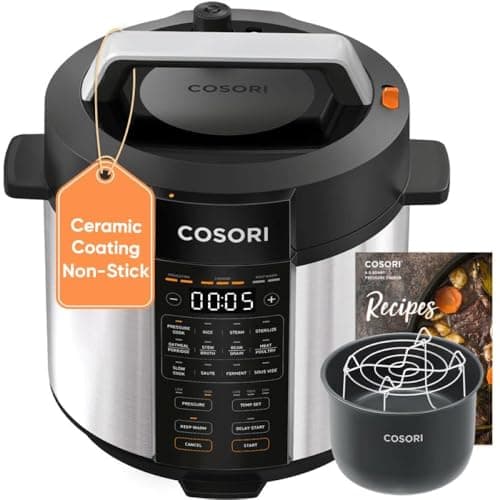
Buy it if you want the best-documented budget pressure cooker and can live with a coated pot. Cosori publishes 1,100 W, a 6.0 qt / 5.7 L capacity rated for four to six people, thirteen cooking functions, a two-year limited warranty, and — unusually — both working-pressure bands: 9.4–12.3 psi (65–86 kPa) high and 5.1–8 psi (35–55 kPa) low. That is the most complete pressure documentation of any cooker in this catalog, Instant Pot included. The counterweight is one line of the same spec sheet: the removable inner pot has a nonstick interior coating. Those two facts are the whole of Cosori against Instant Pot, which puts this cooker next to the Duo and the Pro spec for spec.
The pressure documentation, and why we make a fuss of it
Almost nobody publishes a low-pressure band. Instant Brands publishes 10.2–11.6 psi high for the Duo in its manual and nothing at all for some newer models; Ninja publishes no pressure figure for the HyperHeat; Kuhn Rikon publishes none for the Duromatic. Cosori publishes both bands in two units on its own product page, which means you can actually reason about a recipe: a low-pressure program at 5.1–8 psi is a genuinely different cooking temperature from a high-pressure one, and a delicate fish or a custard behaves differently there in a way you can predict rather than discover.
Note what Cosori's high band implies against an Instant Pot's. Its ceiling, 12.3 psi, is above the Duo's 11.6; its floor, 9.4, is below the Duo's 10.2. So it is a wider band rather than a higher one — the pot will sometimes cook a little faster and sometimes a little slower than an Instant Pot at the same nominal setting. In practice that is a non-issue for everything except the longest cooks. Neither comes near the roughly 15 pounds a stovetop cooker holds.
The pot, which is the real decision
Cosori publishes the inner pot as removable with a nonstick interior coating. A coating is not a defect and it has advantages — rice and porridge release cleanly, cleanup is easier, and a sauté of onions will not stick the way it can on bare steel. But it is the one part of a pressure cooker that is guaranteed to wear out, it can be scratched by metal utensils, and it cannot be deglazed as aggressively as stainless. Instant Brands puts an 18/8 stainless pot with a tri-ply base in cookers at this price, with no coating at all, and the reason that matters is not health — we make no claim there, and our non-toxic page is explicit about reporting materials rather than making claims — it is longevity. A stainless pot is still a stainless pot in year eight.
That single line is why the Cosori places where it does on the budget pressure cooker roundup and on the beans roundup: it out-documents the Instant Pot and loses to it on the one component that does not get replaced.
The warranty is the quiet win
Two years, published. Every Instant Pot in this catalog is one year. Every Ninja cooker here is one year. At this price point, doubling the warranty is a more meaningful difference than two extra programs, and it is the strongest argument for buying outside Instant Brands in the budget bracket. The brand-level version of this comparison is on the pressure cooker brands page, where Cosori leads on pressure documentation and Instant Pot leads on parts availability.
Functions: thirteen, and a documentation wrinkle
Cosori's own product page states thirteen cooking functions, and the set includes sous vide and ferment — neither of which the similarly-priced Instant Pot Duo has. The sous vide program is worth exactly what every multicooker's sous vide program is worth: it heats a still pot of water with no pump, so it holds temperature far more loosely than a real circulator. If sous vide is the reason you are buying, read how to choose a sous vide machine first; if it is a bonus you will use three times a year, it is a fine bonus.
The wrinkle is that Cosori's Amazon listing and its own product page do not agree on the function count. We follow the manufacturer's own page, which is the rule everywhere on this site, but an internal inconsistency in a brand's documentation is worth knowing about when the documentation is the reason you are considering the brand. Instant Brands' pages do not have that problem.
Parts, in year three
The least glamorous reason to prefer an Instant Pot, and a real one. A sealing ring perishes — every pressure cooker's does — and Instant Pot rings, lids and accessories are stocked by half the retailers in the country. Cosori's accessory and replacement-part ecosystem is much smaller. If a cooker is going to live in your kitchen for a decade, the availability of a $12 gasket matters more than a spec-sheet victory, and the Cosori's two-year warranty only covers the first fifth of that decade.
Who should buy it, and who should not
Buy it if you specifically want a non-Instant-Pot electric cooker, you value a documented low-pressure band and a two-year warranty, and a coated pot is acceptable to you — which for most cooks it is. Do not buy it if an uncoated cooking surface is the reason you are buying a pressure cooker at all: for roughly the same money a stainless-pot Instant Pot Duo exists, and which Instant Pot to buy sorts that range. If you want a cooker that also air-fries, neither applies — the air-fryer multicookers is the page for that.
How we picked
Machines we claim to have tested: 0
Everyone in this category tells you they tested twenty cookers. We have tested none, and we say so. Here is what we do instead: read the manufacturer's manual and spec page, record the published wattage, capacity, pressure or temperature figure and warranty term, work out what the machine costs to run per hour, show the arithmetic so you can redo it with your own electricity rate, and cite all of it. Where a brand publishes no wattage, we print no running cost rather than borrowing a number from a similar model. Prices come live from Amazon's API and disappear rather than go stale.
The scores above are judgments from that documented research — not test results. One of the five metrics is Documentation: whether the manufacturer will tell you what its cooker draws at all. The full rubric, including what disqualifies a pick, is published in full.