HUB 02 · Rice Cookers
Do Rice Cookers Use a Lot of Electricity?
No - a rice cooker is one of the cheapest hot appliances in the kitchen, and the gap between the thriftiest and the thirstiest is about twelve cents a cook. Here is the arithmetic in full, with every wattage traced to the maker's own page and the honest admission about Keep Warm.
We earn a commission if you buy through our links. It does not change the price you pay, and it does not decide our picks — the scoring rubric is published in full, including what disqualifies a pick. How this works.
The short answer
No. Rice cookers are among the cheapest hot-cooking appliances in a kitchen, and the published draws of the cookers we cover run from 450 W at the bottom to 1,230 W at the top. At the US average residential electricity rate of 18.83¢ per kWh, a typical 50-minute white-rice cycle costs between about 7¢ and 19¢ — and that is computed at full rated draw for the whole cycle, which no rice cooker actually does. The real figure is lower. Five cycles a week for a year comes to roughly $18 to $50 at those same ceilings, which is the whole annual cost of the appliance that makes most of your dinners.
The arithmetic, so you can redo it with your own rate
Running cost is watts ÷ 1,000 × hours × your rate in cents per kWh. Nothing hidden, no adjustment factors. The 680 W Zojirushi Neuro Fuzzy over a 50-minute cycle is 0.68 × 0.833 = 0.567 kWh, and at 18.83¢ that is 10.67¢.
The rate we use is the US-total average residential price published by the EIA in Electric Power Monthly, and it is a single constant across this entire site so no two pages can contradict each other on it. Your bill will differ — residential rates vary by more than a factor of two across US states — which is exactly why the sum is printed rather than just the answer. Put your own number in the last term.
Every published draw we can cite
| Cooker | Published draw | Per hour | 50-min cycle | 5 cycles/week, 1 year |
|---|---|---|---|---|
| Aroma ARC-994SG | 450 W | 8.5¢ | 7.1¢ | $18.36 |
| Cuckoo CR-0631F | 580 W | 10.9¢ | 9.1¢ | $23.66 |
| Zojirushi NS-TSC10 | 610 W | 11.5¢ | 9.6¢ | $24.89 |
| Tiger JAX-T10U | 641 W | 12.1¢ | 10.1¢ | $26.15 |
| Zojirushi NS-ZCC10 | 680 W | 12.8¢ | 10.7¢ | $27.74 |
| Cuckoo CRP-P0609S | 890 W | 16.8¢ | 14.0¢ | $36.31 |
| Zojirushi NW-QAC10 (induction) | 1,080 W | 20.3¢ | 17.0¢ | $44.06 |
| Zojirushi NP-HCC10 (induction, no longer sold on Amazon) | 1,230 W | 23.2¢ | 19.3¢ | $50.18 |
Two cookers in our catalog are missing from that table and their absence is deliberate: the Toshiba mini and the discontinued Aroma ARC-954SBD, because neither maker publishes a wattage we could verify for those SKUs. Where a manufacturer publishes no figure we print no running cost rather than borrowing one from a similar model — the number that is not there is a finding too, and it is how our method handles every unsourceable spec.
Why these are ceilings and not estimates
A rice cooker does not draw its rated wattage for the length of a cycle. It draws it to bring the water to the boil, and then the microcomputer in a fuzzy-logic cooker cycles the element on and off to hold the right temperature profile through the absorption and steaming phases. Our fuzzy-logic page explains what that control is doing, and the consequence here is simple: real consumption is below rated draw times time, always.
How far below depends on the duty cycle, and no manufacturer on this site publishes one. So rather than invent a plausible-looking fudge factor and present the result as a measurement, we compute at full rated draw and label the result a maximum. That is the difference between a number you can check and a number you have to trust us about.
Does Keep Warm use a lot of electricity?
This is the sub-question people actually ask, and the honest answer is that we cannot give you a number, because nobody publishes one. Not one manufacturer in our catalog states a separate wattage for the keep-warm element, so any figure we printed would be invented.
What can be said from physics rather than from a spec sheet: keep-warm holds the rice near serving temperature rather than cooking it, so the element is replacing heat lost through the body and lid rather than putting energy into boiling water, and that is a small fraction of the cooking draw. It is cheap. It is also not the reason to avoid leaving rice on it — the reason is food safety and texture, which the page on leaving rice in the cooker covers against the USDA's guidance.
The comparison that actually matters: against the stove
A rice cooker is not competing with doing nothing; it is competing with a pot on a hob. A typical electric cooktop element runs well over 1,000 W and often over 2,000 W, so a rice cooker at 450–680 W is drawing less than the burner it replaces, and it is heating a small insulated vessel instead of a pan on an open coil with a kitchen above it. Our rice cooker versus stovetop comparison covers the rest of that trade, and are rice cookers worth it is the broader version of the question.
The same logic is what makes the pressure-cooker running-cost page end up where it does: wattage without time is a misleading number, and a high-draw appliance that runs for minutes beats a low-draw one that runs all day.
Is the induction cooker worth 1,080 watts?
It is the one place on this page where the draw is genuinely worth a second look, because it is about 60% more than every Micom machine. The published gap in annual terms, at the ceilings in the table above: about $44 a year against about $28 for the Neuro Fuzzy at five cycles a week. Sixteen dollars a year. (The NP-HCC10 that used to hold this slot drew 1,230 W and would have cost about $50 — but Zojirushi no longer has a buyable Amazon listing for it.)
That is not a reason to buy or not buy an induction rice cooker, and we would rather say so plainly than dress it up. The reason to buy the NW-QAC10 is that it cooks the best rice you can currently buy here; the reason not to is that it costs several hundred dollars, which is decades of the electricity difference. Our induction versus fuzzy logic page makes that case properly, and are expensive rice cookers worth it is the honest counterweight.
The bottom line
A rice cooker costs cents per meal and tens of dollars per year, even computed at a draw it never sustains. If you are weighing cookers, the electricity is not a tiebreaker — spend the attention on capacity, on whether the heat control is a real microcomputer, and on whether the pot will outlast the warranty. Where a maker publishes no wattage we publish no cost, and every figure above is watts, hours and a cited rate you can replace with your own. See how we compute every figure.
The hardware
The cookers this page is about
The cookers referred to above, with prices pulled live from Amazon and dated on every card. Full rankings live in the roundups linked from this page.
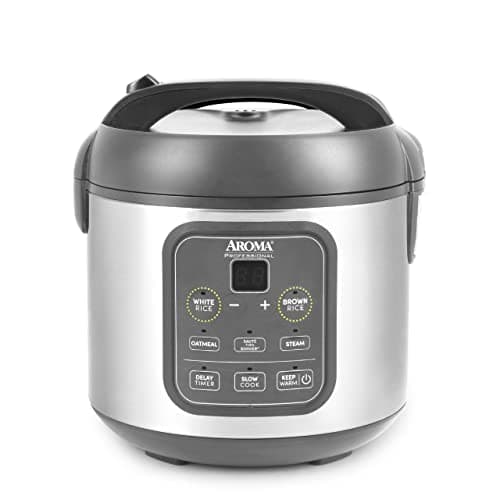
450 W
Aroma Professional ARC-994SG Digital Rice Cooker & Multicooker
The budget pick now, and an honest one. For around forty dollars it cooks white and brown rice, sautés then simmers, slow-cooks for 2 to 10 hours and steams — a genuine little multicooker in a small pot — and Aroma publishes its 450 W draw. What Aroma does not publish is how its 'Sensor Logic' works, and there are only two rice programs, so this is the versatility pick, not the rice-quality one.
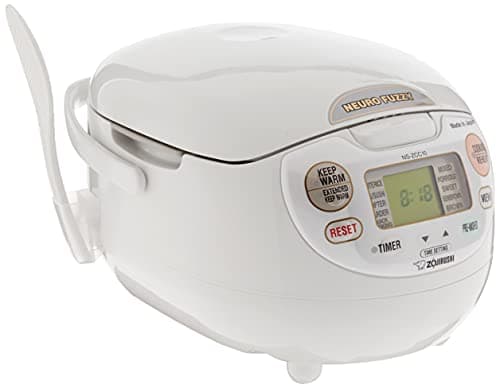
680 W
Zojirushi NS-ZCC10 Neuro Fuzzy Rice Cooker & Warmer, 5.5 Cup
The rice cooker every other one is measured against. Its Neuro Fuzzy microcomputer adjusts heat through the cook rather than running a fixed timer, which is the whole reason a $260 rice cooker cooks rice better than a $30 one. Made in Japan, 680 W, and the settings that matter are all there.
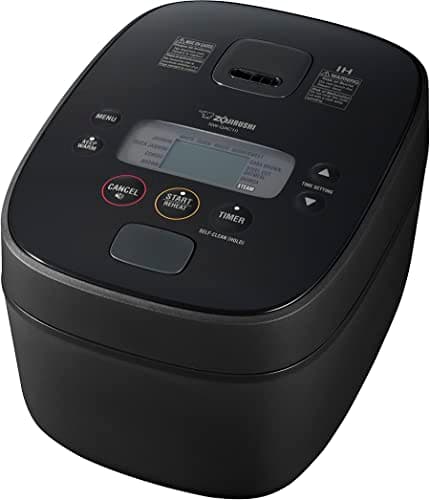
1,080 W
Zojirushi NW-QAC10 Induction Rice Cooker & Warmer, 5.5 Cup
Zojirushi's in-stock 5.5-cup induction cooker, and the one we now point daily rice eaters at. Whole-pot induction heating, made in Japan, in a flat-top body that is smaller than the NP-HCC10 it replaces and draws 1,080 W rather than 1,230. The trade is documentation: Zojirushi does not publish a triple heater for this one, and the pan is nonstick-coated rather than left unstated.
#ad · As an Amazon Associate we earn from qualifying purchases.
Questions
Frequently asked
Do rice cookers use a lot of electricity?
How many watts does a rice cooker use?
Does the Keep Warm function use a lot of electricity?
Is a rice cooker cheaper to run than cooking rice on the stove?
Why do you compute at full rated draw if that is not what happens?
Does an induction rice cooker cost much more to run?
Keep reading
Related
- Are electric pressure cookers cheap to run?The same arithmetic for the multicooker hub.
- Is it safe to leave rice in a rice cooker?The real reason to come off Keep Warm.
- Induction vs fuzzy logic rice cookersWhat the extra 550 watts actually buys.
- Rice cooker vs stovetopWhat the appliance is really competing with.
Receipts
Sources
- Aroma Housewares — ARC-994SG Digital Rice & Grain Multicooker product page (Overview & Specs)
- Zojirushi — NS-ZCC10 Neuro Fuzzy Rice Cooker product page
- Zojirushi — NP-HCC10 Induction Heating Rice Cooker product page
- Zojirushi — NS-TSC10 Micom Rice Cooker product page
- Tiger Corporation (USA) — JAX-T10U rice cooker product page
- Cuckoo CRP-P0609S series manual (specification page)
- Cuckoo CR-0631F series manual (specification page)
- US Energy Information Administration — Electric Power Monthly, Table 5.3 (average residential price)
- US EIA — How much electricity does an American home use? (FAQ)
We have not tested these machines in a lab and we do not pretend to have. Specifications come from the manufacturer's own published documents; electricity rates come from the US Energy Information Administration; prices come from the live Amazon API. Where a figure is not published, the page says “not published” rather than guessing. Read the full method.