The short answer
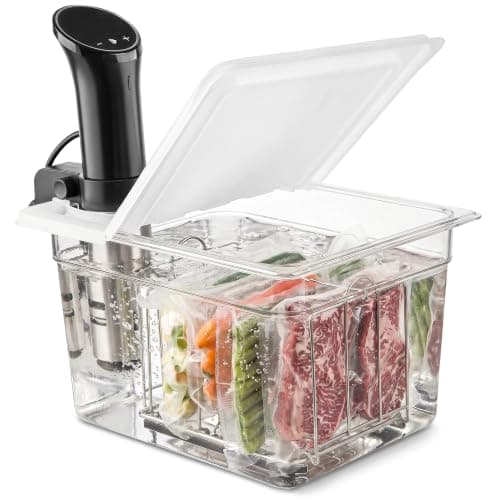
Buy the EVERIE 12-quart kit if you want one box that works. It is the only container here that arrives with the universal collapsible hinged lid and the rack included, and the lid is cut for clip-on circulators rather than being a flat cover you have to notch with a knife. The cost of that convenience is documentation: EVERIE has no manufacturer website, so there is no published material and no temperature rating for it anywhere. Buy the LIPAVI C20if you cook at volume — 24 liters is the largest bath on this page and LIPAVI is the only maker here that publishes liters, quarts and external millimetres for every size it sells, plus the caveat the others leave out: nominal capacity is not usable water volume. Its rack and lid are both extra. Buy the Cambro 12SFSCWif you want a tub whose specification you can read before you buy: 12 quarts of clear Camwear polycarbonate, NSF Listed, published from −40°F to 210°F. The Rubbermaid Commercial 12-quartis the cheapest thing on this page worth owning, and the only one whose maker uses the words “great for sous vide cooking” — but at 7.75 inches it is also the shallowest, which is the wrong end of the trade on a long cook.
Why the container is not an accessory
A circulator does one job: hold water at a set point and move it around. Every spec sheet in the category is about the first half of that sentence — rated power, accuracy to a tenth of a degree, temperature range. The vessel decides the second half, and it decides three failure modes that no amount of accuracy fixes.
- Bags stack, and stacked bags cook unevenly. Water has to move between bags for the bath to be one temperature. A tall, narrow vessel makes bags lie on top of each other; the machine happily reports the right number at its own sensor while the bag in the middle of the pile sits cooler. Width is what fixes this, and a rack is what fixes it properly.
- An open bath evaporates, and evaporation ends the cook. Every circulator has a minimum water line, and below it the machine stops. Over an eight- or twenty-hour cook an uncovered bath can lose enough water to cross that line, which is why the lid is not a nicety. The Wancle publishes a 4.5 cm minimum water depth — a figure worth knowing against the depth of whatever you are filling.
- Volume is a power problem. Water takes a fixed amount of energy to heat. A 24-liter bath takes roughly twice as long to come up as a 12-liter one and costs correspondingly more to hold, so a big tub paired with a small machine is the worst of both. We work that arithmetic out in how much electricity a sous vide uses.
None of those three is on a circulator's box, and all three are decided by the thing you probably have not thought about.
How we ranked them
Lid and rack inclusion first, because a bare tub plus a matching lid plus a rack routinely costs more than a kit and only works if all three fit your machine. Then usable depth and footprint — width for bags, height against the minimum and maximum water lines. Then published material and temperature rating, which is where a commercial foodservice container pulls ahead of a consumer one. Then price, last. As everywhere on this site, we have not cooked in any of these: every figure comes from the manufacturer's own page, cited on each card, and where a maker publishes nothing the card says so instead of filling the gap. The full rubric is in our methodology. Prices move, so we do not print them in prose; the live price sits on each card.
One thing we deliberately do not score: insulation. None of the four makers publishes a thermal figure, and an insulating sleeve or a few strips of neoprene is an aftermarket purchase on all of them. A container's heat loss is real — it is why a cover matters — but ranking four tubs on a number nobody publishes would be inventing evidence.
The specs that decide it, side by side
The gaps in this table are as informative as the entries. Two of the four makers publish a temperature rating; two do not. One includes the lid and rack; three do not.
| Container | Capacity | Lid / rack | Published material | Published temperature range |
|---|
| EVERIE 12 qt kit | 12 quarts | Both included | Not published | Not published |
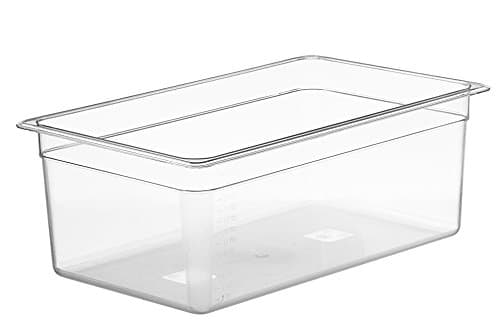
| LIPAVI C20 | 24 L (26 qt) nominal | Both sold separately | Temperature-resistant polycarbonate | Not published as a range |
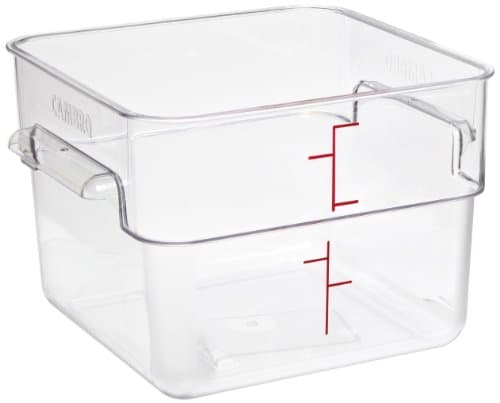
| Cambro 12SFSCW | 12 qt (11.4 L) | Cover separate, no rack | Camwear clear polycarbonate | −40°F to 210°F |
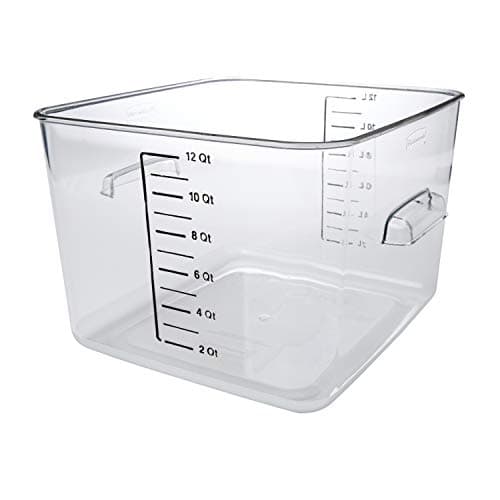
| Rubbermaid Commercial | 12 quarts | Lid separate, no rack | Polycarbonate | −40°F to 212°F |
Read the right-hand column against the hottest thing sous vide asks for. Nothing on this site cooks above 100°C, and most circulators cap well below it — Wancle's published ceiling is 90°C (194°F). A tub rated to 210°F or 212°F has real headroom. A tub with no published rating is not necessarily worse plastic; it is a tub whose maker has not told you.
Size: the number people get wrong in both directions
Bags need to sit side by side without touching, with water able to move around them, so the practical rule is that a bath holds comfortably about half what it looks like it should. A 12-quart container handles roughly six to eight steak-sized bags laid out properly — which is why 12 quarts is the size three of the four picks here are, and why it suits most households.
Going bigger is a real decision rather than a free upgrade. The LIPAVI C20 holds twice as much water, which means twice the heat-up time, more electricity to hold, a 530 mm footprint on the worktop and a full bath far too heavy to carry to the sink. It earns that if you genuinely cook for a crowd, and the circulators that can drive a bath that size are a shorter list than the full catalog. If the honest answer is “occasionally eight portions”, two 12-quart tubs and two cheap circulators beat one big setup: two temperatures, half the single-point-of-failure risk, and both of them fit in a cupboard.
Going smaller rarely works. A stockpot is the vessel everyone starts with and the one that causes the stacking problem in the first place, because depth without width is exactly the wrong shape. If you only ever cook two portions, a small wide container is better than a tall narrow one of the same volume.
The lid is the part that decides whether a long cook finishes
A circulator's minimum water line is a shutdown threshold, not a suggestion. On a 2-hour steak nothing you do about evaporation matters. On an overnight cook, or the kind of 48-hour brisket that long unattended cooksinvolve, an uncovered wide bath can drop below that line and switch the machine off with the food in it — and the food has then spent hours in cooling water, which is a safety problem and not just a ruined dinner.
There are three honest ways to deal with this and only one of them is a product on this page. A matched lid with a cut-out for your machine is the clean fix, and the EVERIE kit is the only pick that includes one. A flat foodservice cover plus foil or plastic wrap over the circulator gap works and looks like what it is. Ping-pong balls floating on the surface are the classic hack and do genuinely cut evaporation. What does not work is a tight lid with no vent at all, which traps steam against the control head.
LIPAVI is worth reading carefully here because it is the only maker that publishes fitment: its universal lids fit cylindrical circulators up to 70 mm in diameter, and machine-specific custom-cut lids are made separately. That is the sort of detail you want before you buy a lid, not after — and it is the reason a “universal” lid is not universal if your machine has an unusual body.
Racks: the cheapest thing that fixes the most common mistake
A rack holds bags upright and apart so water can move between them. Without one, bags in a square tub lean against each other and against the walls, and the parts that touch are the parts that lag. This is the single most common cause of “my sous vide was uneven” and it has nothing to do with the machine.
Only the EVERIE kit includes one. LIPAVI sells matched racks by part number for every container size it makes (the C20 takes the N20X or the L20), which is more thought than any other brand here has given the problem. The Cambro and the Rubbermaid include nothing, so budget for a rack or use the low-tech version: bag clips on the rim, or binder clips, or simply fewer bags at a time.
Material, NSF listings and what “food safe” actually tells you
All four of these are polycarbonate where a material is published at all, which is the standard clear food-storage plastic: rigid, see-through, dishwasher safe and rated well past any sous vide temperature. Cambro and Rubbermaid both publish a range that goes above boiling. LIPAVI describes its material as temperature-resistant polycarbonate without printing a range. EVERIE publishes nothing at all, which does not mean the plastic is bad — it means you are taking the retailer's word for it.
The Cambro's NSF listing is the one piece of third-party evidence on this page. NSF listing is a commercial-kitchen requirement, not a sous vide one, and it does not certify anything about hot-water immersion specifically. But it is a standard somebody else checked, which is a different class of claim from a consumer listing that says “food safe” about itself. If you care about that distinction, the same reasoning runs through our non-toxic rice cooker page, which takes the makers' own documents rather than their marketing.
What you do not need to buy
A dedicated sous vide container is a genuine improvement and a small one. If you are new to this, cook in the biggest pot you own for a month first — you will learn whether the stacking problem bites you, how long your cooks actually run, and therefore which of the four columns in the table above you should be shopping on. Plenty of people cook sous vide happily forever in a stockpot with a lid balanced on top.
You also do not need a vacuum sealer to use any of these. The water-displacement method works with a zip bag and costs nothing, and we are clear in can you use Ziploc bags for sous vide about where its limits are. If you have decided to buy one anyway, the machines are ranked in the best vacuum sealers for sous vide, which is the other half of this page.
Choosing in one minute
You want to start cooking out of one box. EVERIE. The lid and the rack are the parts people under-buy, and it has both. Accept that nothing about its material is published.
You cook for six or more regularly.LIPAVI C20, plus the matching rack and lid, plus a circulator with the power to drive 24 liters. Budget for all three.
You want to know exactly what you bought.Cambro. NSF Listed, Camwear polycarbonate, a published range from −40°F to 210°F, and a cover you buy separately.
You want the cheapest thing that is not a mistake. Rubbermaid Commercial, and keep your cooks under about eight hours or cover it properly, because it is the shallowest here.
The three mistakes
Buying tall instead of wide. A 12-quart vessel in the wrong proportions stacks bags and undoes everything the circulator is doing. Skipping the lid. Evaporation is what ends long cooks, and the shutdown is abrupt. And over-buying volume: a bath you fill twice a year costs you heat-up time and electricity every other time you cook.