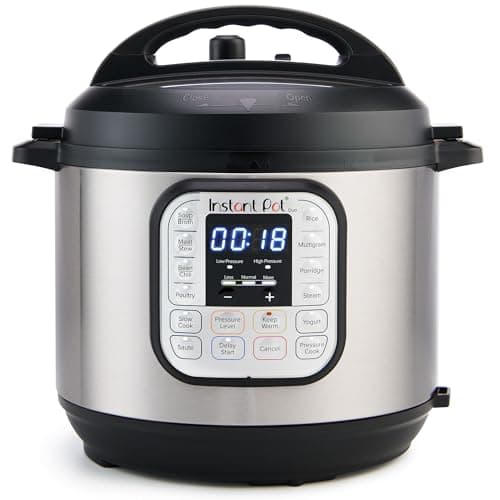
Why this is still the default
The Instant Pot Duo is the machine that turned “electric pressure cooker” into a household word, and the reason it remains our overall multicooker pick is not nostalgia. Instant Brands publishes the full specification for it — a 1,000 W rated draw, a 6 quart capacity, and, unusually, a working-pressure range of 10.2–11.6 psi on the IP-DUO60 manual — and it pairs that with an 18/8 stainless inner pot rather than a coating that will scratch off. Most of the field cannot match that documentation, and almost none of it does so while costing less.
What the seven functions really are
The “7-in-1” badge covers pressure cook, slow cook, sauté, rice, steam, yogurt and keep-warm, expressed through 13 one-touch programs. That is fewer than the sticker-count leaders that advertise nine, ten or thirteen functions — but most of those extra numbers are the same heating element run at a different set point, not a genuinely new capability. The Duo does the jobs a pressure cooker is bought for: dried beans in under an hour with no soak, a pot roast in a fraction of the oven time, rice while the main cooks elsewhere. The stainless pot browns properly on Sauté before you seal, which the sear-then-pressure workflow depends on.
The two things it leaves out
There is no sous vide program and no air-fry lid, and both omissions are by design rather than oversight. Reaching for a Duo and then wishing it did sous vide is the most common Instant Pot regret, which is why we say plainly: if either matters to you, this is not your model. The Pro adds a real sous vide program; the Duo Crisp adds crisping. The other honest limitation is the steam release — a manual toggle you flip yourself, not the quiet auto-sealing release of the pricier models. Forget it on Venting and the pot simply will not come to pressure, the single most common first-week mistake.
Build and documentation
This is where the Duo quietly beats cookers that cost more. The 18/8 stainless, tri-ply-base inner pot has no nonstick layer to fail, so it outlives the coated pots in machines two price tiers up. Instant Brands publishes the wattage on the product page and confirms it, along with the working pressure, in the manual — the complete set. On this site's Documentation metric, which scores whether a manufacturer will tell you what its cooker draws at all, the Duo rates among the highest of any multicooker, and that is a claim you can verify yourself against the linked sources rather than take on faith.
Duo vs the models above it
If you are cross-shopping, the honest ladder is short. The Prois the Duo's mechanicals with the interface fixed — sous vide, an auto-sealing lid and five programmable buttons — and it cooks identically, so you are paying for convenience, not better food. The Duo Plus splits the difference with sous vide and a quieter release. The Duo Crisp adds air frying under one lid. The full range is mapped in which Instant Pot to buy; the point of this review is that none of those upgrades makes the rice, beans or roast come out better than the Duo already does.
Who should skip it
Skip the Duo if you specifically want sous vide, a quieter steam release, or an air-fry finish — it has none of those, and the model in the range that does each one is a better buy for you than a Duo you will outgrow in a month. Buy the Duo if you want the most proven, best-documented and cheapest genuinely good multicooker on the counter, and you are happy to flip the valve yourself. For most kitchens, that is exactly the right trade. See where it ranks against the budget field.
How we picked
Machines we claim to have tested: 0
Everyone in this category tells you they tested twenty cookers. We have tested none, and we say so. Here is what we do instead: read the manufacturer's manual and spec page, record the published wattage, capacity, pressure or temperature figure and warranty term, work out what the machine costs to run per hour, show the arithmetic so you can redo it with your own electricity rate, and cite all of it. Where a brand publishes no wattage, we print no running cost rather than borrowing a number from a similar model. Prices come live from Amazon's API and disappear rather than go stale.
The scores above are judgments from that documented research — not test results. One of the five metrics is Documentation: whether the manufacturer will tell you what its cooker draws at all. The full rubric, including what disqualifies a pick, is published in full.