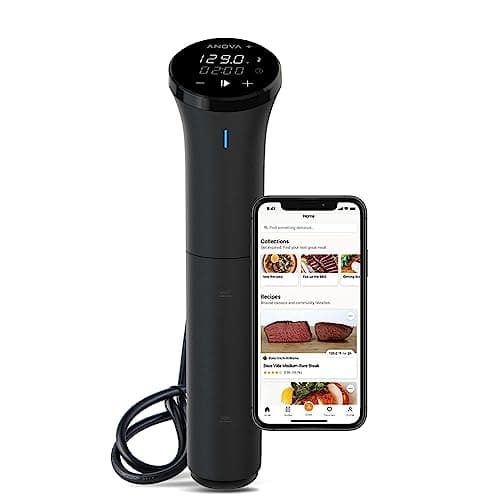
The small Anova, and the sensible entry point
The Anova Precision Cooker Nano is the pick for most people who want Anova's build and app without the full model's size or price. It is a slimmer, lighter circulator rated at 850 W rather than the flagship's 1,100, and the current 3.0 generation adds WiFiwhere the old Nano was Bluetooth-only — a real fix, because it means you can start and monitor a cook from another room. For a single steak or a couple of portions in a normal pot, it is all the circulator most home cooks actually need, and it is the natural pick in our best budget sous vide lineup.
What the lower power does — and doesn't — change
The headline difference from the full Precision Cooker 3.0 is power: 850 W and a 7 L/min pump against 1,100 W and 8 L/min. What that changes is how fast it heats a large, deep bathand how much water it can keep evenly circulated — cook big batches in a tall stockpot and the full model pulls ahead. What it does not change is the thing that matters most: the Nano holds the same ±0.1°C accuracy and the same 0–92°C range as the flagship. Once a bath is up to temperature, a steak does not know whether an 850 W or an 1,100 W element got it there. The lower power costs you heat-up speed at scale, not precision.
The specification, in full
This is where Anova always earns its place: it publishes the complete spec. The Nano lists 850 W, a 0–92°C (32–197°F) range, ±0.1°C accuracy, a 7 L/min pump and dual-band WiFi, all on Anova's own product page — which is more than almost any rival in this price class manages, and it is why the Nano scores near the top of our Documentation metric. On a precision device, a manufacturer that will simply tell you the accuracy and range is telling you it has nothing to hide. One small note we follow openly: some third-party retailers list the Nano at 800 W, but Anova's own page says 850, and we follow the manufacturer's figure.
The warranty, and the price quirk
The Nano carries Anova's two-year warranty— the longest of any sous vide machine on this site, and identical to the full model's, so choosing the small Anova does not mean choosing less coverage. The one genuine quirk is stock: at our last price check the Nano had no live Amazon price, which usually signals intermittent availability, so the buy button shows “check price” rather than a number. That is worth knowing before you set your heart on it — the Nano comes and goes, and when it is out, the Inkbird or Monoprice are the fallback value picks.
Who should skip it
Skip the Nano if you regularly cook big batches in a large, deep container— there the full Precision Cooker 3.0's extra power and pump flow genuinely earn the difference. Skip it, too, if you want the absolute cheapest way to try the technique regardless of brand — the Monoprice undercuts it. But buy the Nano if you want Anova's accuracy, app, WiFi and two-year warranty for the least money, and you mostly cook normal, everyday portions — for that buyer it is the smarter spend than the full model, giving up only the heat-up speed you would not miss. See where it lands in the best sous vide machines, or weigh it directly in Anova Precision vs Nano.
How we picked
Machines we claim to have tested: 0
Everyone in this category tells you they tested twenty cookers. We have tested none, and we say so. Here is what we do instead: read the manufacturer's manual and spec page, record the published wattage, capacity, pressure or temperature figure and warranty term, work out what the machine costs to run per hour, show the arithmetic so you can redo it with your own electricity rate, and cite all of it. Where a brand publishes no wattage, we print no running cost rather than borrowing a number from a similar model. Prices come live from Amazon's API and disappear rather than go stale.
The scores above are judgments from that documented research — not test results. One of the five metrics is Documentation: whether the manufacturer will tell you what its cooker draws at all. The full rubric, including what disqualifies a pick, is published in full.