HUB 03 · Sous Vide
Sous Vide vs Boiling
They look like the same thing - food, water, heat - and they are opposites. Boiling cooks with water far hotter than any target doneness and races the food past it. Sous vide sets the water to the target and lets the food stop there. Here is what that changes, and the cases where boiling is still the right call.
We earn a commission if you buy through our links. It does not change the price you pay, and it does not decide our picks — the scoring rubric is published in full, including what disqualifies a pick. How this works.
The short answer
Boiling cooks food with water that is far hotter than anything you want to eat; sous vide sets the water to exactly the temperature you want the food to finish at. Boiling water is 212 °F (100 °C), fixed by physics at sea level. A medium-rare steak is about 130 °F, a chicken breast is safe and still juicy around 150 °F, an egg yolk sets in the sixties. In boiling water, food is sprinting past every one of those marks and your only control is when you pull it out. In a sous vide bath, the food cannot go past the target, because there is nothing hotter than the target in the pot. The same physics explains the second difference: the food is sealed in a bag, so flavour and juices stay with it instead of dissolving into the water.
The giveaway: most circulators cannot boil water
If you want one fact that settles whether these are variations on the same method, it is this: several of the machines in our catalog physically cannot bring water to the boil, and their makers publish it. Anova states a range of 0–92 °C for both the Precision Cooker 3.0 and the Nano. Wancle publishes 25–90 °C. Inkbird reaches 99 °C and stops a degree short.
Those ceilings are not cost-cutting. They are an accurate statement of what the device is for. Nothing in our temperature guide asks for more than about 85 °C — vegetables, the hottest thing anyone actually does in a bath, sit at 83–85 — so a circulator is built for the band below boiling and a kettle is built for boiling. They barely overlap.
What boiling does to food, mechanically
Three things, all consequences of the water being hotter than the target.
It overshoots the outside to get the inside done. Heat moves inward from the surface, so the only way to bring a thick piece of meat to 130 °F in the middle with 212 °F water is to take the outer layers well past it. That is the grey band on a pan-cooked steak and the stringy outside of a boiled chicken breast. In a 130 °F bath the gradient flattens: given enough time the whole piece arrives at 130 and sits there, edge to centre.
It leaches. Water is a solvent, and boiling food naked in it moves soluble flavour compounds, salts and some vitamins out of the food and into the water. That is the entire point when the water is the product — stock, broth, a court-bouillon — and a straight loss when it is not. Sealing the food in a bag, which is all “sous vide” literally means, keeps that material in contact with the food.
It agitates. A rolling boil is violent. It is why boiled fish falls apart, why boiled eggs crack, and why delicate things are poached rather than boiled in the first place.
Sous vide is not "boil in a bag"
The phrase comes up a lot and it is worth separating. Boil-in-a-bag puts sealed food in boiling water: you get the sealing benefit — nothing leaches out — and none of the temperature benefit, because the water is still 100 °C and the food is still racing past its target. It is a convenience format, not a cooking technique.
Sous vide is the bag plus the controlled temperature, and the temperature is the half that changes the result. Which is also why the no-machine method works at all: a pot of water held at the right temperature with a thermometer and an occasional splash from the kettle gets you most of the way there, badly and with a lot of attention. The circulator is a device for holding a temperature, not for holding a bag.
The temperatures, side by side
| Food | Sous vide bath | Boiling water | What the gap does |
|---|---|---|---|
| Steak, medium-rare | ~130 °F (54 °C) | 212 °F | 82 °F of overshoot — the grey band |
| Chicken breast | ~150 °F (66 °C) | 212 °F | Fibres contract and squeeze out moisture |
| Salmon | ~122–130 °F | 212 °F | Albumin squeezes out as white curd |
| Egg, jammy yolk | ~145 °F (63 °C) | 212 °F | Timing becomes the only control |
| Vegetables | ~183–185 °F | 212 °F | The one case where the gap is small |
| Pasta, rice, stock | Not a sous vide job | 212 °F | Boiling is correct — see below |
Read the right-hand column as one idea: the bigger the gap between the target and 212 °F, the more sous vide changes the outcome. That is why steak and salmon are the method's showpieces and vegetables are where people shrug — at 185 °F you are nearly boiling anyway. Our steak, salmon and egg pages have the set points and times, and the vegetable page is honest about the shrug.
Where boiling is simply the right method
This is not a page arguing that one technique replaces the other, and the cases where boiling wins are not edge cases — they are most of what happens in a kitchen.
When the water is the product. Stock, broth and soup exist because water leaches: you want the flavour out of the bones and into the liquid. Sealing that in a bag would defeat the entire exercise, which is why bone broth is a pressure-cooker job and not a sous vide one.
When the food needs water to cook at all. Dried pasta, rice, pulses and grains need to absorb water and they need near-boiling heat to gelatinize their starch. A 55 °C bath will not cook rice, which is the whole reason this site has a separate rice cooker section.
When speed matters more than precision. Blanching green beans, cooking a weeknight egg, reheating something: boiling is instant and sous vide is an hour minimum. Nobody should set a circulator for broccoli on a Tuesday.
The safety point, because the water is cooler
Sous vide does not rely on heat high enough to kill pathogens on contact; it relies on time and temperature together. Holding chicken at 150 °F for long enough pasteurizes it as surely as a brief trip to 165 °F, and the USDA addresses exactly this combination. Our is sous vide safe page works through the guidance in full, and it is genuinely worth reading before you cook poultry in a bath.
The corollary is that sous vide has less margin for carelessness than boiling does. Boiling is forgiving because 212 °F is so far above anything that survives; a 130 °F bath is not, so the time matters and the set point matters. That is the real trade behind the better texture, and it is also why overnight cooks and cooking from frozen have their own pages rather than a line in this one.
So which, for what
Sous vide for anything where the finish temperature is the point and the gap to boiling is large: steak, lamb, pork chops, salmon, chicken breast, eggs, and the long tough cuts where hours at a set temperature do something no other method does. Boiling for starches, for stock, for blanching and for speed. They are complementary tools and almost nobody needs to choose.
If you are deciding whether to own a circulator at all, is sous vide worth it is the honest page and the main roundup is where the machines get ranked. If you want to understand the method before spending anything, what sous vide is starts from the beginning.
The hardware
The cookers this page is about
The cookers referred to above, with prices pulled live from Amazon and dated on every card. Full rankings live in the roundups linked from this page.
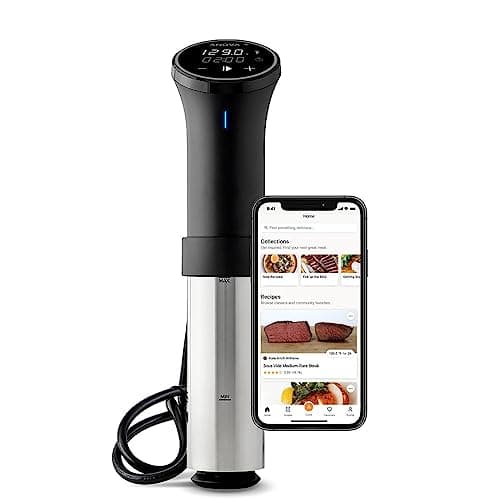
1,100 W
Anova Precision Cooker 3.0 (WiFi), 1100 W
The sous vide circulator most people should buy. Anova publishes the full specification — 1,100 W, a 0–92°C range, ±0.1°C accuracy, an 8 L/min pump — and backs it with a two-year warranty, the longest here. It has an on-device screen so it works without the app, which the Joule does not.
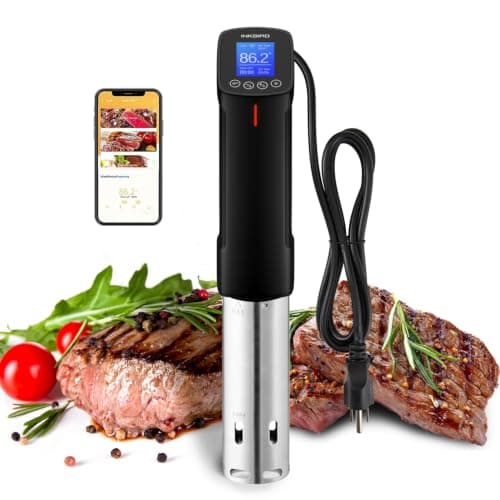
1,000 W
Inkbird ISV-100W WiFi Sous Vide, 1000 W
The value pick that does not feel like one. Under $100, and Inkbird still publishes the full specification: 1,000 W, a 25–99°C range, ±0.1°C accuracy, 15 L capacity, WiFi and an on-device dot-matrix screen. It undercuts the Anova by more than half and gives up remarkably little on paper.
#ad · As an Amazon Associate we earn from qualifying purchases.
Questions
Frequently asked
What is the difference between sous vide and boiling?
Can a sous vide machine boil water?
Is sous vide the same as boil in a bag?
Why does boiled chicken go dry when sous vide chicken does not?
When is boiling better than sous vide?
Is sous vide safe if the water is cooler than boiling?
Keep reading
Related
Receipts
Sources
- Anova Culinary — Precision Cooker 3.0 product page
- Inkbird — ISV-100W WiFi Sous Vide product page
- Wancle — 820 sous vide cooker (1100 W, IPX7) product specification page
- Anova Culinary — Precision Cooker Nano 3.0 product page
- USDA FSIS — cooking safely with time and temperature (pasteurization basics)
- USDA Food Safety and Inspection Service — safe minimum internal cooking temperatures
We have not tested these machines in a lab and we do not pretend to have. Specifications come from the manufacturer's own published documents; electricity rates come from the US Energy Information Administration; prices come from the live Amazon API. Where a figure is not published, the page says “not published” rather than guessing. Read the full method.