Skip to content
DD

HUB 04 · Buying Guides

Rice Cooker vs Instant Pot

An Instant Pot cooks rice; a rice cooker only cooks rice. So why would anyone buy the rice cooker? Because for the one job they share, the dedicated machine does it better — and for everything else, the multicooker wins. Here is the honest split.

By Stephen V.Updated How we rank
#ad

We earn a commission if you buy through our links. It does not change the price you pay, and it does not decide our picks — the scoring rubric is published in full, including what disqualifies a pick. How this works.

The short answer

Quick picks

#CookerBest forScorePrice
011,000 W
8.6
$104.04Amazon
02680 W
8.1
$265.96Amazon

#ad · Prices pulled live from the Amazon Product API, last checked Jul 21, 2026. Where we have no verified live price we show none — we would rather leave a gap than print a number that has gone stale. The wattage column is what the manufacturer publishes; “not published” means exactly that, and we have not estimated one. Scores are ours, compiled from published specifications, and are not test results.

They are not really competing

An Instant Pot pressure-cooks, slow-cooks, sautés, steams and yes, cooks rice. A rice cooker cooks rice, and holds it warm, and that is essentially all. So the versatility question has an obvious answer — the Instant Pot does far more. The real question is narrower: for rice specifically, is the dedicated cooker enough better to justify a second appliance?

For rice, the rice cooker wins — but by how much depends

A good fuzzy-logic rice cooker adjusts the heat through the cook and produces more even, better-textured rice than an Instant Pot's rice program, which is a fixed pressure cycle. The gap is real but it is a matter of degree: the Instant Pot makes perfectly good rice for most people, and the Zojirushi makes excellent rice for people who notice. If you eat rice a few times a week, the Instant Pot's rice is fine. If you eat it daily and care, the rice cooker earns its place on the counter.

The keep-warm difference nobody mentions

A rice cooker is built to hold rice at a perfect serving texture for hours without drying it out or turning it gummy — that is a genuinely refined function on a Zojirushi. An Instant Pot keeps food warm but is not tuned for rice specifically, so rice held long in one can dry at the edges. For a household that cooks rice in the morning and eats it through the day, this alone can justify the dedicated cooker.

The decision rule

Buy just the Instant Pot if you want one versatile machine and eat rice occasionally — its rice is good enough and it does everything else too. Add a rice cooker if you eat rice most days, cook specialty rice (sushi, brown, mixed), or want it held perfectly warm for hours. Buy just the rice cooker only if rice is genuinely most of what you cook and you do not want a pressure cooker. For many kitchens the honest answer is an Instant Pot now and a rice cooker later, if the rice matters.

In detail

The picks, in full

01
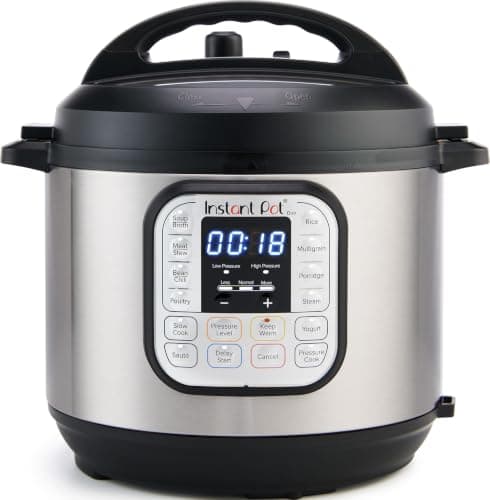
Instant Pot Instant Pot Duo 7-in-1 Electric Pressure Cooker, 6 Quart

The one to buy if you are not sure

Instant Pot Duo 7-in-1 Electric Pressure Cooker, 6 Quart

Stainless inner potWattage & pressure published
8.6/10

The multicooker that made the category, and still the right default. Instant Brands publishes the wattage, the working pressure range and a stainless (not nonstick) inner pot, which is more than most of the field manages — and it costs less than almost all of them.

Capability
7.5
Capacity
8
Documentation
9.5
Build
8.5
Value
9.5

What it gets right

  • Instant Brands publishes the wattage, the working-pressure range and the pot material — the full set, which most of the field does not
  • The 18/8 stainless inner pot has no coating to scratch off, so it outlives the nonstick pots in cookers costing more
  • At the current price it is the cheapest genuinely well-documented multicooker on this site

What it doesn't

  • No sous vide or air-fry program — this is the plain pressure-and-slow-cook model, by design
  • The steam release is a manual toggle, not the quiet auto-release of the Duo Plus or Pro
  • Seven functions is fewer than the sticker-count leaders, though most of those are the same element at different set points

What it costs to run

About 18.8¢ an hour at full rated draw, at the US average of 18.83¢ per kWh.

1,000 W ÷ 1000 × 1 h × 18.83¢ = 18.8¢

1000 W at 120 V / 60 Hz, published on the Instant Pot Duo product page and confirmed on the IP-DUO60 manual specification page. This is an upper bound: the element only draws full power while it is heating up or pressurizing, then cycles off to hold temperature, and no manufacturer publishes a duty cycle — so we compute at full rated draw rather than invent a correction factor. The full method is published.

Skip this if…

you specifically want sous vide, a quieter steam release, or an air-fry lid — the Duo has none of those, and reaching for it and then wishing it did more is the most common Instant Pot regret. Step up to the Pro or Duo Crisp instead.

$104.04on Amazon

$109.995% off

Price last checked Jul 21, 2026. Prices move constantly — Amazon's at checkout is the one that counts.

#ad · we may earn a commission from this link to Instant Pot Duo 7-in-1 Electric Pressure Cooker, 6 Quart

02
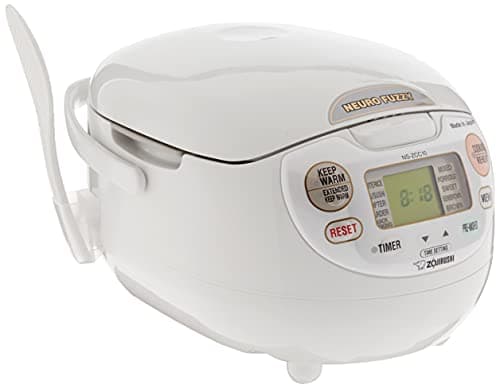
Zojirushi Zojirushi NS-ZCC10 Neuro Fuzzy Rice Cooker & Warmer, 5.5 Cup

The benchmark fuzzy-logic rice cooker

Zojirushi NS-ZCC10 Neuro Fuzzy Rice Cooker & Warmer, 5.5 Cup

Made in JapanFuzzy-logic heat control
8.1/10

The rice cooker every other one is measured against. Its Neuro Fuzzy microcomputer adjusts heat through the cook rather than running a fixed timer, which is the whole reason a $260 rice cooker cooks rice better than a $30 one. Made in Japan, 680 W, and the settings that matter are all there.

Capability
8.5
Capacity
7.5
Documentation
9
Build
8
Value
7.5

What it gets right

  • Neuro Fuzzy logic adjusts the heat during the cook, which is what actually separates good rice from timer-and-hope rice
  • Zojirushi publishes the wattage, the capacity and the origin plainly — and it is genuinely made in Japan
  • The settings people actually use are all present: white, sushi, softer, harder, mixed, porridge, brown, rinse-free

What it doesn't

  • It is a Micom cooker, not induction — the NP-HCC10 heats the whole pot electromagnetically and cooks marginally better, for a lot more money
  • At this price you are paying for the logic, not the build; the pot and body are ordinary
  • The retro 1990s styling has not changed in years and looks it

What it costs to run

About 12.8¢ an hour at full rated draw, at the US average of 18.83¢ per kWh.

680 W ÷ 1000 × 1 h × 18.83¢ = 12.8¢

680 W at 120 V, published on Zojirushi's own NS-ZCC10 product page. This is an upper bound: the element only draws full power while it is heating up or pressurizing, then cycles off to hold temperature, and no manufacturer publishes a duty cycle — so we compute at full rated draw rather than invent a correction factor. The full method is published.

Skip this if…

you eat rice most days and want the genuine best — then the induction NP-HCC10 is the upgrade, not this. Or if you cook rice a couple of times a week and $260 feels steep for the job, a budget Aroma does 80% of it for a sixth of the price.

$265.96on Amazon

Price last checked Jul 21, 2026. Prices move constantly — Amazon's at checkout is the one that counts.

#ad · we may earn a commission from this link to Zojirushi NS-ZCC10 Neuro Fuzzy Rice Cooker & Warmer, 5.5 Cup

How we picked

Machines we claim to have tested: 0

Everyone in this category tells you they tested twenty cookers. We have tested none, and we say so. Here is what we do instead: read the manufacturer's manual and spec page, record the published wattage, capacity, pressure or temperature figure and warranty term, work out what the machine costs to run per hour, show the arithmetic so you can redo it with your own electricity rate, and cite all of it. Where a brand publishes no wattage, we print no running cost rather than borrowing a number from a similar model. Prices come live from Amazon's API and disappear rather than go stale.

The scores above are judgments from that documented research — not test results. One of the five metrics is Documentation: whether the manufacturer will tell you what its cooker draws at all. The full rubric, including what disqualifies a pick, is published in full.

Questions

Frequently asked

Can an Instant Pot replace a rice cooker?
For most people, yes — the Instant Pot's rice program makes perfectly good rice and it does far more besides. A dedicated rice cooker makes more even, better-textured rice and holds it warm better, which matters if you eat rice most days or care about texture. For occasional rice, the Instant Pot alone is enough.
Does a rice cooker make better rice than an Instant Pot?
A good fuzzy-logic rice cooker does, yes — it adjusts the heat through the cook for more even, better-textured rice, and it holds rice warm without drying it. The Instant Pot uses a fixed pressure cycle that is good but less refined. The best rice cookers are here.
Do I need both a rice cooker and an Instant Pot?
Only if you eat a lot of rice. The Instant Pot covers pressure cooking, slow cooking and everyday rice in one machine. A dedicated rice cooker is worth adding when rice is a near-daily staple or you want specialty-rice quality and perfect keep-warm — otherwise it is a second appliance doing a job the Instant Pot already does adequately.

Keep reading

Receipts

Sources

We have not tested these machines in a lab and we do not pretend to have. Specifications come from the manufacturer's own published documents; electricity rates come from the US Energy Information Administration; prices come from the live Amazon API. Where a figure is not published, the page says “not published” rather than guessing. Read the full method.