The short answer
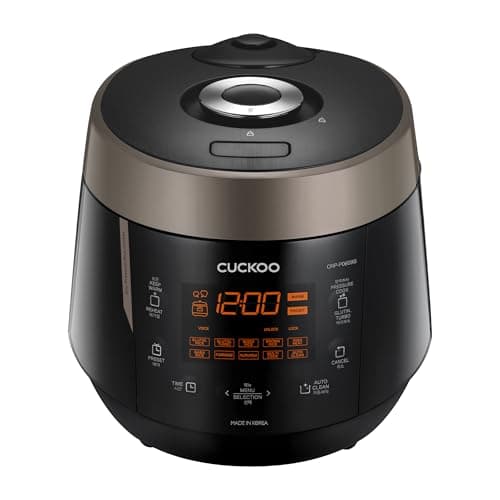
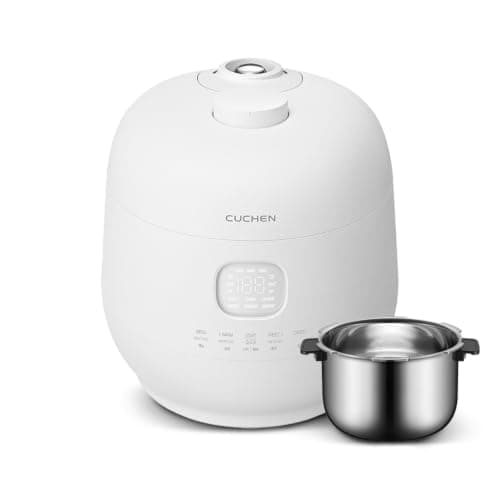
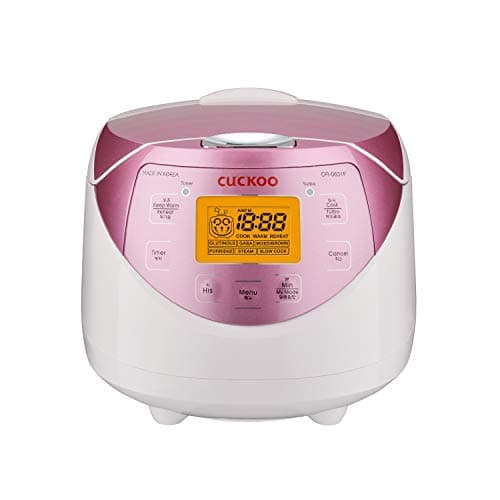
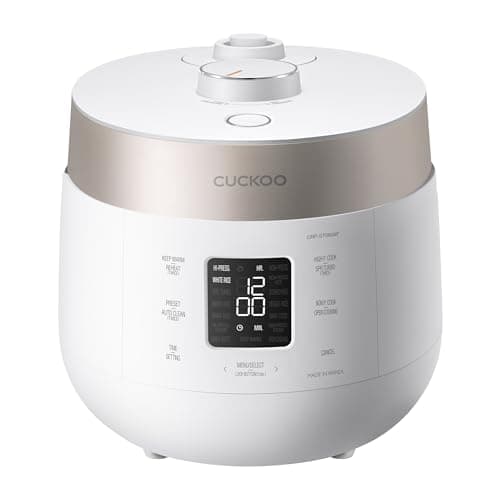
Buy the Cuckoo CRP-ST0609F Twin Pressure. It is the only cooker here that does both jobs: a high-pressure side at a published 78.4 kPa (0.8 kgf/cm²)for short-grain and mixed rice, and a genuine non-pressure mode for the long-grain and vegetable rice that pressure turns gluey. 880 W, and Cuckoo publishes a complete specification for it — including the awkward part, which is that the six-cup capacity applies to plain white rice only. Buy the CRP-P0609Sif you only ever want the pressure texture: same category, 890 W, a 304-stainless-backed pot, and less money than the Twin Pressure because it leaves out the half you would not use. Buy the Cuchen CRH-TWS0610PWUSif an uncoated cooking surface matters to you more than price — it is the only rice cooker on this entire site whose maker states the inner pot has no coating on it, and it is also the most expensive machine in our rice-cooker catalog by a wide margin. The Cuckoo CR-0631Fis the Korean build without the pressure mechanism at all: 580 W, the cheapest to run of any full-size cooker we cover, and deliberately not the machine this page is about.
What makes a Korean rice cooker Korean
Pressure. That is genuinely the answer, and it is worth being precise about why it changes the rice.
Water boils at 100°C at sea level, and a conventional rice cooker — Japanese, American, induction, fuzzy-logic, any of them — cooks rice in water at or just below that temperature. Seal the lid and raise the internal pressure and the boiling point goes up with it. Cuckoo publishes 78.4 kPa of working pressure for its pressure models, which is roughly 0.8 atmospheres above ambient, and water in that pot boils meaningfully hotter than 100°C. Hotter water gelatinizes starch faster and more completely, and the result on the plate is a grain that is chewier, glossier and more cohesive — the texture Korean rice is supposed to have, and the texture a Japanese cooker cannot produce because it is not trying to.
That is also the reason the category is not universally better. Pressure suits short-grain and sticky rice, mixed grains and the GABA germinated-brown programs Korean makers build in. It is the wrong treatment for basmati and jasmine, where the goal is separate dry grains and extra cohesion is a defect — which is why our basmati ranking promotes a non-pressure Zojirushi and demotes the pressure Cuckoo that wins the general roundup. If your rice is mostly long-grain, a Korean cooker is the wrong purchase however good it is.
How we ranked them
Published working pressure first, because it is the category's defining mechanism and two of these four machines have it. Then whether that pressure can be switched off, which is what turns a specialist into a cooker you can use for everything. Then inner-pot surface, where this group now contains the only uncoated pot on the site. Then real per-program capacity — not the number on the box. Then documentation and warranty, and price last.
As everywhere here, we have cooked rice in none of these machines. Every figure comes from the manufacturer's own manual or product page, cited on each card, and every pick carries a real disqualifying con. Where a maker publishes nothing — Cuchen publishes no wattage for the CRH-TWS anywhere we could reach — the card prints nothing rather than borrowing a number from a comparable cooker. The full rubric is in our methodology. Prices move, so we do not print them in prose; the live price sits on each card.
The specs that decide it, side by side
| Cooker | Published power | Working pressure | Pressure off? | Inner pot |
|---|
| Cuckoo CRP-ST0609F | 880 W | 78.4 kPa (0.8 kgf/cm²) | Yes — non-pressure mode | Nonstick coating |
| Cuckoo CRP-P0609S | 890 W | Pressure + fuzzy logic | No | 304 stainless + nonstick |
| Cuchen CRH-TWS0610PWUS | Not published | Dual high / non-pressure | Yes | Stainless, uncoated |
| Cuckoo CR-0631F | 580 W | None — Micom only | n/a | Nonstick coating |
Two gaps in that table are worth naming rather than glossing. Cuchen publishes no wattage for the CRH-TWS, so there is no running-cost figure on its card; the watt numbers floating around retail listings for it disagree with one another, and we are not going to pick one. And Cuckoo publishes 78.4 kPa for the Twin Pressure in its manual but states the CRP-P0609S's pressure only as “heating pressure + fuzzy logic” on the product page we cite, so the two are not directly comparable on that number even though they are the same brand.
The four-cup problem, which nobody mentions
This is the single most useful thing on this page, and it comes straight out of Cuckoo's own specification table rather than from anyone's opinion.
The CRP-ST0609F is sold as a six-cup cooker, and it is — on the plain White Riceprogram, where Cuckoo publishes 1–6 cups (0.18–1.08 liters). On High Heat White Rice, Super Turbo White Rice, Mixed Rice and GABA Rice, the published capacity is 1–4 cups. In other words, the programs that are the reason to buy a pressure cooker hold two thirds of what the headline number suggests.
That matters practically. A Korean household cooking mixed multigrain rice for four people is using the program capped at four cups, not the one rated for six. If you are sizing a cooker for a family, size it on the program you will actually use — which is the same argument we make at more length in what size rice cooker to buy. It also explains why Korean makers sell 10-cup versions of cookers that would seem enormous for the stated household size.
The uncoated pot, and a correction
Until this page existed, this site said flatly that not one rice cooker we cover has a bare cooking surface. That was true when we wrote it and it is now false, because of the Cuchen.
Cuchen's own English user manual for the CRH-TWS line states that “The Stainless inner pot is uncoated”, documents that the product offers an interchangeable stainless pot and coated pot, and then spends most of a page on what uncoated stainless does in practice: mineral deposits from food leave water stains and rainbow-colored spots, which Cuchen says are harmless, and which you remove with a stainless-specific detergent or with vinegar or lemon juice. That is an unusually honest piece of manufacturer documentation and it is also a fair warning. Uncoated stainless is the surface that does not wear out and the surface that sticks.
We have updated the non-toxic rice cooker page in the same release so it no longer makes a claim this page disproves. If a coating-free cooking surface is the thing you came looking for, the Cuchen is the answer and the price is the catch.
Cuckoo against Cuchen, and what you are paying for
Cuckoo is the brand most people mean by “Korean rice cooker” and the one with the broader US presence: three of the four picks here are Cuckoos, its manuals are thorough, and its US service structure is documented in them by region. Cuchen is the other major Korean maker, sells a narrower range here, and its US documentation is noticeably thinner — one combined manual covering two product lines, with no specification table, no published wattage and no dimensions we could verify.
That is a real difference and it is reflected in the scores. But Cuchen brings two things Cuckoo does not at this level: the uncoated pot, and induction heating, which drives the pot itself rather than a plate underneath it. Induction is the same mechanism that puts Zojirushi's NW-QAC10 at the top of our general ranking, and pairing it with pressure is a genuinely premium combination. Whether it is worth more than double the CRP-P0609S is a judgement about how much you care about the pot.
Should you buy Korean at all?
Three honest reasons not to.
Your rice is long-grain.Pressure's advantage is smallest on basmati and jasmine and its disadvantage — extra cohesion — is most visible there. A good fuzzy-logic or induction cooker matches or beats a pressure cooker on those grains.
You want the simplest possible machine.A pressure lid is a sealing gasket, a pressure weight and a locking mechanism, all of which are wear parts and all of which need cleaning after cooking. Cuckoo's manual is explicit that the double-motion pressure packing needs periodic replacement to keep its seal. The CR-0631F exists precisely for people who do not want any of that, and our Cuckoo pressure-versus-Micom comparison is the long version of that decision.
You already own a multicooker. An Instant Pot cooks rice adequately under pressure, and if your household eats rice twice a week rather than twice a day a second appliance is hard to justify. We argue both sides in do you need a rice cooker if you have an Instant Pot.
If none of those applies — if you eat short-grain or mixed rice most days and you want the texture a Korean cooker makes — then this is one of the few appliance categories where the expensive answer is genuinely a different result rather than a nicer version of the same one.
Living with one: voice guides, cleaning and the things that surprise people
Korean cookers talk. Every Cuckoo here has a voice guide, the Cuchen has one in multiple languages, and announcements for “cooking has started” and “steam is being released” are not to everyone's taste. They can be muted on all of them, and it is the single most common complaint from first-time buyers.
They also need cleaning in more places than a plain cooker does. A pressure lid has a steam cap, a pressure weight, a pressure control nozzle and a packing ring, and Cuckoo's manual tells you to clean the packing, the top heater plate and the inner pot after any cook involving mixed or sticky rice. Both Cuckoo pressure models and the Cuchen have an automatic cleaning or steam-clean cycle for exactly this, and using it is not optional if you want the seal to last. The general version of this is in how to clean a rice cooker.
And they are slow to come up to pressure, which is a different clock from a Micom cooker. If you want rice in twenty minutes the Super Turbo program exists on the Twin Pressure — at four cups maximum, as above. Our timings page, how long a rice cooker takes, sets out what to expect from each type.
One more thing about that four-cup cap: the programs it applies to are Mixed Rice and GABA, which is a bigger deal if a grain mix is your weekly pot rather than an occasional one. The best rice cookers for mixed grains ranks the whole field on that published limit, and on which makers name a multigrain cycle in their own documents at all.