What matters in a dorm or first apartment
A student kitchen is defined by what it does not have: counter space, storage, a big budget, and often much more than a single outlet and a shared microwave. So the best cooker for a college student is not the most capable one — it is the one that does the most jobs in the smallest footprint for the least money, and that you can actually run under your building's rules. Versatility per square inch is the whole game: one small appliance that replaces several is worth more in a dorm than any single specialist. These three are the picks that earn their spot on a crowded shelf, ranked for a student who has one shot at one cooker.
How we ranked them
We ranked on footprint and affordability first — small enough to store, cheap enough to buy on a student budget — then on how much one appliance can do, because in a dorm the machine that replaces three others wins. Documentation and live price break the ties. Every pick is a genuine recommendation, chosen here specifically for a dorm room or a tiny first apartment. Where a manufacturer publishes no wattage or a price is intermittent, we say so plainly. The full rubric is in our methodology, and if space rather than the student setting is your real constraint, the best cookers for small kitchens roundup covers the same ground for any cramped kitchen.
Check your dorm's appliance policy before you buy. Many residence halls ban appliances with open or exposed heating elements — hot plates, coil burners, some toasters — while allowing enclosed, self-contained countertop cookers. An enclosed multicooker or rice cooker heats its own sealed pot with nothing glowing and exposed, which is usually the safer bet under those rules than a bare hot plate. Rules vary by school, so read your specific housing policy and, if it is ambiguous, ask your residence staff before spending.
1. Instant Pot Duo Mini — a whole kitchen in one 3-quart pot
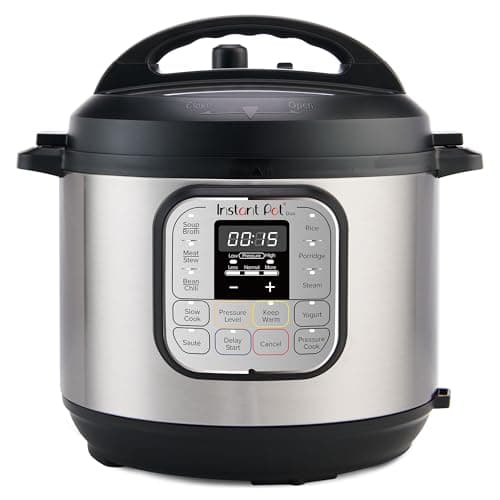
For a student, the Instant Pot Duo Mini is the most appliance for the least space, and it is the clear number one. It is the Duo shrunk to 3 quarts— the right size for one person or a couple of roommates — with the same 7-in-1 function set as the full-size model: it pressure-cooks, slow-cooks, sautés, steams, makes rice and yogurt, all from one enclosed pot on an 18/8 stainless inner pot with no coating to scratch away. That versatility is the whole argument in a dorm: one box replaces a rice cooker, a steamer, a small slow cooker and more, so it earns its single slot of shelf space several times over. At 700 W it is the lowest-draw Instant Poton this site, and small and light enough to live in a cupboard between uses. Its enclosed, self-contained design — a sealed pot heated from within, nothing exposed and glowing — is also the kind of appliance more likely to pass a dorm appliance rule that bans open heating elements like a hot plate, though you should always confirm against your own building's policy. The honest con: three quarts is a hard ceiling — it cooks for one or two, not a hall of friends, and doubling a recipe means two rounds — and the tight interior makes searing in batches fiddly. But for a student cooking for themselves or splitting meals with one roommate, that ceiling is rarely the real limit, and no other single appliance here does as much in as little space — one pot that is dinner one night, a side the next, breakfast oats and a batch of hard-boiled eggs on other days is exactly the kind of do-everything machine a dorm rewards. It is the pick we would hand a student first, and the one most likely to still be in use by senior year.
2. Toshiba Mini — the simplest good rice for one
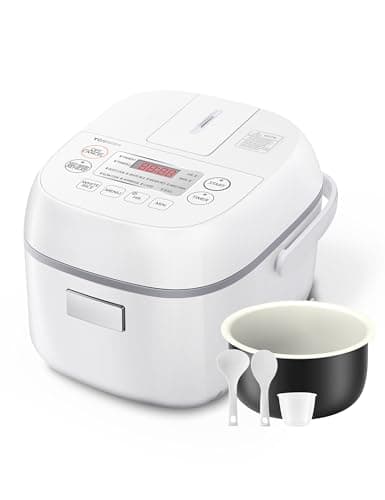
If rice, grains and one-pot rice bowls are the core of how you actually eat, a dedicated rice cooker is one-touch cooking at its simplest, and the Toshiba Mini is the compact pick. It is a 3-cup cooker that, unusually for something this small, still uses fuzzy logic — it senses and adjusts the heat rather than running a dumb on/off timer, which most cheap minis drop — so you add rice and water, press one button, and it handles the rest, with a 24-hour delay timer so rice is ready when you get back from class. It is small, light, affordable and about as foolproof as a cooker gets, which is exactly what a first rice cooker in a dorm should be. The honest con: it is genuinely small, so like the Duo Mini it cooks for one or two and not a group, and Toshiba does not publish a wattagefor this mini SKU that we could verify, so we show no running-cost figure for it — do not confuse it with Toshiba's larger 6-cup models. It also does one job where the Duo Mini does several, which is why it sits at number two: pick it if rice specifically is your priority and you want the simplest possible path to good rice, and pick the Duo Mini if you want one appliance to do everything. Where it shines is the student whose default dinner is a rice bowl — rice plus whatever protein and vegetables land on top — because it makes the base of that meal genuinely well and asks nothing of you but water and the press of a button. As a second small appliance beside a microwave, it also spares you ever babysitting a pot of rice on a shared stovetop you may not even have.
3. Monoprice Strata — the cheapest way to try sous vide
Sous vide sounds like a chef's technique and is actually one of the most forgiving ways to cook a single perfect steak, chicken breast or batch of eggs in a dorm — you heat water in any pot you already own, drop the food in a sealed bag, set a temperature and walk away, and it is genuinely hard to overcook. The Monoprice Strata is the low-stakes way in: the cheapest circulator on this site, with simple physical controls, an 800 W element, and a clever directional pump cap that helps with delicate first cooks like fish and eggs. For a student it clips onto a stockpot and disappears into a drawer afterward, taking almost no permanent space. The honest con: it quotes ±1% temperature stabilityrather than the tighter ±0.1°C of the pricier machines, which matters on long, low cooks, and Monoprice does not publish a warranty term in the manual — it is the try-it-first circulator, not the keep-it-forever one. But at this price, finding out whether sous vide fits your student cooking costs almost nothing, and it needs no dedicated counter space at all. For a student it is also the most quietly impressive thing you can cook for friends on a budget — a steak or salmon that comes out the same every time — for the price of the cheapest gadget in the category. Just know going in that it is a single-technique tool, not a do-everything cooker like the Duo Mini, so it is the third pick precisely because it does one thing rather than many.
Power draw and the outlets you actually have
A dorm rarely gives you the wiring a real kitchen has. You are often sharing one circuit with a roommate's mini-fridge, a microwave and whatever is plugged into a single overloaded power strip, and you have no say in what the building can take before a breaker trips. That makes a cooker's power draw a practical concern rather than a spec-sheet footnote. Among these picks, the Duo Mini is the lowest-draw Instant Pot on this site at 700 W, the Monoprice sous vide draws 800 W, and Toshiba does not publish a wattage for the mini rice cooker at all, so we cannot quote one for it. A lower draw is gentler on a shared circuit and less likely to trip a breaker than a hungry countertop unit or a bare hot plate running full tilt, and it is one more reason a small, enclosed cooker tends to fit dorm life — and dorm rules — better than a big, power-hungry appliance. None of this replaces reading your building's policy, but it is worth weighing alongside footprint and price when a single outlet is doing the work of a whole kitchen.
What a single small cooker realistically makes
It helps to be honest about the cooking a dorm actually supports, because it is what makes the “one versatile machine” argument concrete. With the Duo Mini alone, a week of real meals is within reach: a one-pot pasta or a small chili on Monday, steamed vegetables and rice as sides through the week, oatmeal or a batch of hard-boiled eggs for breakfasts, a soup that reheats for lunches, a pot of beans or lentils that stretches across several dinners. None of that needs a stovetop, an oven or more than a single outlet, and none of it is fussy — it is mostly add-ingredients, press a button, come back. The Toshiba Mini narrows that to the one thing a lot of students eat most, rice and rice bowls, and does it with even less effort. The Monoprice adds a trick the others cannot match — a genuinely restaurant-quality piece of protein — but only that. The reason we rank them the way we do is that versatility per square inch is what a dorm rewards, and the more of your week one machine can quietly cover, the more it earns a place on a shelf that has no room for three.
Which cooker for which student
Pick by how you actually eat in your room. If you want one appliance to do everything — rice one night, a small stew the next, steamed vegetables, a fast bowl of something from dried beans — the Instant Pot Duo Mini is the answer, because in a dorm the machine that replaces three others is worth more than any specialist, and its 3-quart size and 700 W draw fit a student setup. If rice and rice bowls are your staple and you want the simplest, most foolproof one-touch result, the Toshiba Mini does that one job beautifully in a smaller, cheaper package — just remember it is a rice cooker, not a whole kitchen. And if you are curious about sous vide and want to cook a restaurant-quality single portion with near-zero risk of ruining it, the Monoprice Stratais the cheapest way to try, and it stores in a drawer. For most students, the Duo Mini is the one-cooker answer; add the Toshiba only if you eat enough rice to want a dedicated pot, or the Monoprice only if precise proteins are your thing. Whatever you choose, confirm it against your building's appliance rules first, and if pure space rather than the student budget is the driver, the small-kitchen roundup and the beginner roundup both overlap heavily with these picks. One last piece of student-specific advice: buy the machine you will genuinely use, not the most impressive one on the shelf, because a cooker that lives in a closet is worse than no cooker at all. For most students that machine is the Duo Mini, and everything else here is an addition to it rather than a replacement for it. Prices are pulled live from Amazon and dated on each card.