The short answer
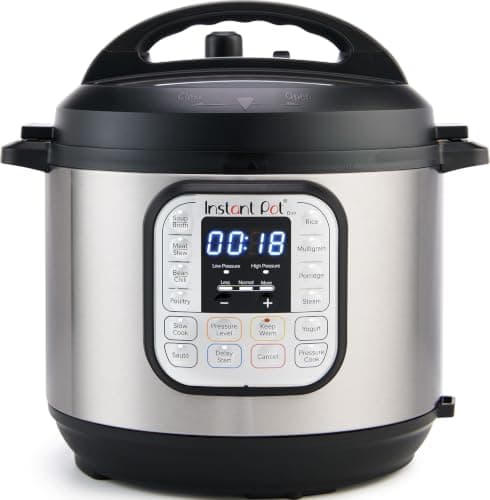
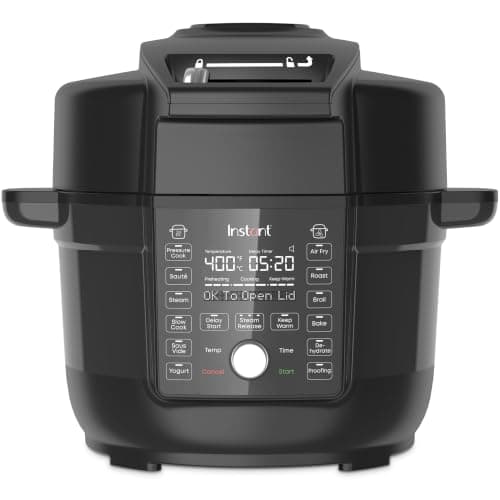
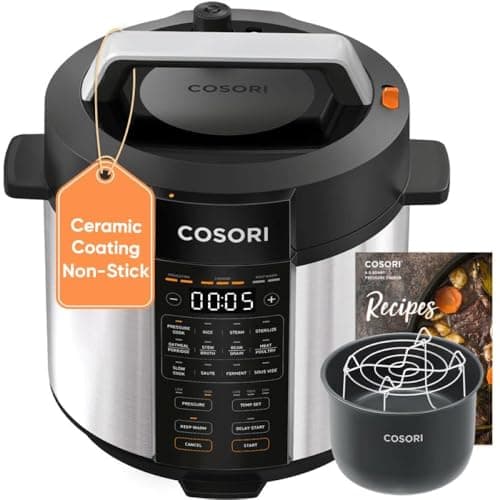
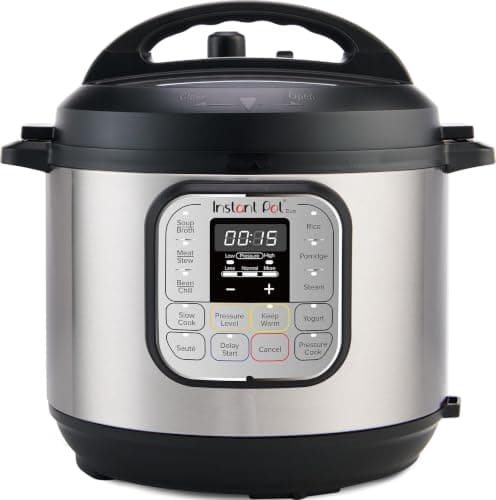
Buy the 3-quart Instant Pot Duo Mini if you cook for one or two. Instant Brands publishes its external size as 10 in × 11.4 in × 11.2 inand its draw as 700 W — the only cooker here that will stand under a wall cabinet and go back in one, and the lightest load on a kitchen circuit that is probably already carrying a microwave. If two of you cook properly and keep leftovers, the 6-quart Instant Pot Duo is the step up that still fits: 13.4 in long, 12.5 in tall, 1,000 W, and the cheapest fully-documented cooker on this site. If the plan is to own one appliance instead of two, the Duo Crisp Ultimate Lid pressurizes and air-fries under a single lid — a real space argument, paid for with the biggest body here (15.5 in × 15.4 in) and 1,500 W. The Cosori 6-quart is the non-Instant-Pot alternative, and the cheapest way to get a published working-pressure range — on a coated pot rather than bare stainless.
Why an apartment ranks this field differently
Every general multicooker roundup, including our own, ranks on what the machine does: functions, working pressure, pot material, documentation. None of that changes in a small apartment. What changes is that four other constraints become binding, and three of them are physical facts the manufacturer publishes rather than matters of taste.
- Where it lives when you are not using it.A galley kitchen has about two feet of usable counter, and most of it is the only place you can chop. A machine that has to stay out is a machine that costs you your prep space, so the real question is whether it goes in a cabinet — and standard US wall cabinets sit about 18 inches above the counter, which turns height into a hard gate rather than a preference.
- Where the steam goes. A quick release fires a column of steam upward for the better part of a minute. Plenty of apartments have a recirculating hood that vents nowhere, or no hood at all. This is the constraint nobody writes about and the one renters notice first, because steam under a cabinet becomes condensation on the cabinet.
- What the circuit is already carrying.Older apartment kitchens routinely put several countertop outlets on one 15 A branch circuit, which is roughly 1,800 W of continuous headroom in total. A 1,500 W cooker on the same circuit as a 1,000 W microwave is a tripped breaker waiting for a bad moment. A 700 W cooker is not.
- Whether it lets you not buy something else.In a small kitchen every appliance has to justify its volume against the others. A multicooker that genuinely replaces a rice cooker and a slow cooker is doing three machines' work in one footprint — which is the entire reason this category exists, and it matters far more at 400 square feet than at 2,000.
The footprint table
These are the external dimensions and rated power Instant Brands publishes on each product page, reproduced rather than measured. The Duo Mini page prints its figures in inches explicitly; the Duo, RIO and Duo Crisp spec tables give the same three numbers with no unit stated, and we read them as inches on that basis. Cosori does not publish external dimensions for its 6-quart at all, so its row says so — we are not going to estimate a number that decides whether a machine fits a cabinet.
Published external size and rated draw. Dimensions are each manufacturer's own figures; the capacity column is usable cooking volume, not body size.| Cooker | Published size (L × W × H) | Rated draw | Capacity |
|---|
| Instant Pot Duo Mini | 11.4 × 10 × 11.2 in | 700 W | 3.0 Quart |
|---|
| Instant Pot Duo 6 Qt | 13.4 × 12.2 × 12.5 | 1,000 W | 6 Qt / 5.7 L |
|---|
| Instant Pot RIO 6 Qt | 12.13 × 13.82 × 12.6 | 1,000 W | 6.0 Quart |
|---|
| Instant Pot Duo Crisp Ultimate Lid | 15.5 × 15.4 × 13.4 | 1,500 W | 6.5 Qt / 6.2 L |
|---|
| Cosori 6-Quart | Not published | 1,100 W | 6.0 qt / 5.7 L |
|---|
Read down the height column and the decision mostly makes itself. The Mini is the only one of the five under a foot tall, and its 10-inch width is narrower than most dinner plates — it goes in a cabinet, which is the difference between owning a pressure cooker and living with one. The 6-quart Duo at 12.5 inches stands under a standard wall cabinet with room to open the lid in front of it, and it is the size most renters settle on. The Duo Crisp is a different class of object: at 15.5 by 15.4 inches it takes roughly the footprint of a dinner plate and a half, and the Ultimate Lid is attached hardware you do not get to store elsewhere.
One number that is notin that table, because the manufacturers do not publish it, is the clearance you need above the valve. Every one of these cookers vents straight up. Whatever the body height is, add room for a plume — which in practice means you pressure-cook with the machine pulled forward onto the counter, not tucked under the cabinet where it lives.
The 3-quart question, answered honestly
A 3-quart cooker is not a 6-quart cooker with less in it. The pressure max-fill line is two-thirds of the pot, and half for anything that foams — beans, grains, pasta, split peas. So the Mini's real working volume is about two quarts for a stew and about a quart and a half for beans. That is two generous portions, or two portions and a lunch. It is genuinely enough for one person, or for a couple who cook most nights. It is genuinely not enough to batch-cook, to make stock, or to host.
The flip side is the one nobody mentions: a small pot comes up to pressure faster, because there is less water to heat. Most of the wall-clock time in a pressure recipe is pre-heating rather than cooking, and the Mini spends less of it — which on a weeknight is a more noticeable difference than any function on the panel. What size Instant Pot to buy works the sizing through in full, and the Duo Mini against the Duo is the head-to-head if you are stuck between exactly these two.
If you are cooking for one, the best cookers for one personis worth reading as well — it covers the case where a rice cooker, not a pressure cooker, is the machine that earns the counter space.
The circuit, and why wattage is not only a running cost
On most of this site, wattage is an efficiency question — what an electric pressure cooker costs to run does that arithmetic, and the answer is pennies per meal whichever model you buy, because the element only works hard while the pot comes up to pressure. In an apartment the number does a second job: it tells you whether the machine can share a circuit with the kettle.
The spread here is wide, and every figure is the manufacturer's own. The Duo Mini draws 700 W, the Duo and the RIO 1,000 W, the Cosori 1,100 W, and the Duo Crisp 1,500 W. A 15-amp branch circuit at 120 V gives roughly 1,800 W of continuous headroom, and apartment kitchens are where several counter outlets most often share one. Nothing here is unsafe — a 1,500 W cooker is an ordinary countertop appliance. But if your toaster and microwave already trip the breaker when they run together, the 1,500 W machine is the one that will make that worse and the 700 W one is the one that will not.
The one-appliance-instead-of-three argument
This is where the Duo Crisp earns its footprint back, if it earns it at all. The Ultimate Lid pressurizes and air-fries without swapping hardware, so it occupies the volume of one machine while doing the job of two — and an air fryer is the single most common second appliance in a small kitchen. If you do not already own one, the combo is a smaller total footprint than a Duo plus a basket fryer, and the best multicookers with an air fryer covers that field properly. If you already own an air fryer you like, the argument evaporates and you are paying a premium for a function you have. Instant Brands' own instructions also have you remove a hot protective cover from the air-fry element when you switch from pressure to crisping, which is an oven-mitt step mid-recipe in a kitchen with nowhere to put a hot part down.
The same logic applies downward. All four picks here slow-cook and all four cook rice, so a multicooker in an apartment can legitimately be the reason you do not buy a slow cooker or a rice cooker. How well it does the rice half is a genuine argument — rice cooker versus Instant Pot takes it seriously, and the honest summary is that a multicooker makes good rice and a dedicated fuzzy-logic cooker makes better rice. In a kitchen with one spare cabinet shelf, good is usually the right trade.
Steam, condensation and thin walls
Two practical notes that only matter in a small space. First, release method: a natural release vents almost nothing and takes fifteen to twenty-five minutes, while a quick release is immediate, loud, and sends up a sustained plume. Natural versus quick release covers which recipes need which, but in an apartment the useful habit is to choose natural release wherever the recipe allows it, and to pull the cooker out from under the cabinet before you flip the valve on the recipes that do not.
Second, noise. None of these machines is loud while cooking — a pressure cooker under load is quieter than a kettle. The noises are the beeps and the release. The Duo and Duo Mini both use a manual toggle valve, and Instant Brands' quieter auto-release appears on the Duo Plus and the Instant Pot Prorather than on anything in this list — worth knowing if you cook late in a building with thin walls. Which Instant Pot to buy maps the whole model line if that pushes you up a tier.
If an Instant Pot is not the right answer
Three alternatives deserve a look before you buy one, because the apartment constraint sometimes points somewhere else entirely.
A non-Instant-Pot electric cooker.The Cosori 6-quart is the one on this list, and it is here on merit: it publishes both of its working-pressure bands (9.4–12.3 psi high, 5.1–8 psi low) on its own product page, which not even Instant Brands does, and it carries two years of warranty against Instant Brands' one. Its pot is nonstick-coated rather than bare stainless, which is the reason it places fourth here and not higher — a coating in a pot you will sear in is a wear item. The best budget pressure cookers has the wider cheap-end field.
A stovetop pressure cooker. This is the genuinely underrated apartment answer. A Presto 01362 is a 6-quart stainless pot with a lid: no electronics, no element, no cord, no standby draw. It nests in a cabinet like any other pot, it works on an induction hob, Presto warranties it for twelve years, and it holds higher pressure than any electric cooker here. The price is that you have to stand at the stove and hold the burner steady. The best stovetop pressure cookers and stovetop versus electric are where that trade gets argued out. If storage rather than attention is your binding constraint, this is the pick.
A different machine altogether.If what you actually cook is rice and vegetables, a small rice cooker has a smaller footprint than any pressure cooker and is better at the job — see the best small rice cookers. If it is steak and chicken breast, a sous vide stick stores in a drawer and clamps to a pot you already own, which is the smallest footprint of any cooking appliance we cover — and the cheapest one we rank, the Wancle, costs less than any pressure cooker on this page. The best cookers for small kitchens is the cross-category version of this page, and which kitchen appliance you need is where to start if you have not settled on a category at all.
What we would buy, by household
One person, studio or dorm:the Duo Mini. Three quarts is right, 700 W is kind to the circuit, and it fits in a cabinet. Two people who cook most nights:the 6-quart Duo. The extra three quarts is leftovers and stock, and 12.5 inches still clears a wall cabinet. Two people with no air fryer and no room for one:the Duo Crisp, with eyes open about the footprint and the 1,500 W draw. Anyone who would rather have two years of warranty and a published pressure range than a bare pot: the Cosori. And anyone whose real problem is storage rather than time: a stovetop Presto, which is not an Instant Pot at all and is the honest answer anyway.