HUB 03 · Sous Vide
How Much Electricity Does a Sous Vide Use?
Between 16 and 21 cents an hour at full rated draw - which a circulator only pulls while it is heating the bath, not while it is holding one. The arithmetic is laid out in full here, including the honest version of the long-cook question and the one change that genuinely cuts the number.
We earn a commission if you buy through our links. It does not change the price you pay, and it does not decide our picks — the scoring rubric is published in full, including what disqualifies a pick. How this works.
The short answer
A circulator draws between 850 and 1,100 watts depending on the model, which at the US average residential electricity rate of 18.83¢ per kWh is 16 to 21 cents per hour at full rated draw. A one-hour steak is therefore about 21 cents in the worst case and genuinely less. The number that worries people is the long cook, and here is the honest version: a 48-hour brisket on an 1,100 W machine has a ceiling of about $9.94 — and the real figure is a small fraction of that, because a circulator pulls its rated wattage to bring a bath up to temperature and then idles, topping up the heat the bath loses to the room.
The arithmetic, so you can redo it with your own rate
Running cost is watts ÷ 1,000 × hours × your rate in cents per kWh. An 1,100 W Anova for one hour is 1.1 kWh, and at 18.83¢ that is 20.71¢. Nothing is hidden and nothing is adjusted.
The rate is the US-total average residential price published by the EIA in Electric Power Monthly, held as a single constant across this whole site so no two pages can disagree. Residential rates vary by more than a factor of two across US states, so swap your own figure into the last term — which is why we print the sum rather than only the answer.
Every published draw, and what it costs at the ceiling
| Circulator | Published draw | Per hour | 4-hour cook | 24 hours | 48 hours |
|---|---|---|---|---|---|
| Anova Nano 3.0 | 850 W | 16.0¢ | 64¢ | $3.84 | $7.68 |
| Inkbird ISV-100W | 1,000 W | 18.8¢ | 75¢ | $4.52 | $9.04 |
| Anova Precision Cooker 3.0 | 1,100 W | 20.7¢ | 83¢ | $4.97 | $9.94 |
| Breville Joule Turbo | 1,100 W | 20.7¢ | 83¢ | $4.97 | $9.94 |
| Greater Goods | 1,100 W | 20.7¢ | 83¢ | $4.97 | $9.94 |
| Wancle 820 | 1,100 W | 20.7¢ | 83¢ | $4.97 | $9.94 |
Four of the six machines in our catalog publish exactly 1,100 W, which tells you something about the category: this is a mature design with a settled power budget, and the cheapest circulator here has the same rated element as the most expensive. Wattage is not what you are paying the difference for — the budget roundup is where that gap gets named honestly.
Why the long-cook figures are ceilings, and badly misleading ones
On a 40-minute pressure cook the gap between rated draw and real consumption is modest. On a 48-hour sous vide cook it is enormous, and it is worth understanding the mechanism rather than taking a number on trust.
A circulator does two different jobs over a cook. First it heats the bath, which is the element running flat out: lifting, say, 12 litres of tap water from 20 °C to 55 °C takes a fixed amount of energy no matter how long the cook lasts afterwards. Then it holds the bath, and in that phase the element is only replacing heat leaking out through the walls of the container, the surface of the water and the air above it. A bath at 55 °C in a 20 °C kitchen loses heat slowly, so the element spends most of a long cook switched off.
That means the heating energy is roughly the same for a one-hour steak and a two-day brisket, and only the holding adds up. How much it adds up by, we will not tell you, because it depends on the bath volume, the container, whether it is covered and how cold the room is — and no manufacturer publishes a standby or holding draw. Inventing a percentage and presenting it as a measurement would be the dishonest way to make this page more satisfying. What we can say with confidence is the direction and the bound: the real cost of a 48-hour cook is well under $9.94, and the ceiling is the only figure here that is actually checkable.
The one change that genuinely cuts the number
Cover the bath. Most of the heat a sous vide bath loses leaves through the open water surface, by evaporation and convection, and a lid, a sheet of foil, a layer of ping-pong balls or a cut piece of insulation board stops the majority of it. On a long cook that is the difference between topping the water up twice and not at all, which is the same thing as the difference in energy.
Two secondary levers. Use the smallest container the food fits in, because you pay to heat every litre of water you fill it with and then pay again to keep it warm. And start with hot tap water rather than cold if your set point is above it, which hands the first part of the heating job to a water heater that is usually cheaper per unit of heat than a 1,100 W element — though if you are cooking at 54 °C for a steak, check the tap is not already hotter than the target. Our container guide covers the vessel choice and overnight cooks covers the rest of what a long hold involves.
Against the oven, which is the real comparison
Nobody chooses between a circulator and nothing. The alternative for most of what sous vide does is an oven, and a domestic electric oven's element is typically two to three kilowatts — two or three times a circulator's rated draw — heating a large insulated box full of air rather than a few litres of water. For a long low-temperature cook, the circulator is comfortably the cheaper appliance per hour, and sous vide versus the oven works through the cooking differences.
The same logic across the rest of the site: a high-draw appliance that runs briefly can beat a low-draw one that runs all day, which is the whole argument of the pressure-cooker running-cost page, and the reason a rice cooker that runs most days deserves the look its own page gives it.
The bottom line
A steak costs pennies, a chicken breast costs less than a dollar, and even the two-day cuts have a worst case of about ten dollars against a real cost far below that. Electricity is not a reason to avoid sous vide or to choose between circulators — four of the six machines we cover publish the identical 1,100 W. If you want the number smaller, put a lid on the bath. Where a maker publishes no wattage we publish no cost, and every figure here is watts, hours and a cited rate you can swap for your own. See how we compute every figure.
The hardware
The cookers this page is about
The cookers referred to above, with prices pulled live from Amazon and dated on every card. Full rankings live in the roundups linked from this page.
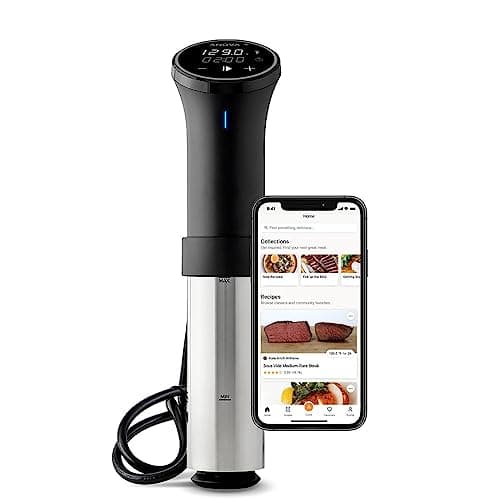
1,100 W
Anova Precision Cooker 3.0 (WiFi), 1100 W
The sous vide circulator most people should buy. Anova publishes the full specification — 1,100 W, a 0–92°C range, ±0.1°C accuracy, an 8 L/min pump — and backs it with a two-year warranty, the longest here. It has an on-device screen so it works without the app, which the Joule does not.
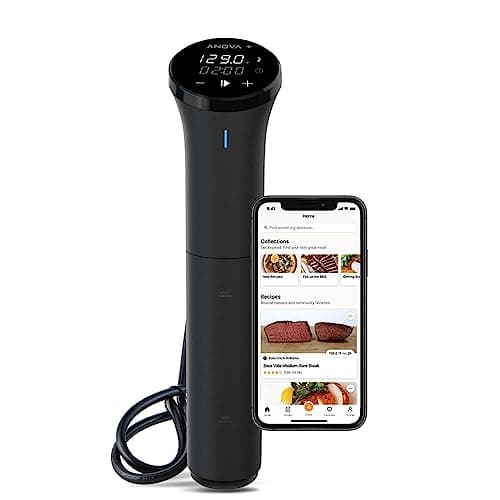
850 W
Anova Precision Cooker Nano 3.0 (WiFi), 850 W
The small Anova, and the sensible entry point. 850 W rather than the full 1,100, in a slimmer, lighter body, now with WiFi where the old Nano was Bluetooth-only. For a single steak or a couple of portions in a modest pot, it is all the circulator most people need — and it carries Anova's two-year warranty.
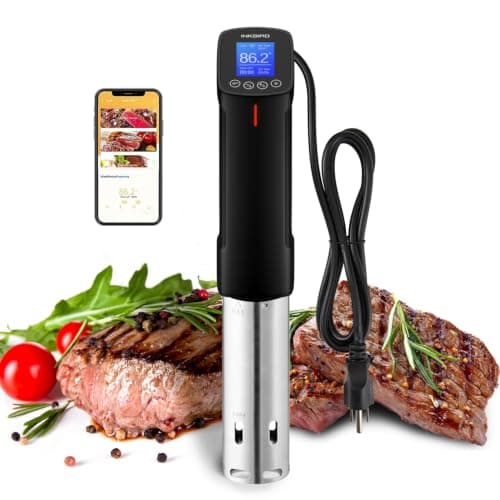
1,000 W
Inkbird ISV-100W WiFi Sous Vide, 1000 W
The value pick that does not feel like one. Under $100, and Inkbird still publishes the full specification: 1,000 W, a 25–99°C range, ±0.1°C accuracy, 15 L capacity, WiFi and an on-device dot-matrix screen. It undercuts the Anova by more than half and gives up remarkably little on paper.
#ad · As an Amazon Associate we earn from qualifying purchases.
Questions
Frequently asked
How much electricity does a sous vide use?
How many watts does a sous vide machine use?
Does a 48-hour sous vide cook cost a lot in electricity?
How do I reduce what a sous vide cook costs to run?
Is sous vide energy efficient compared with an oven?
Why do you publish a ceiling instead of a real figure?
Keep reading
Related
- Are electric pressure cookers cheap to run?The same arithmetic for the multicooker hub.
- Do rice cookers use a lot of electricity?The category where the appliance runs most days.
- Can you sous vide overnight?What a long hold actually involves.
- Sous vide vs the ovenThe appliance it is really competing with.
Receipts
Sources
- Anova Culinary — Precision Cooker 3.0 product page
- Anova Culinary — Precision Cooker Nano 3.0 product page
- Inkbird — ISV-100W WiFi Sous Vide product page
- Breville — Joule (BSV600) safety guide [PDF]
- Wancle — 820 sous vide cooker (1100 W, IPX7) product specification page
- US Energy Information Administration — Electric Power Monthly, Table 5.3 (average residential price)
- US EIA — How much electricity does an American home use? (FAQ)
We have not tested these machines in a lab and we do not pretend to have. Specifications come from the manufacturer's own published documents; electricity rates come from the US Energy Information Administration; prices come from the live Amazon API. Where a figure is not published, the page says “not published” rather than guessing. Read the full method.