Skip to content
DD

HUB 02 · Rice Cookers

The best rice cookers under $200

Two hundred dollars is the interesting ceiling in this category, because it is exactly where the mechanism changes. Under it you can buy pressure, or Japanese fuzzy logic, or Korean build - and you cannot buy induction from Zojirushi, which is the one thing the money above the line is for.

By Stephen V.Updated How we rank
#ad

We earn a commission if you buy through our links. It does not change the price you pay, and it does not decide our picks — the scoring rubric is published in full, including what disqualifies a pick. How this works.

The short answer

Quick picks

#CookerBest forScorePrice
01
Cuckoo Cuckoo CRP-P0609S High-Pressure Rice Cooker, 6 Cup
Cuckoo CRP-P0609S High-Pressure Rice Cooker, 6 Cup

The fluffiest rice, under pressure

890 W
8.1
$199.99Amazon
02641 W
7.9
$184.99Amazon
03
Cuckoo Cuckoo CR-0631F Micom Rice Cooker, 6 Cup
Cuckoo CR-0631F Micom Rice Cooker, 6 Cup

Cuckoo build without the pressure price

580 W
7.8
$149.99Amazon
04
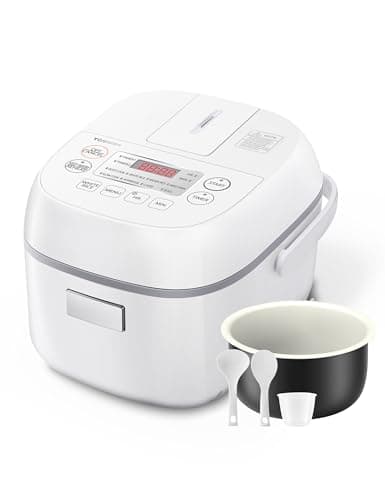
Toshiba Toshiba Mini Rice Cooker, 3 Cups Uncooked, with Fuzzy Logic
Toshiba Mini Rice Cooker, 3 Cups Uncooked, with Fuzzy Logic

One or two people who still want fuzzy logic

Wattage not published
5.9
$94.99Amazon
05
Aroma Housewares Aroma Professional ARC-994SG Digital Rice Cooker & Multicooker
Aroma Professional ARC-994SG Digital Rice Cooker & Multicooker

The cheapest cooker that does more than rice

450 W
6.9
$39.20Amazon

#ad· Prices pulled live from Amazon's official Creators API, last checked November 13, 2026. Where we have no verified live price we show none — we would rather leave a gap than print a number that has gone stale. The wattage column is what the manufacturer publishes; “not published” means exactly that, and we have not estimated one. Scores are ours, compiled from published specifications, and are not test results.

The short answer

Buy the Cuckoo CRP-P0609S. It is the only cooker under this ceiling that cooks rice under pressure, which raises the boiling point inside the pot and produces a chewier, glossier, more cohesive grain than any non-pressure machine can — and at 890 W on a 304-stainless-backed pot it sits a cent under $200 rather than above it. If your rice is mostly long-grain, buy the Tiger JAX-T10U instead: made in Japan, 641 W, ten auto-cook menus and the tacook plate that cooks a dish above the rice at the same time. Pressure is the wrong treatment for basmati and jasmine, and this is the page's one real fork. The budget pick is the Aroma ARC-994SG— 450 W, documented White Rice and Brown Rice programs and a sauté-then-simmer function, for a small fraction of everything else here. It is not as good at rice and we will not pretend otherwise.

Every cooker ranked below was under $200 when our price layer last refreshed, and the Quick Picks table above carries that date. Prices move daily, so the table is the authority rather than this sentence.

What the ceiling excludes, and whether you should care

This is the part most under-$N pages leave out, so: at $200 you cannot buy a Zojirushi. Not the NS-ZCC10 Neuro Fuzzy, not the NS-TSC10 Micom, and certainly not the induction NW-QAC10, which is roughly double the ceiling. The whole Zojirushi range sits above this line in our catalog.

What that costs you, honestly, is induction heating— driving the pot itself electromagnetically rather than heating a plate underneath it — and Zojirushi's Neuro Fuzzy heat control, which is the benchmark every other fuzzy-logic cooker is measured against. Both are real advantages and both are incremental. Neither is the difference between bad rice and good rice; they are the difference between very good rice and excellent rice, and we say the same thing in are expensive rice cookers worth it.

What the ceiling does not cost you is mechanism. Pressure is available under $200 and induction is not, and pressure changes the grain more dramatically than induction does. If you eat short-grain rice most days, the cooker under this ceiling is arguably the more interesting machine.

How we ranked

Heating mechanism first. Pressure, then fuzzy logic with a published heat strategy, then plain micom, then a sensor-logic machine with two rice programs. That ordering is not a preference; it is the order in which the published mechanism changes the cooked grain.

Documentation second. A cooker whose maker publishes wattage, capacity, pot material and origin beats one that publishes two of the four. That is how our method works across this whole site, and in the rice category it separates the field more than price does.

Then capacity and price. Both last, which is why the cheapest cooker here places fifth rather than first and the 3-cup Toshiba places fourth rather than out.

Pressure, under the line

Cuckoo publishes 78.4 kPa of working pressure for its pressure models — roughly 0.8 atmospheres above ambient — and water in a sealed pot at that pressure boils meaningfully hotter than 100°C. Hotter water gelatinises starch faster and more completely, and the result on the plate is the chewy, glossy, cohesive grain that Korean and Japanese short-grain rice is supposed to have.

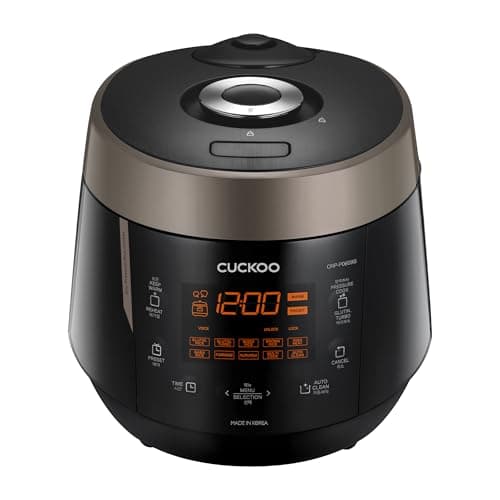
The CRP-P0609S is the pressure-only machine in Cuckoo's US range: 890 W, a 304 stainless pot with a nonstick coating over it, made in South Korea, and six cups uncooked. It is the cooker we would buy at this ceiling, and the full argument for the category is in the best Korean rice cookers.

Two honest limits. Pressure's advantage is smallest on basmati and jasmine and its extra cohesion is a defect there, which is why the Tiger exists on this page. And a pressure lid is a sealing gasket, a pressure weight and a locking mechanism — wear parts that need cleaning after every sticky or mixed-rice cook. Cuckoo's manual says so, and our Cuckoo pressure-versus-Micom comparison is the long version of that trade.

The Japanese option under the line

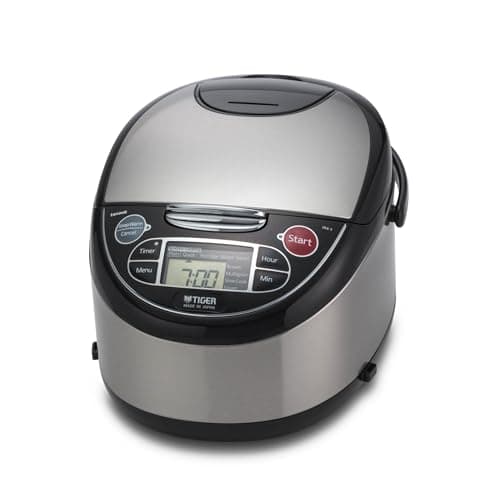
The Tiger JAX-T10U is the only cooker on this page made in Japan, and at this ceiling that is worth knowing. 641 W, micom heat control, 5.5 cups uncooked, ten auto-cook menus, and the tacook synchronised-cooking plate — a tray that sits above the rice so a piece of fish or a dish of vegetables cooks in the steam while the rice cooks beneath it.

For long-grain rice it is the better buy than the Cuckoo, full stop. For short-grain it is very good and not pressure. If you want the comparison properly, Zojirushi versus Tiger sets Tiger against the brand this ceiling excludes, and the JAX-T10U review is the single-machine version.

Korean build without the pressure, and the small end

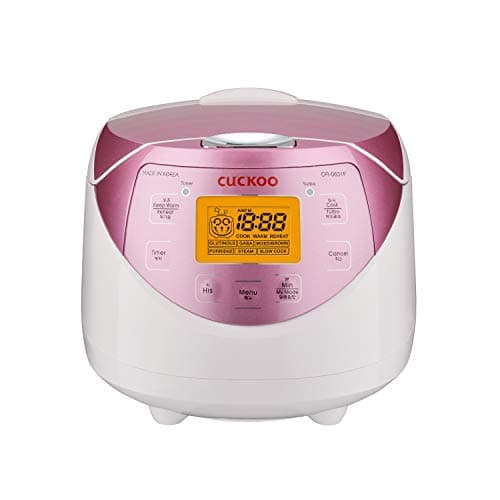
The Cuckoo CR-0631Fis the same Korean manufacture without the pressure mechanism at all: 580 W, which makes it the cheapest full-size cooker in our catalog to run, six cups, and nothing to maintain beyond a nonstick pot. If the pressure gasket is the part of the Cuckoo you do not want, this is the machine, and it leaves a lot of the ceiling unspent.

The Toshiba miniis here because capacity is a feature in both directions. Three cups uncooked, fuzzy logic, and a 24-hour delay timer — for one or two people, a 6-cup cooker is the wrong machine and a 3-cup fuzzy-logic one is the right one. We rank the small end properly in the best small rice cookers and work through the arithmetic in what size rice cooker to buy.

The budget end of a $200 budget

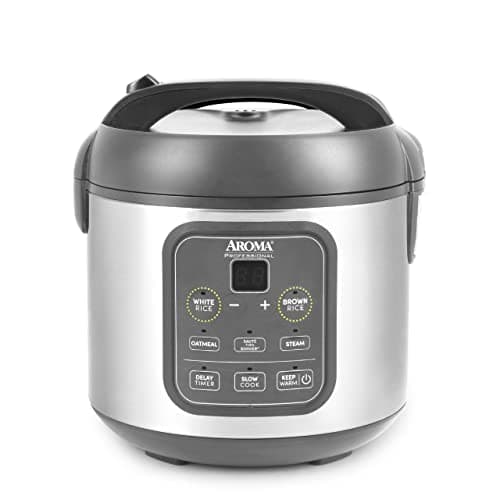
The Aroma ARC-994SG is the honest floor. Aroma publishes 450 W, a ceramic-coated nonstick pot, sensor-logic heat control, a slow-cook range of two to ten hours and a sauté-then-simmer function — and exactly two rice programs, White Rice and Brown Rice. That last figure is the limitation: there is no sushi setting, no mixed-grain program and no porridge cycle, so it is a cooker that does plain rice adequately and other jobs as well.

It belongs on a $200 page for one reason: if you are here because you are not sure a rice cooker is worth it, spending a tenth of your ceiling to find out is a better decision than spending all of it. We argue both sides in are rice cookers worth it, and the budget ranking is where the cheap end gets a proper list of its own.

In detail

The picks, in full

01
Cuckoo Cuckoo CRP-P0609S High-Pressure Rice Cooker, 6 Cup

The fluffiest rice, under pressure

Cuckoo CRP-P0609S High-Pressure Rice Cooker, 6 Cup

Cooks under pressure304 stainless pot
8.1/10

A pressurized rice cooker, which is the Korean approach and a genuinely different one: cooking rice under pressure raises the boiling point and produces a distinctly fluffier, stickier grain, especially for short-grain and mixed rice. 890 W, a 304 stainless pot, and Cuckoo's signature talking interface.

Capability
9
Capacity
8
Documentation
7.5
Build
8.5
Value
7.5

What it gets right

  • Pressure cooking raises the boiling point and produces a fluffier, stickier grain — the real advantage of the Korean-style cooker
  • A 304 food-grade stainless pot under the nonstick, which is a step up from the plain nonstick pots at this price
  • Fuzzy logic plus a full menu set including GABA rice, porridge and a scorched-rice (nurungji) mode

What it doesn't

  • The wattage is on Cuckoo's manual, not the retail product page — you have to go looking for it
  • The talking voice guide is not to everyone's taste and, on the US model, the default voice options are limited
  • A pressure rice cooker has a sealing gasket that eventually needs replacing, unlike a plain Micom cooker

What it costs to run

About 16.8¢ an hour at full rated draw, at the US average of 18.83¢ per kWh.

890 W ÷ 1000 × 1 h × 18.83¢ = 16.8¢

890 W as published in Cuckoo's own CRP-P0609S series manual specification page. This is an upper bound: the element only draws full power while it is heating up or pressurizing, then cycles off to hold temperature, and no manufacturer publishes a duty cycle — so we compute at full rated draw rather than invent a correction factor. The full method is published.

Skip this if…

…you mostly cook long-grain or basmati, where the pressure advantage is smallest and a good fuzzy-logic cooker matches it. The pressure difference shows most on short-grain, sticky and mixed rice.

$199.99on Amazon

$269.9926% off

Price last checked November 13, 2026. Prices move constantly — Amazon's at checkout is the one that counts.

#ad · we may earn a commission from this link to Cuckoo CRP-P0609S High-Pressure Rice Cooker, 6 Cup

02
Tiger Tiger JAX-T10U Micom Rice Cooker & Warmer with tacook, 5.5 Cup

Cook rice and a dish at once

Tiger JAX-T10U Micom Rice Cooker & Warmer with tacook, 5.5 Cup

tacook synchro-cookingMade in Japan
7.9/10

Tiger's answer to Zojirushi, with one trick the Zojirushis do not have: the tacook synchronous-cooking tray steams a dish above the rice while it cooks below, from the same 641 W. A Micom fuzzy-logic cooker made in Japan, with a genuinely useful feature the marketing did not invent.

Capability
8.5
Capacity
7.5
Documentation
8
Build
7.5
Value
8

What it gets right

  • The tacook tray genuinely cooks a main and the rice at the same time — a real weeknight shortcut, not a preset
  • Tiger publishes the wattage and 10 named auto-cook settings, and it is made in Japan
  • 641 W keeps it among the most efficient full-size cookers here to run

What it doesn't

  • The tacook tray's capacity is small — it steams a portion of protein or vegetables, not a full second course
  • Tiger's US documentation is thinner than Zojirushi's; the pot material is not clearly published
  • Micom, not induction — the rice is very good but not the best on this site

What it costs to run

About 12.1¢ an hour at full rated draw, at the US average of 18.83¢ per kWh.

641 W ÷ 1000 × 1 h × 18.83¢ = 12.1¢

641 W, published on Tiger Corporation's own JAX-T10U product page. This is an upper bound: the element only draws full power while it is heating up or pressurizing, then cycles off to hold temperature, and no manufacturer publishes a duty cycle — so we compute at full rated draw rather than invent a correction factor. The full method is published.

Skip this if…

…you only ever cook plain rice. The tacook tray is the reason to pick this over a Zojirushi, and if you will never use it you are paying for a feature you do not want — a Zojirushi Micom cooks the rice itself just as well.

$184.99on Amazon

Price last checked November 13, 2026. Prices move constantly — Amazon's at checkout is the one that counts.

#ad · we may earn a commission from this link to Tiger JAX-T10U Micom Rice Cooker & Warmer with tacook, 5.5 Cup

03
Cuckoo Cuckoo CR-0631F Micom Rice Cooker, 6 Cup

Cuckoo build without the pressure price

Cuckoo CR-0631F Micom Rice Cooker, 6 Cup

Lowest draw, full-size
7.8/10

Cuckoo's non-pressure Micom cooker: the same Korean build and fuzzy-logic control as the CRP, without the pressure mechanism or its price. 580 W, a 6-cup nonstick pot, and a menu set that still covers GABA and brown rice. The sensible Cuckoo if you do not need pressure.

Capability
7.5
Capacity
8
Documentation
7.5
Build
7.5
Value
8.5

What it gets right

  • Cuckoo's build and fuzzy-logic control without paying for a pressure mechanism you may not need
  • 580 W is the lowest draw of any full-size rice cooker on this site — the cheapest to run
  • Still covers GABA brown, mixed and porridge, plus a My Mode custom setting

What it doesn't

  • No pressure, so it does not get the fluffier short-grain result the CRP does
  • The wattage is on the manual, not the product page
  • Plain nonstick pot rather than the CRP's stainless-backed one

What it costs to run

About 10.9¢ an hour at full rated draw, at the US average of 18.83¢ per kWh.

580 W ÷ 1000 × 1 h × 18.83¢ = 10.9¢

580 W as published in Cuckoo's own CR-0631F series manual specification page. This is an upper bound: the element only draws full power while it is heating up or pressurizing, then cycles off to hold temperature, and no manufacturer publishes a duty cycle — so we compute at full rated draw rather than invent a correction factor. The full method is published.

Skip this if…

…you specifically want the pressurized-rice texture — that is the CRP, and this is deliberately the model without it. For plain fuzzy-logic rice, though, this is the value pick in the Cuckoo line.

$149.99on Amazon

Price last checked November 13, 2026. Prices move constantly — Amazon's at checkout is the one that counts.

#ad · we may earn a commission from this link to Cuckoo CR-0631F Micom Rice Cooker, 6 Cup

04
Toshiba Toshiba Mini Rice Cooker, 3 Cups Uncooked, with Fuzzy Logic

One or two people who still want fuzzy logic

Toshiba Mini Rice Cooker, 3 Cups Uncooked, with Fuzzy Logic

Fuzzy logic in a miniNo published wattage
5.9/10

A small fuzzy-logic cooker for one or two people — the rare compact rice cooker that still senses and adjusts rather than running a dumb timer. Three cups uncooked, one-touch operation, and a 24-hour delay so rice is ready when you get home.

Capability
7
Capacity
4.5
Documentation
4
Build
6.5
Value
7.5

What it gets right

  • Fuzzy-logic heat control in a genuinely small cooker — most compact rice cookers drop to a dumb on/off thermostat
  • Three cups is right-sized for one or two people, so you are not heating a full pot for a small portion
  • The 24-hour delay timer means rice ready when you walk in, which is most of why people buy a rice cooker at all

What it doesn't

  • Toshiba does not publish a wattage for this mini SKU that we could verify, so we show no running cost — do not confuse it with Toshiba's 6-cup models
  • Three cups is a firm ceiling; it will not cook for a family
  • The nonstick pot is small and thin, and the build is budget-tier

What it costs to run

Toshiba publishes no wattage for this cooker in any document we could find, so we do not show a running-cost figure for it. We are not going to estimate one from a similar model. Here is the method we would have used.

Skip this if…

…you cook for more than two or ever entertain — the 3-cup capacity is the whole limit here. A 5.5-cup fuzzy-logic cooker is only a little more and far more flexible for a household.

$94.99on Amazon

Price last checked November 13, 2026. Prices move constantly — Amazon's at checkout is the one that counts.

#ad · we may earn a commission from this link to Toshiba Mini Rice Cooker, 3 Cups Uncooked, with Fuzzy Logic

05
Aroma Housewares Aroma Professional ARC-994SG Digital Rice Cooker & Multicooker

The cheapest cooker that does more than rice

Aroma Professional ARC-994SG Digital Rice Cooker & Multicooker

Sauté-then-Simmer + slow cookOnly white & brown rice programs
6.9/10

The budget pick now, and an honest one. For around forty dollars it cooks white and brown rice, sautés then simmers, slow-cooks for 2 to 10 hours and steams — a genuine little multicooker in a small pot — and Aroma publishes its 450 W draw. What Aroma does not publish is how its 'Sensor Logic' works, and there are only two rice programs, so this is the versatility pick, not the rice-quality one.

Capability
6.5
Capacity
6.5
Documentation
7
Build
5.5
Value
9

What it gets right

  • Rice, Sauté-then-Simmer, a 2-to-10-hour slow cook and a steam tray in one small pot for around forty dollars — a real multicooker, not just a rice pot
  • Aroma publishes the draw — 450 W on its own product page — so, unlike the ARC-954SBD it replaces, it gets a real running-cost figure, and it is the lowest published draw of any rice cooker on this site
  • A 15-hour delay timer and automatic Keep Warm, so rice or oatmeal can be ready when you walk in

What it doesn't

  • Only two rice programs, White and Brown (plus Oatmeal) — no sushi, porridge or texture settings, and fewer than the ARC-954SBD it replaces, which added Quick Rice and Quinoa
  • Aroma says its Sensor Logic 'automatically controls the internal temperature' but explains nothing more, never calls it fuzzy logic, and the manual does not mention it — so we cannot tell you how it compares with a Zojirushi's
  • The ceramic-coated pot is the part that wears: Aroma recommends hand-washing it to lengthen its lifespan and warns the dishwasher can discolor it

What it costs to run

About 8.5¢ an hour at full rated draw, at the US average of 18.83¢ per kWh.

450 W ÷ 1000 × 1 h × 18.83¢ = 8.5¢

450W at 120V 60Hz, listed under Power Consumption on Aroma's own ARC-994SG product page. The instruction manual itself gives only the 120V AC requirement. This is an upper bound: the element only draws full power while it is heating up or pressurizing, then cycles off to hold temperature, and no manufacturer publishes a duty cycle — so we compute at full rated draw rather than invent a correction factor. The full method is published.

Skip this if…

…rice quality is the whole point of the purchase. It gives you two rice buttons and a sensor Aroma does not explain; if you want dedicated sushi, porridge and texture settings from a documented fuzzy-logic cooker, the Zojirushi Neuro Fuzzy is the one — this is the value and versatility pick, not the rice-quality pick.

$39.20on Amazon

$49.9922% off

Price last checked November 13, 2026. Prices move constantly — Amazon's at checkout is the one that counts.

#ad · we may earn a commission from this link to Aroma Professional ARC-994SG Digital Rice Cooker & Multicooker

Choosing in one minute

You eat short-grain, sushi or mixed rice most days. Cuckoo CRP-P0609S. Pressure is the only mechanism under this ceiling that changes the grain.

Your rice is basmati or jasmine. Tiger JAX-T10U. Made in Japan, ten menus, and pressure is actively the wrong treatment for long-grain.

You want Korean build and no gasket to maintain.Cuckoo CR-0631F, at 580 W the cheapest full-size cooker here to run.

You are cooking for one or two. Toshiba mini, 3 cups, fuzzy logic, 24-hour delay.

You want to find out whether you like having a rice cooker. Aroma ARC-994SG, and keep the rest of the budget.

The two mistakes

Spending the whole ceiling on capacity you will never fill — a half-filled 6-cup cooker makes worse rice than a well-filled 3-cup one. And buying pressure for long-grain rice, where the extra cohesion it produces is the opposite of what you want.
The hardware

The cookers this page is about

The cookers referred to above, with prices pulled live from Amazon and dated on every card. Full rankings live in the roundups linked from this page.

  • Zojirushi Zojirushi NS-ZCC10 Neuro Fuzzy Rice Cooker & Warmer, 5.5 Cup

    680 W

    Zojirushi NS-ZCC10 Neuro Fuzzy Rice Cooker & Warmer, 5.5 Cup

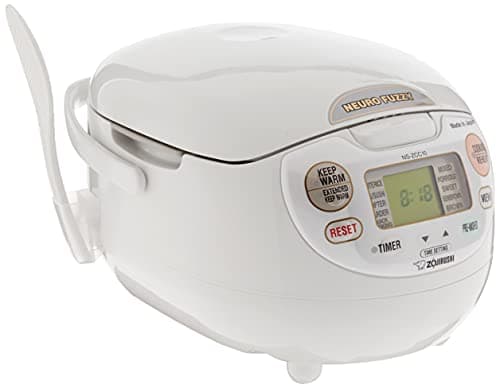
    The rice cooker every other one is measured against. Its Neuro Fuzzy microcomputer adjusts heat through the cook rather than running a fixed timer, which is the whole reason a $260 rice cooker cooks rice better than a $30 one. Made in Japan, 680 W, and the settings that matter are all there.

#ad · As an Amazon Associate we earn from qualifying purchases.

How we picked

Machines we claim to have tested: 0

Everyone in this category tells you they tested twenty cookers. We have tested none, and we say so. Here is what we do instead: read the manufacturer's manual and spec page, record the published wattage, capacity, pressure or temperature figure and warranty term, work out what the machine costs to run per hour, show the arithmetic so you can redo it with your own electricity rate, and cite all of it. Where a brand publishes no wattage, we print no running cost rather than borrowing a number from a similar model. Prices come live from Amazon's API and disappear rather than go stale.

The scores above are judgments from that documented research — not test results. One of the five metrics is Documentation: whether the manufacturer will tell you what its cooker draws at all. The full rubric, including what disqualifies a pick, is published in full.

Questions

Frequently asked

What is the best rice cooker under $200?
The Cuckoo CRP-P0609S. It is the only cooker under the ceiling that cooks rice under pressure - Cuckoo publishes 78.4 kPa of working pressure for its pressure models - which raises the boiling point inside the pot and produces a chewier, glossier, more cohesive grain than any non-pressure machine. 890 W, a 304-stainless-backed pot, six cups uncooked, made in South Korea. If your rice is mostly basmati or jasmine, buy the Tiger JAX-T10U instead, because pressure is the wrong treatment for long-grain.
Can you buy a Zojirushi for under $200?
Not in our catalog. The NS-TSC10 Micom, the NS-ZCC10 Neuro Fuzzy and the induction NW-QAC10 all sit above this ceiling, the last one at roughly double it. What the ceiling costs you is induction heating and Zojirushi's Neuro Fuzzy heat control, both of which are real and both of which are incremental - they separate very good rice from excellent rice, not bad from good.
Is a $200 rice cooker better than a $40 one?
Yes, and the gap is in the mechanism rather than the features. A $40 cooker runs a heating plate under a pot and uses a sensor to decide when the water has gone; a $200 cooker either pressurises the pot or adjusts the heat continuously through the cook. Both produce edible rice. The expensive one produces consistently better texture, and it has programs for grains the cheap one simply does not list - the Aroma on this page publishes exactly two rice programs, White and Brown.
How much should I spend on a rice cooker?
If you eat rice a couple of times a week, $40 to $100 buys a cooker that does the job and the step up is hard to justify. If you eat rice most days, $150 to $200 is the sweet spot on this site, because that is where pressure and Japanese fuzzy logic become available. Above $200 you are buying induction, which is a genuine improvement and a smaller one than the jump you just made.
Does a pressure rice cooker really make better rice?
It makes different rice, and for short-grain it is better. Sealing the lid raises the internal pressure, which raises the boiling point of the water above 100C, and hotter water gelatinises starch more completely - the result is chewier, glossier and more cohesive. That is ideal for Japanese and Korean short-grain, sushi rice and mixed rice, and actively wrong for basmati and jasmine, where you want separate dry grains.
What is the best rice cooker under $200 for long-grain rice?
The Tiger JAX-T10U. It is made in Japan, draws 641 W, carries ten auto-cook menus and includes the tacook plate that cooks a dish in the steam above the rice. More importantly it does not pressurise, which is what you want for basmati and jasmine - the extra cohesion pressure produces is a defect on long-grain. Our basmati-specific ranking goes further into which published programs matter for aromatic rice.
Is the cheapest rice cooker on this page worth buying?
As a way to find out whether you want a rice cooker at all, yes. The Aroma ARC-994SG publishes 450 W, a ceramic-coated nonstick pot, sensor-logic heat control, a two-to-ten-hour slow cook and a saute-then-simmer function, for roughly a tenth of this page's ceiling. The limitation is in writing: exactly two rice programs, White Rice and Brown Rice. There is no sushi setting and no mixed-grain cycle.
Are the prices on this page current?
They come from a daily price refresh, and the Quick Picks table prints the date of the most recent one next to the buy buttons. If the refresh stops, every number on this site disappears and the buttons fall back to 'Check price on Amazon' rather than showing a stale figure. Treat the table as the authority over any number in the prose.

Keep reading

Receipts

Sources

We have not tested these machines in a lab and we do not pretend to have. Specifications come from the manufacturer's own published documents; electricity rates come from the US Energy Information Administration; prices come from the live Amazon API. Where a figure is not published, the page says “not published” rather than guessing. Read the full method.