HUB 04 · Buying Guides
Air Fryer vs Convection Oven
The honest version: these are the same technology at two scales. A fan pushes hot air past food in both. What differs is cavity size, air speed and how close the food sits to the element - and those three things decide which one you should reach for.
We earn a commission if you buy through our links. It does not change the price you pay, and it does not decide our picks — the scoring rubric is published in full, including what disqualifies a pick. How this works.
The short answer
An air fryer is a convection oven. Not an analogy — the same mechanism: a heating element and a fan that forces hot air past the food so heat reaches it by moving air rather than by radiation from a hot wall. Every meaningful difference comes from three physical facts. The cavity is much smaller, so it preheats in a couple of minutes instead of fifteen. The fan is proportionally much faster, so air moves past the surface hard enough to strip away the insulating layer of cooler air that forms around food. And the food sits in a perforated basket within inches of the element, so air reaches the underside too. Those three things make an air fryer better at browning small quantities fast, and a convection oven better at everything that needs room.
Why "air fryer" is a marketing word
There is no frying in an air fryer. No oil bath, no immersion, nothing that behaves like a deep fryer. What you get is dry convective heat producing a Maillard crust, which is also what a roasting oven produces — faster, on a smaller tray. Countertop convection ovens with fans have existed for decades under names like “turbo oven” and “halogen oven”; the basket, the fan speed and the word were what changed.
That matters practically, not just pedantically. If you already have an oven with a convection or fan setting, you already own most of an air fryer, and the honest question is whether the remaining difference — preheat time, air speed, basket geometry — is worth a countertop appliance. For a lot of households it is, because the preheat is the part that decides whether you bother on a Tuesday. For a lot of others it is a box that lives on the counter doing a job the oven already did.
What each one is genuinely better at
The air fryer wins on speed to first bite. A small cavity reaches temperature in two or three minutes against ten to fifteen for a full oven, and that is not a trivial margin — it is most of the reason people reach for it. For one or two portions, from cold to food, an air fryer is comfortably quicker end to end even when the cooking time itself is similar.
The air fryer wins on crust, in a single layer. Air speed and proximity do real work: fries, wings, breaded things and anything that wants a dry exterior come out crisper than the same food on a tray in a fan oven, as long as the basket is not crowded. Crowd it and the advantage inverts completely, because the air cannot circulate and you have built a steamer.
The convection oven wins on capacity, which is most of real cooking. A sheet pan of vegetables for four, a chicken, two trays at once, anything tall, anything in a dish. An air fryer basket typically holds a single layer for one or two people, and the way you cook more is in batches — which hands the time advantage straight back.
The convection oven wins on gentleness and evenness. A big cavity with a slower fan is more forgiving: it bakes, it roasts low and slow, it does not dry out the surface of something that needs an hour. An air fryer's intensity is an advantage for fifteen minutes and a liability for ninety.
The comparison in one table
| Air fryer | Convection (fan) oven | |
|---|---|---|
| Mechanism | Element + fan | Element + fan |
| Cavity | A few quarts | Tens of quarts |
| Preheat | 2–3 minutes | 10–15 minutes |
| Air speed past the food | High | Moderate |
| Food surrounded by air? | Yes — perforated basket | Underside sits on a tray |
| Typical rated draw | 1,400–1,800 W | 2,000–3,000 W |
| Best at | Crust, small batches, speed | Volume, baking, long roasts |
| Worst at | Anything that fills the basket | Cooking one portion quickly |
Which costs more to run
The air fryer, per hour; the oven, per meal — and the second one is what matters.
A full-size electric oven element is typically two to three kilowatts, against roughly 1,400–1,800 W for a countertop air fryer. Instant Brands publishes 1,500 W for the Duo Crisp with Ultimate Lid, which is the one machine in our catalog that air fries, and it is the highest draw of any Instant Pot we cover. At the US average residential rate of 18.83¢ per kWh, twenty minutes at that draw is about 9.4¢ at full rated draw.
The oven's disadvantage is not the element, it is the cavity: you pay to heat a large insulated box of air for ten to fifteen minutes before any food cooks, and then you pay to keep it hot. For one tray of food that overhead dominates. For three trays it disappears, because the air fryer would have needed three batches. The arithmetic is the same one our running-cost guide sets out: watts times hours times your rate, computed at full rated draw and labelled a ceiling, because an element cycles once it is at temperature and no manufacturer publishes a duty cycle.
Where a multicooker comes into this
This is a kitchen-appliance site that covers pressure cookers, rice cookers and sous vide, so the useful thing we can add is the overlap. The Instant Pot Duo Crisp with Ultimate Lid is the only machine in our catalog that air fries, and Instant Brands lists air fry alongside pressure cook, bake, dehydrate, sous vide and proof across its thirteen functions, at 1,500 W in a 6.5-quart pot with a stainless inner pot. One lid does both jobs.
That is a genuinely good answer for a small kitchen, and it has a real cost in convenience that we would not gloss over: switching from pressure to air fry means removing a protective cover from over the air-fry element, which Instant Brands' own instructions warn will be hot. It is an oven-mitt step in the middle of a recipe. Our air-fryer multicooker roundup and the Duo Crisp review go through whether the combination is worth it, and Instant Pot vs air fryer compares the two appliances as appliances.
The honest flip side: if you already own an air fryer or a fan oven you are happy with, the combo's entire premium is putting both jobs in one box, and the plain Instant Pot Pro does the pressure half better for less money. That is why it is the second pick on this page rather than an afterthought.
Converting recipes between them
Both directions follow the same rule, because both are convection. Going from a conventional (non-fan) oven recipe to either one, drop the temperature by about 25 °F and expect it to finish sooner — moving air transfers heat faster than still air, so the recipe temperature is calibrated for a machine that works less hard.
Going from a fan oven to an air fryer, keep the temperature and cut the time, then check early: the first time you cook anything in an air fryer it will be done before you expect. Going the other way — air fryer recipe in a fan oven — keep the temperature, add time, and accept slightly less crust. And in either, do not crowd the tray or the basket, because the single thing that makes convection work is air actually moving past the surface.
For food safety the standard applies regardless of the appliance: the finish temperature is what matters, measured in the food rather than inferred from a timer. The USDA's safe minimum internal temperatures are the reference, and they do not change because the air is moving faster.
So which should you buy
You already have an oven with a fan setting and cook for three or more: you do not need an air fryer. You need to use the convection setting and stop crowding the tray.
You cook for one or two and the oven's preheat is why you order takeaway: buy the air fryer. The preheat is the whole product and it is worth the counter space.
You have a small kitchen and no multicooker: look at the Duo Crisp, which does both jobs under one lid, and read the oven-mitt caveat above before you commit.
You have a small kitchen and already air fry: buy a plain pressure cooker, not a combo. If you are not sure which category you are shopping in at all, which kitchen appliance do you need is the page that sorts it out, and the best kitchen appliances is the broad buying guide.
The hardware
The cookers this page is about
The cookers referred to above, with prices pulled live from Amazon and dated on every card. Full rankings live in the roundups linked from this page.
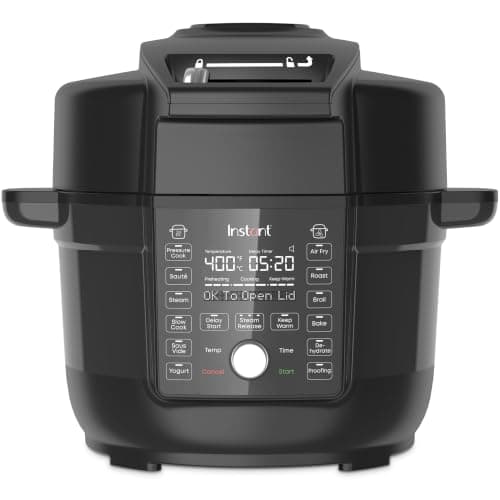
1,500 W
Instant Pot Duo Crisp Ultimate Lid, 13-in-1 Air Fryer & Pressure Cooker, 6.5 Quart
The one lid that both pressurizes and crisps, which is the whole argument against buying a pressure cooker and an air fryer separately. It draws 1,500 W — the most of any Instant Pot here — and that higher draw is the air-fry element doing real work, not a spec-sheet flourish.
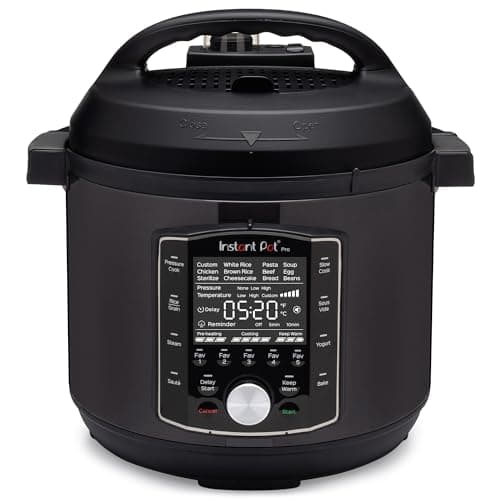
1,200 W
Instant Pot Pro 10-in-1 Pressure Cooker, 6 Quart
The Duo's mechanicals with the interface fixed: a genuine sous vide program, an auto-sealing lid, grab-and-go pot handles and five programmable buttons. It draws 1,200 W rather than the Duo's 1,000, and Instant Brands does not publish a working-pressure figure for it — the one gap in an otherwise well-documented cooker.
#ad · As an Amazon Associate we earn from qualifying purchases.
Questions
Frequently asked
Is an air fryer the same as a convection oven?
Do I need an air fryer if I have a convection oven?
Does an air fryer actually fry?
Which uses less electricity, an air fryer or an oven?
How do I convert an oven recipe for an air fryer?
Is a pressure cooker with an air fryer lid as good as a real air fryer?
Keep reading
Related
- Instant Pot vs air fryerThe two appliances compared as appliances.
- The best multicookers with an air fryerIf one lid doing both is the plan.
- Which kitchen appliance do you need?The page that sorts the whole decision out.
- Are electric pressure cookers cheap to run?Where the running-cost arithmetic comes from.
Receipts
Sources
- Instant Brands — Instant Pot Duo Crisp with Ultimate Lid 6.5qt product page
- Instant Brands — Instant Pot Duo Crisp with Ultimate Lid 6.5qt product page
- Instant Brands — Instant Pot Pro 6qt product page
- US Energy Information Administration — Electric Power Monthly, Table 5.3 (average residential price)
- USDA Food Safety and Inspection Service — safe minimum internal cooking temperatures
We have not tested these machines in a lab and we do not pretend to have. Specifications come from the manufacturer's own published documents; electricity rates come from the US Energy Information Administration; prices come from the live Amazon API. Where a figure is not published, the page says “not published” rather than guessing. Read the full method.