HUB 03 · Sous Vide
How to Sous Vide Eggs
Eggs are the dish that shows off sous vide better than anything else, because with an egg the water temperature is the recipe. A degree or two turns a runny yolk into a set one, which is exactly why the precise machines earn their keep here. Here is how temperature shapes the texture, how long it takes, and the safety line that matters.
We earn a commission if you buy through our links. It does not change the price you pay, and it does not decide our picks — the scoring rubric is published in full, including what disqualifies a pick. How this works.
Why eggs are the sous vide showcase
If you want to see what sous vide does that a stove cannot, cook an egg. On a pan or in boiling water you control an egg with time— three minutes for soft, ten for hard — and the result is a race against a moving target. Sous vide flips that: you hold the egg at an exact temperature, and because egg proteins set at specific, narrow temperatures, that single number decides the texture. This lets you hit a custardy, barely-set egg that is genuinely impossible to make reliably on a stove— the famous silky “onsen”-style egg where the white is just-set and the yolk is thick and jammy. It is the purest demonstration of the whole technique.
Temperature is the recipe
The reason temperature matters so much is that a whole egg is really two foods that set at different temperatures: the white firms up at a higher temperature than the yolk thickens, so where you land on the dial decides which one wins. A custardy, onsen-style egg is commonly cooked around 145°F (about 63°C), which gives a loose, delicate white and a thick, spoonable yolk. Nudge higher and the white sets more firmly while the yolk moves from jammy toward fudgy; higher still and you approach a traditional soft- or hard-set egg. Treat those as commonly-used starting points, not gospel — the exact numbers for a poached-style egg versus a firm one belong in a chart, and we keep a full one in the sous vide temperature guide. Pick the texture you want, set that temperature, and the egg does the rest.
No bag required
Eggs are the one sous vide food you do not bag at all. The shell is already a sealed, waterproof container, so you simply lower whole eggs straight into the water bath — no zip-top bag, no vacuum sealer, no water-displacement method. That makes eggs the cheapest, lowest-friction way to try sous vide: if you already have a circulator, you need nothing else. Use a slotted spoon to lower and lift them gently so they do not crack against the pot, and cook them straight from the fridge — the times below assume cold eggs.
How long they take
For a whole egg cooked in the shell, plan on roughly 45 minutes to an hourat your chosen temperature — long enough for the center to come fully up to the water temperature and settle there. Unlike a boiled egg, there is a generous window: because the water can never be hotter than your set point, the egg cannot overshoot the way it does in a pan, so a few extra minutes will not ruin it. That said, eggs are not infinitely forgiving — hold them for many hours and the texture keeps evolving, so this is not a set-and-forget-all-day food the way a tough cut of meat is. Cook, then crack straight into a bowl or over toast; the white slips out of the shell and the yolk stays intact.
Why precision matters more for eggs than for steak
This is the part worth understanding before you buy a machine to cook eggs on. With a steak, a degree or two of drift is cosmetic — 131°F versus 133°F is a shade of medium-rare almost nobody would notice. With an egg, that same couple of degrees is the difference between a runny yolk and a set one, because egg proteins coagulate across an unusually narrow band. That is why tight temperature control is more valuable here than almost anywhere else. The Anova and the Inkbird both publish ±0.1°C accuracy, which is exactly the kind of steadiness eggs reward. The cheaper Monoprice quotes ±1% stabilityinstead — looser control that is academic on a steak but can genuinely show up on an egg held right at a set point. You can absolutely cook eggs on the Monoprice; just know that eggs are the food where the pricier machines' precision does the most visible work.
A word on safety
Eggs cooked to a soft, custardy set sit at lower temperatures than a fully hard-cooked egg, so it is worth being clear about safety. As with the rest of sous vide, safety here comes from time and temperature together: holding an egg at temperature for long enough pasteurizes it, which is the same logic the USDA describes for cooking safely with time and temperature. Cooking eggs to a runny or barely-set texture carries the usual raw- or undercooked-egg considerations, so anyone serving very young children, older adults, pregnant people or anyone immunocompromised should lean toward firmer, hotter eggs or follow a validated pasteurization time rather than eyeballing it. Use clean, fresh eggs, and if you are cooking ahead, chill promptly rather than leaving cooked eggs sitting warm. The precise pasteurization times belong in a reference; the principle is what matters here, and it is the same one behind is sous vide safe?
The short version
Texture is temperature:a custardy onsen-style egg is commonly cooked around 145°F (about 63°C), and firmer eggs come from higher — see the temperature guide for the full chart. No bag: cook whole eggs in the shell, straight into the bath, about 45 minutes to an hour. Precision pays off:eggs are the food where ±0.1°C control (Anova, Inkbird) beats the looser ±1% of a budget machine. Safety:soft eggs carry the usual undercooked-egg considerations — use fresh eggs, hold long enough to pasteurize, and go firmer for anyone vulnerable. Then go cook the rest of it.
The hardware
The cookers this page is about
The cookers referred to above, with prices pulled live from Amazon and dated on every card. Full rankings live in the roundups linked from this page.
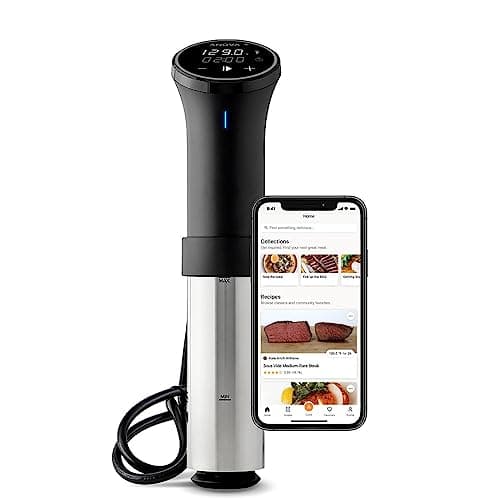
1,100 W
Anova Precision Cooker 3.0 (WiFi), 1100 W
The sous vide circulator most people should buy. Anova publishes the full specification — 1,100 W, a 0–92°C range, ±0.1°C accuracy, an 8 L/min pump — and backs it with a two-year warranty, the longest here. It has an on-device screen so it works without the app, which the Joule does not.
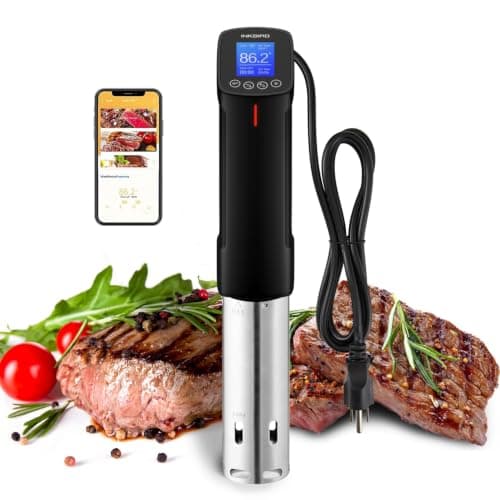
1,000 W
Inkbird ISV-100W WiFi Sous Vide, 1000 W
The value pick that does not feel like one. Under $100, and Inkbird still publishes the full specification: 1,000 W, a 25–99°C range, ±0.1°C accuracy, 15 L capacity, WiFi and an on-device dot-matrix screen. It undercuts the Anova by more than half and gives up remarkably little on paper.
- PickNo image
800 W
Monoprice Strata Home Sous Vide Immersion Cooker, 800 W
The cheapest way to find out whether you actually like sous vide. Physical controls only, an 800 W element, a factory-calibrated sensor you can recalibrate yourself, and a directional pump cap that is a genuinely thoughtful touch at the price. Monoprice publishes the full spec in the manual, which the price does not lead you to expect.
#ad · As an Amazon Associate we earn from qualifying purchases.
Questions
Frequently asked
What temperature do you sous vide an egg?
Do you need a bag to sous vide eggs?
Why does temperature accuracy matter more for eggs?
Keep reading
Related
Receipts
Sources
- Anova Culinary — Precision Cooker 3.0 product page
- Monoprice — Strata Home Sous Vide (21594, 800W) user manual [PDF]
- USDA Food Safety and Inspection Service — safe minimum internal cooking temperatures
- USDA FSIS — cooking safely with time and temperature (pasteurization basics)
We have not tested these machines in a lab and we do not pretend to have. Specifications come from the manufacturer's own published documents; electricity rates come from the US Energy Information Administration; prices come from the live Amazon API. Where a figure is not published, the page says “not published” rather than guessing. Read the full method.