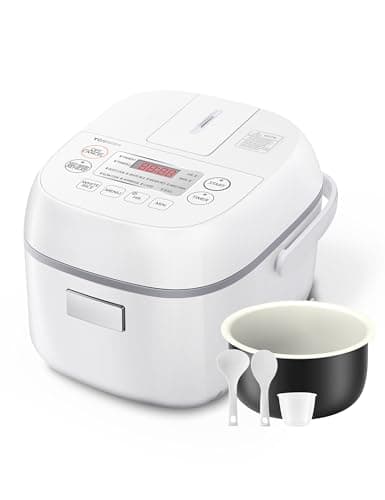
Fuzzy logic in a mini is the whole story
Most compact rice cookers cut a corner that matters: they drop to a dumb on/off thermostat, boiling until the water is gone and then clicking off, which is exactly the timer-and-hope cooking that a good rice cooker is supposed to replace. The Toshiba Mini does not. It keeps fuzzy-logic heat control — sensing and adjusting through the cook — in a genuinely small, 3-cup-uncooked body. That is rare at this size, and it is the entire reason to choose it over the flood of cheap mini cookers that look similar and cook worse.
Right-sized for one or two
Three cups uncooked is sized for one or two people, so you are not heating a full 5.5-cup pot to cook a single portion. For a solo cook, a couple, a dorm or a small kitchen, the smaller pot is the correct size rather than a compromise, and it earns its place in our small-kitchen roundup. The 24-hour delay timer is the feature that seals it: load the rice in the morning, come home to it cooked and kept warm — which, honestly, is most of why people buy a rice cooker in the first place. One-touch operation keeps the whole thing simple.
The limits: no published wattage, and a firm ceiling
Two honest caveats. First, Toshiba does not publish a wattagefor this mini SKU in any manufacturer document we could verify, so — following this site's rule that a number we cannot source is a number we do not print — we show no running-cost figurefor it. Do not confuse this compact model with Toshiba's 6-cup cookers, which are documented differently. Second, three cups is a hard ceiling: it will not cook for a family, and there is no working around the size. The nonstick pot is also small and thin, and the build is budget-tier — this is a well-chosen little cooker, not a premium one.
How the rice compares
The Toshiba Mini makes genuinely good rice for its class — the fuzzy logic sees to that — but it is not Zojirushi-good, and it was never going to be at this size and price. If rice quality is the entire point of the purchase and you have the counter space, a full-size fuzzy-logic cooker is a different class. The Mini's argument is specifically the combination: real fuzzy logic and a small footprint and a low price, which is a combination the premium cookers do not offer and the cheap ones fake.
Who should skip it
Skip the Toshiba Mini if you cook for more than two or ever entertain — the 3-cup capacity is the whole limit, and a 5.5-cup fuzzy-logic cooker is only a little more money and far more flexible for a household. Buy the Mini if you cook for one or two, want real fuzzy-logic rice from a compact, affordable machine, and value the delay timer that has dinner ready when you walk in. It is the right small rice cooker, not the right rice cooker for everyone. See it against the budget field in the best budget rice cookers.
How we picked
Machines we claim to have tested: 0
Everyone in this category tells you they tested twenty cookers. We have tested none, and we say so. Here is what we do instead: read the manufacturer's manual and spec page, record the published wattage, capacity, pressure or temperature figure and warranty term, work out what the machine costs to run per hour, show the arithmetic so you can redo it with your own electricity rate, and cite all of it. Where a brand publishes no wattage, we print no running cost rather than borrowing a number from a similar model. Prices come live from Amazon's API and disappear rather than go stale.
The scores above are judgments from that documented research — not test results. One of the five metrics is Documentation: whether the manufacturer will tell you what its cooker draws at all. The full rubric, including what disqualifies a pick, is published in full.