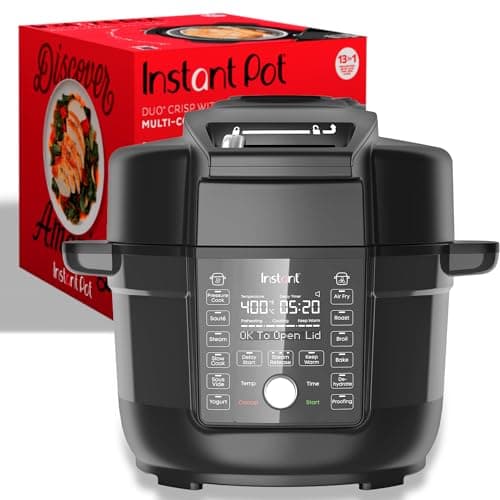
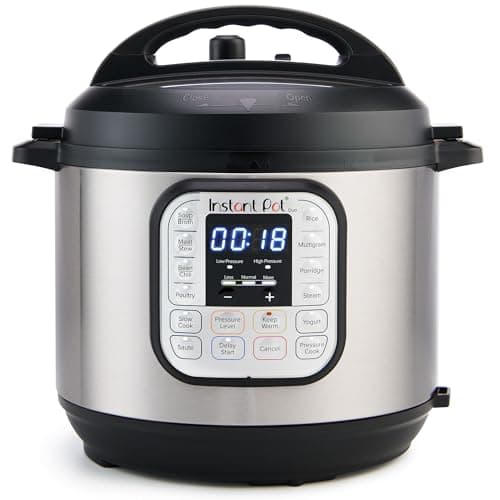
The same cooker, taken one step further
The Duo and the Duo Crisp start from the same place. Both are Instant Pots that pressure-cook, slow-cook, sauté, steam, cook rice, make yogurt and keep warm on a stainless inner pot, and both are the sensible, well-documented core of the range. The difference is a single piece of hardware. The 6-quart Duo is the original 7-in-1, rated 1,000 W, and it stops at pressure-and-slow-cook by design. The 6.5-quart Duo Crisp adds a convertible Ultimate Lid that does something the Duo physically cannot: it air-fries. The same machine that pressure-cooks a roast can then crisp the top without moving the food to a second appliance. That one capability is what you are paying for, and the whole comparison is really a question of whether you want it.
What the Duo Crisp adds
The headline is the crisp finish, but the Duo Crisp's lid brings more than air fry. Instant Brands publishes it as a 13-in-1 whose function set spans pressure, air fry, bake, dehydrate, sous vide and proof— the useful extras people actually asked for, not just the same heating element relabeled. In practice the two that change how you cook are air fry, which browns and crisps with hot air under the lid, and sous vide, which the plain Duo lacks entirely. So the Duo Crisp is not merely “a Duo that air-fries”; it is closer to a pressure cooker, an air fryer and a couple of specialty modes folded into one box. If a crisp top on a pressure-cooked dish, or dehydrating and proofing on the same counter footprint, is genuinely appealing, that is the argument for it. If you only ever pressure-cook and slow-cook, none of it matters and you are paying for lids and modes you will not touch.
Running cost: 1,000 W vs 1,500 W
The extra capability is not free to run. The Duo draws 1,000 W; the Duo Crisp draws 1,500 W, both figures published by Instant Brands. That makes the Duo Crisp the highest-draw Instant Pot on this site, and the gap is real — the crisping element is a genuine high-heat heater doing real work, not a spec-sheet flourish, so it costs the most per minute of any cooker here to run. The exact per-hour figures are computed on each product card below at the US average electricity rate, so you can compare them directly and redo the sum with your own rate. Two things keep this honest. First, you only pay the higher draw when you actually air-fry — pressure cooking on the Duo Crisp is not meaningfully thirstier than on the Duo. Second, neither cooker is expensive to run in absolute terms. But if you buy the Crisp and never crisp, you have bought a 1,500 W machine to do a 1,000 W machine's job.
The cupboard cost of the extra lid
Here is the trade nobody mentions in the marketing. The Duo Crisp's whole pitch is that it saves counter space by replacing two appliances with one — but the crisping hardware has to live somewhere. The Ultimate Lid is heavier and bulkier than the plain Duo's pressure lid, and while it is a single lid rather than the two that some combo cookers ship, it is still more to store, handle and eventually clean. A combo unit solves counter space and then quietly eats cupboard space. The Duo, by contrast, is a simpler object: one modest pressure lid, less to find a home for, and mechanically less to go wrong over years of use. If your kitchen is tight, that simplicity is a genuine point in the Duo's favor, and it is easy to underrate until you are living with the larger machine.
Both use a stainless pot — and share the same limits
It is worth stating what does not change between them, because it is a point in both their favor. Both use a stainless steel inner pot— the Duo's is an 18/8 stainless, tri-ply-base pot, the Duo Crisp's a stainless pot as well — with no nonstick coating to scratch off, which is why both outlast the coated pots in cookers that cost more. Both are also single-vessel machines that pressure-cook the same way, so the actual pressure cooking is not better on the pricier model. And both are backed by the same one-year warranty. In other words, stepping up to the Duo Crisp buys you air fry and a couple of extra modes; it does not buy you a better pot, a better pressure cook or a longer warranty. That keeps the decision clean: you are paying purely for the crisp finish and the extra programs, nothing else.
Price, and who each is for
The Duo is the cheaper machine, and by a clear margin — it is the least expensive genuinely well-documented multicooker on this site, and the Duo Crisp sits well above it because of the lid and the modes. We do not print live prices in prose because the site pulls the current Amazon price onto each card below, but the shape holds: budget-friendly Duo, premium Duo Crisp. So the buyer split is straightforward. The Duo is for the cook who wants the core Instant Pot done well and cheaply and already owns, or does not want, an air fryer. The Duo Crisp is for the cook who genuinely wants pressure and crisp under one lid — a family that would use both halves, or someone consolidating a pressure cooker and an air fryer into one appliance. If you want to see where the Crisp lands against its combo rivals, the air-fryer multicooker roundup ranks the field.
How we picked
Machines we claim to have tested: 0
Everyone in this category tells you they tested twenty cookers. We have tested none, and we say so. Here is what we do instead: read the manufacturer's manual and spec page, record the published wattage, capacity, pressure or temperature figure and warranty term, work out what the machine costs to run per hour, show the arithmetic so you can redo it with your own electricity rate, and cite all of it. Where a brand publishes no wattage, we print no running cost rather than borrowing a number from a similar model. Prices come live from Amazon's API and disappear rather than go stale.
The scores above are judgments from that documented research — not test results. One of the five metrics is Documentation: whether the manufacturer will tell you what its cooker draws at all. The full rubric, including what disqualifies a pick, is published in full.