HUB 02 · Rice Cookers
Rice cooker vs rice steamer
This is a naming problem more than a product problem. A rice cooker boils rice in a measured amount of water and senses when that water is gone; a steamer cooks food in vapor above water it never touches. Both get called a "rice steamer" on shop shelves, and the difference decides whether your rice works.
We earn a commission if you buy through our links. It does not change the price you pay, and it does not decide our picks — the scoring rubric is published in full, including what disqualifies a pick. How this works.
The short answer
They are usually the same appliance under two names — but not always, and the exception matters. A rice cooker cooks by absorption: the grain sits in a measured amount of water, the pot heats until that water is absorbed and boiled off, a sensor detects the temperature rise that happens when the water is gone, and it switches to keep-warm. A true steamer cooks in vapor:food sits in a basket above boiling water it never touches. Rice cooked that way is possible but mediocre, because the grain needs to sit in water to hydrate evenly. Most things sold as “rice steamers” are rice cookers with a steam tray in the box — and those are the ones worth buying.
The three things called a “steamer”
| What it is | How it cooks rice | Good at rice? |
|---|---|---|
| A rice cooker marketed as a “rice steamer” | Absorption — grain in measured water, sensor cuts the heat when the water is gone | Yes. This is a rice cooker; the word is marketing |
| A rice cooker with a steam tray or basket | Absorption below, true steam above — rice in the pot, vegetables or fish in the tray | Yes, and it does the steamer's job too |
| A stackable electric food steamer, or a stovetop basket | True steam only — the grain never sits in water | Poorly. Slow, uneven hydration, and nothing senses when it is done |
So the practical rule when shopping: ignore the word and look for the bowl and the sensor. If the machine has an inner pot you add measured water to and a cook/keep-warm cycle, it is a rice cooker regardless of what the box says. If it is a stack of perforated trays over a water reservoir, it is a food steamer and rice is not what it is for.
Why a pure steamer makes worse rice
Not because steam is too gentle — steam is 212 °F, the same as boiling water — but because of how rice hydrates. A rice grain needs to be submerged to absorb water evenly from all sides; in a steam basket, the grains on top get vapor and the grains at the bottom sit in condensate, so you get a wet layer and a chalky layer. Steamer instructions work around this by telling you to add water directly to the rice in a solid bowl inside the steamer — at which point you are using absorption again, just with a slower, less controlled heat source and no sensor watching for the end of the cook.
That missing sensor is the real loss. The one thing a rice cooker does that nothing else does is detect the moment the free water is gone. Up to that point the pot sits at boiling; once the water is absorbed the temperature climbs past 212 °F, and the thermostat — or, on a better machine, a microcomputer — reads that climb and stops cooking. Our how a rice cooker works guide walks through the cycle, and what a fuzzy-logic rice cooker is covers the better version of that sensing.
What a steamer is genuinely better at
Everything that is not rice, if you steam a lot of it. A dedicated food steamer has stacked tiers, so you can cook fish on one level and vegetables on two others at once, with far more total capacity than a tray balanced over a rice pot. If you steam dumplings, buns, whole fish or batches of vegetables regularly, a stacking steamer does that better than any rice cooker's accessory tray — it simply should not be your rice plan.
The machines that do both
This is the useful middle, and it is where most people land. Several cookers in this catalog include real steam capability on top of absorption rice:
- Tiger JAX-T10U — the most interesting of them. Its tacooksynchronous-cooking tray sits above the rice and steams a dish while the rice cooks below, off the same 641 W, so a protein and the rice finish together. Tiger's own documentation is clear that the tray is small — a portion, not a second course — but it is a genuine weeknight shortcut rather than a preset with a name.
- Zojirushi NS-TSC10— the Micom Zojirushi that adds steam and cake functions the Neuro Fuzzy does not have, at 610 W. If you want Zojirushi's heat control and a steam function in one machine, this is the model in the range that has both.
- Aroma ARC-994SG— the budget answer. It ships with a steam tray and adds a sauté-then-simmer function and a 2-to-10-hour slow cook, at a published 450 W. Only two rice programs (White and Brown), so it is the versatility pick rather than the rice-quality one.
If what you actually want is one appliance that steams, slow-cooks, pressure-cooks and does rice, the honest answer is that you are describing a multicooker rather than a rice cooker — what a multicooker is sets out what that trade costs you on rice quality, and the best multicooker for rice ranks them for this specific job.
Capacity, and the trap in the word “cup”
One more reason the two categories are hard to compare: they are measured differently. Rice cookers are rated in a 180 ml rice cup of uncooked rice— a “5.5-cup” cooker means 5.5 of those, which is roughly 10–11 US cups of cooked rice. Steamers are rated in total litres of basket volume. A “9-litre” steamer and a 5.5-cup rice cooker are not comparable numbers at all, and listings that put them side by side are comparing nothing. The rice-cooker cup page explains the unit properly, and how much rice per person turns it into servings.
So which should you buy?
If rice is the point, buy a rice cooker — and if you also steam vegetables a couple of times a week, buy one with a tray and you are done with both jobs for one appliance and one shelf. Where to start depends on your budget and how much you care about texture: the best rice cookers covers the whole field, the budget picks start at around forty dollars, and how to choose a rice cooker walks the decision. Buy a dedicated steamer only if you steam seriously — multiple tiers of food at once, often — and treat it as a second appliance rather than a rice solution. And if you were hoping the steamer could replace the rice cooker to save space, the better space answer is a small fuzzy-logic cooker: the small rice cookers fit in a cupboard and still sense the cook.
Once it arrives, the two things that most improve your rice are not the machine: get the ratio right for the grain you are cooking, and rinse the rice until the water runs clear unless the bag says rinse-free. If your first batch comes out wet or sticky, the mushy-rice fix is where to start, and steaming vegetables in a rice cooker covers the tray technique if your cooker came with one.
The hardware
The cookers this page is about
The cookers referred to above, with prices pulled live from Amazon and dated on every card. Full rankings live in the roundups linked from this page.
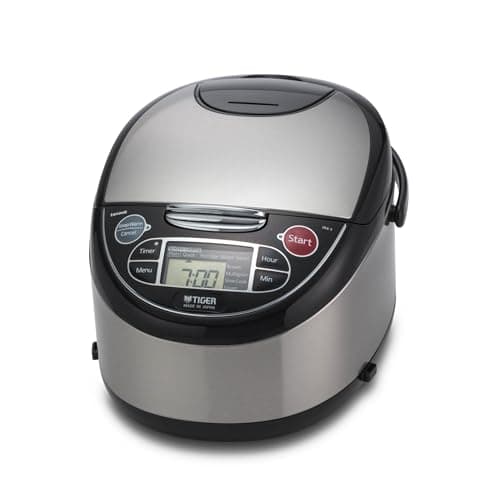
641 W
Tiger JAX-T10U Micom Rice Cooker & Warmer with tacook, 5.5 Cup
Tiger's answer to Zojirushi, with one trick the Zojirushis do not have: the tacook synchronous-cooking tray steams a dish above the rice while it cooks below, from the same 641 W. A Micom fuzzy-logic cooker made in Japan, with a genuinely useful feature the marketing did not invent.
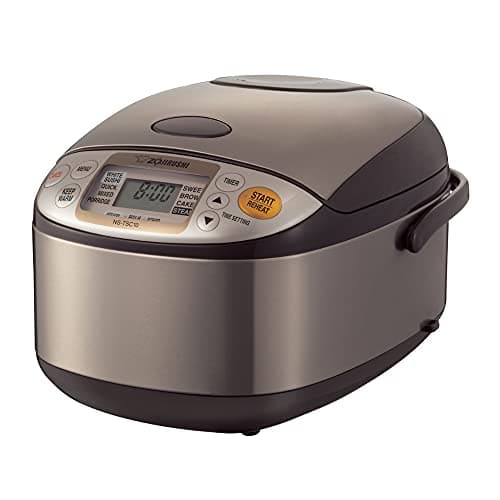
610 W
Zojirushi NS-TSC10 Micom Rice Cooker & Warmer, 5.5 Cup
A Micom fuzzy-logic Zojirushi at meaningfully less than the Neuro Fuzzy, with a couple of trades: it is made in China rather than Japan, and it adds a steam and cake function the NS-ZCC10 lacks. Same fundamental advantage — the microcomputer adjusts heat as it cooks — at 610 W.
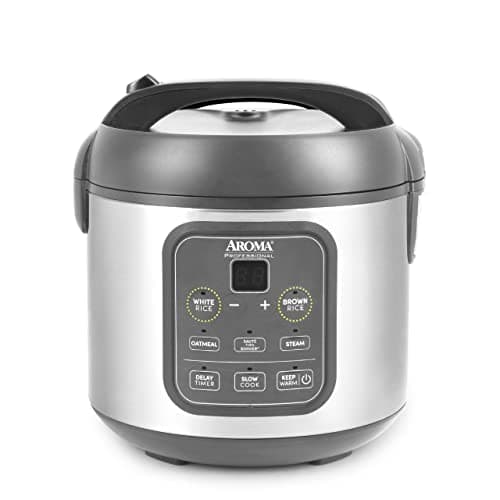
450 W
Aroma Professional ARC-994SG Digital Rice Cooker & Multicooker
The budget pick now, and an honest one. For around forty dollars it cooks white and brown rice, sautés then simmers, slow-cooks for 2 to 10 hours and steams — a genuine little multicooker in a small pot — and Aroma publishes its 450 W draw. What Aroma does not publish is how its 'Sensor Logic' works, and there are only two rice programs, so this is the versatility pick, not the rice-quality one.
#ad · As an Amazon Associate we earn from qualifying purchases.
Questions
Frequently asked
Is a rice cooker the same as a rice steamer?
Can you cook rice in a food steamer?
How does a rice cooker know when the rice is done?
Which rice cookers come with a steamer tray?
Is a steamer healthier than a rice cooker?
Should I buy a rice cooker or a multicooker if I want to steam too?
Keep reading
Related
- How a rice cooker worksThe cook cycle and the sensor, step by step.
- Steaming vegetables in a rice cookerThe tray technique, if yours came with one.
- The best rice cookersWhere to start if rice is the point.
- What a rice-cooker cup isWhy capacity numbers do not compare across categories.
- What else a rice cooker can cookBeyond rice, with the tray and without.
Receipts
Sources
- Tiger Corporation (USA) — JAX-T10U rice cooker product page
- Zojirushi — NS-TSC10 Micom Rice Cooker product page
- Aroma Housewares — ARC-994SG instruction manual [PDF]
- USDA FoodData Central — rice, cooked (nutrition reference)
We have not tested these machines in a lab and we do not pretend to have. Specifications come from the manufacturer's own published documents; electricity rates come from the US Energy Information Administration; prices come from the live Amazon API. Where a figure is not published, the page says “not published” rather than guessing. Read the full method.