The short answer
Buy the Avid Armor USV20if you seal meat regularly. It is a chamber machine rather than a better edge sealer: it drops the pressure around the whole bag, so the purge, brine or marinade that comes out of meat never travels toward a pump — and it is the only sealer here whose maker publishes a seal-bar figure, an 11.5-inch double seal. Buy the Nesco VS-12 if you are portioning a batch rather than sealing liquid: it is the only machine here with a pulse vacuum and a manual seal and separate Dry/Moist seal timing anda Normal/Gentle pressure setting, all documented in Nesco's own guide. The budget pick is the FoodSaver FM2100, the cheapest machine here, with dry and moist settings and bags you can buy in a supermarket.
Every price comes from our daily refresh and the Quick Picks table prints the date of the most recent one. Treat the table as the authority over any sentence below.
Why meat reorders this list
We have two other sealer pages on this site and this one puts them in a different order on purpose, so it is worth saying why in one paragraph.
A sous vide cook's problem is a vacuum that will not stop — a fillet crushed flat, marinade pulled out of the bag and into the machine. That is a question about control, and it is what our sous vide sealer ranking is built on. A meat buyer's problem is different and has two halves: meat releases liquid of its own whatever you do to it, and the bag has to stay sealed for months in a freezer. Both of those are questions about the weld, not the pump. Rank on the weld and the dearest machine on the site goes first.
How we ranked
Can it seal liquid at all? This is first and it is binary. An edge sealer pulls air across the open mouth of a bag, so anything liquid in that bag travels toward the pump as the pressure drops. A chamber machine evacuates the whole box the bag sits in, so the liquid never moves. No amount of suction turns the first mechanism into the second.
Then the seal itself.A double weld — two parallel seal lines rather than one — is what you want on a bag that will be handled, stacked and frozen. Avid Armor publishes a double seal and the bar's width; Nesco's guide documents that both its Dry and Moist settings double-seal; Anova describes a double seal specifically for juicy food. The FoodSaver's listing does not say.
Then the width you can actually use. Big cuts need wide bags, and this is where the field is quiet: Avid Armor is the only maker here that publishes a seal-bar figure at all. Nesco publishes that its storage takes an 11-inch roll, which is a hint rather than a specification. Anova and FoodSaver publish nothing, so bag-width compatibility is something you measure rather than read.
Then whether you can stop the machine— a pulse vacuum and a manual seal, which matter as much on a cold wet steak as on a delicate fillet — and then whether it can keep going, because portioning a batch of meat is twenty bags in a row rather than one.
Price is last, which is why the most expensive machine on this hub is first and the cheapest is still on the page. Our method ranks on what makers publish, and on this page three of the four criteria are things only one of them publishes.
The finding: the box is the limit, not the bar
The honest catch with the chamber machine, and it is the thing nobody mentions when they recommend one. The USV20's seal bar is 11.5 inches wide, which is wider than the roll storage on any edge sealer here — but its chamber holds 4 liters, and the bag has to fit inside the box. A whole brisket is not going in it however wide the bar is.
So the chamber does not solve “I bought a side of beef.” It solves “everything I seal is wet.” If your work is large whole cuts, the machine does not change the answer: portion first, then seal — which is better practice anyway, because a portioned bag thaws faster and more evenly than a slab, and a cut you freeze whole is a cut you have to commit to cooking whole.
The other thing no maker here publishes is a vacuum pressure figure— not in inHg, not in kPa, not one of the four. Anova publishes an extraction rate (12 L/min), which is a flow figure rather than a pressure, and it is the only number of its kind in this catalog. Any claim that one of these machines pulls a stronger vacuum than another is therefore unverifiable, and we have not ranked on it.
The winner, and who should not buy it
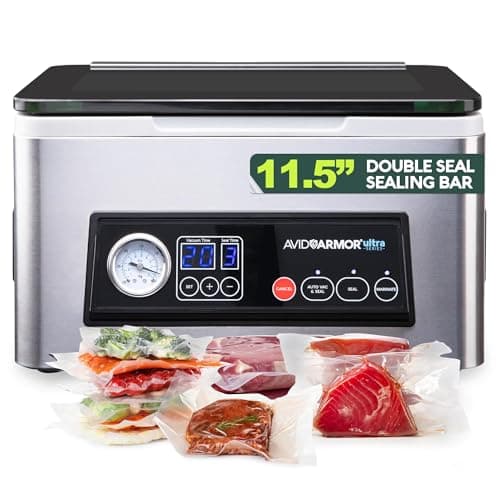
The Avid Armor USV20 is a chamber vacuum sealer: a 4-liter chamber, an 11.5-inch double seal bar, and a machine Avid Armor itself describes as intended for wet foods, soups and liquids. For meat that means brine, marinade and the purge that comes out of a thawed cut can all go in the bag and get sealed, which no edge sealer on this page can do.
The second advantage is the bag cost, and over a year of meat it is not small. Chamber pouches are smooth and generic rather than textured and brand-specific, so the per-bag running cost is lower than any channel-bag roll — which matters if you are sealing dozens of portions a month rather than two.
Three honest reasons not to buy it. It costs several times what the others do. It is roughly seventeen pounds of machine that has to live somewhere on a worktop permanently, because it is not something you lift out of a cupboard. And Avid Armor publishes no wattage for it, so this card carries no running-cost figure — the 300 W number in circulation is a retailer figure rather than the maker's, and we do not print those. If what you seal is portioned, fairly dry meat, an edge sealer does the same job for a fraction of the money and the counter space.
The one for portioning a batch
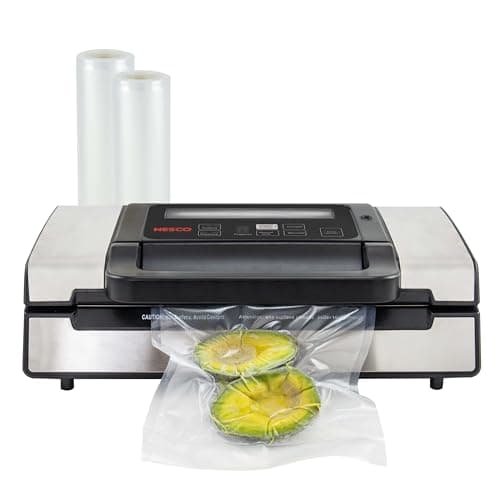
The Nesco VS-12is second and for most home buyers it is the sensible pick. 130 W, and the only machine here with four independent controls documented in the maker's own care-and-use guide: Dry and Moist seal timing, both of which double-seal; Normal and Gentle vacuum pressure; a Pulse Vacuum; and a Manual Seal. Those last two are how you stop the pump the moment a bag is tight rather than when the machine decides — which on a wet steak is the difference between a clean weld and liquid in the seal channel.
Nesco also does the thing we rate highest on this site: it publishes the limitation. Its guide documents a removable tray inside the vacuum chamber that catches liquid pulled out of the bag, and tells you to clean it after every use. That is a manufacturer stating plainly that an edge sealer will pull liquid, and it is more honest than any marketing copy in this category. There is a Marinate program too, which cycles the vacuum rather than pulling once.
The limit is the duty cycle, and for meat specifically it is the thing to know: Nesco's own guide says to let the machine cool for two minutes between uses, and that Manual Seal will not fire within 15 seconds of the last activation. That is fine for a weekend batch of eight portions. It is slow for twenty bags in a row, and it is the reason a hunter processing an animal in one afternoon should be looking at the chamber machine instead. One-year warranty.
The best-documented edge sealer
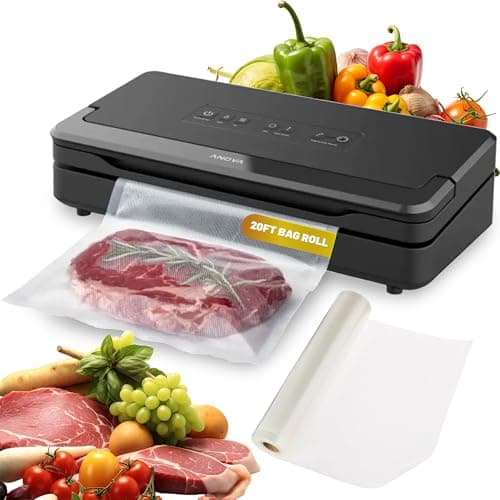
The Anova Precision Vacuum Sealer Prowins our sous vide page and places third here, which is the clearest illustration of what changes when the job changes. Anova publishes 110 W, an extraction rate of 12 L/min — the only flow figure anyone in this field prints — a two-year warranty, the longest here, and an accessory port with the hose in the box for jars and canisters. Its own copy describes a low-pressure suction function and a double seal for juicy food, which is the right pair of features for meat.
What keeps it third is what it does not publish. No seal-bar width and no vacuum pressure, so there is no way to read whether a wide bag fits — you measure. The wet-and-dry mode set appears in its marketing copy and not in its specification table, which is a documentation gap on a machine sold partly on wet-food performance. And it is built around Anova's own bags, which is a consumable you keep buying from one brand. It is an excellent edge sealer and it is still an edge sealer: standing liquid is not its job.
The budget pick
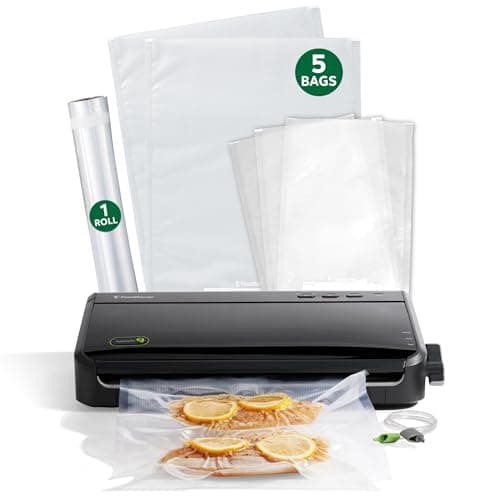
The FoodSaver FM2100 is the cheapest machine here and the one most people already own. One-touch sealing, dry and moist food settings, roll storage and a cutter built into the body so making a custom-length bag for an awkward cut is one motion. Its own listing names sous vide as a use, which matters because a sealer tuned purely for dry pantry goods is the wrong starting point for meat.
The real advantage for a meat buyer is unglamorous: bag availability. FoodSaver rolls are on a supermarket shelf, which no other brand here manages, so you never find yourself with thawed meat and no bags. The real limits are equally plain. One-touch means exactly that — no pulse, no manual seal, so there is no way to cut the vacuum short. FoodSaver publishes no wattage, no vacuum pressure and no seal-bar width anywhere we could reach, so this card carries no running-cost figure at all. And it is built around FoodSaver's own textured bags.
What a vacuum sealer does not do
Two things worth being clear about, because they are where people get hurt rather than disappointed.
Vacuum packing removes the air that causes freezer burn. It does not change the USDA's rules about how long meat may sit at room temperature before it goes into the bag — the two-hour limit applies to a cut you are about to seal exactly as it applies to a cut you are about to cook, and a sealed bag left on the counter is not safer than an unsealed one. Our sous vide safety page goes through the time-and-temperature side of that properly.
And a sealed bag is not a license to skip the thaw. If you are putting a sealed bag straight into a water bath from frozen, read can you sous vide frozen meat first — it works, with a documented adjustment, and it is not the same cook.
If you are not sure you need a machine at all, the water-displacement method in sous vide without a vacuum sealer is free and genuinely adequate for short cooks, and whether Ziploc bags are safe for sous vide is the honest version of the other half of that question. Neither is the right answer for a freezer, which is what this page is about.
Choosing in one minute
Most of what you seal is wet— brine, marinade, thawed cuts that purge. Avid Armor USV20. It is the only machine here that can seal standing liquid, and the only one publishing its seal-bar width.
You portion a batch every few weeks. Nesco VS-12. Pulse vacuum, manual seal, Dry/Moist timing and Normal/Gentle pressure, all documented, plus a liquid-catch tray the maker tells you to clean.
The bags are going in a water bath as often as a freezer.Anova Precision Vacuum Sealer Pro, 12 L/min, two-year warranty, a double seal for juicy food.
You want the cheapest machine and bags you can buy anywhere. FoodSaver FM2100.
You are processing a whole animal in an afternoon.The chamber machine, for the duty cycle rather than the chamber — and portion before you seal, because 4 liters is a hard ceiling.
Three habits that matter more than the machine
Chill the meat before you seal it. Cold meat releases less liquid, so a cut straight from the refrigerator gives any edge sealer a far better chance of a clean weld than one that has been sitting out.
Leave bag above the weld. Three inches of spare bag above the seal line gives you somewhere to cut and re-seal if a bag fails in the freezer, and keeps liquid away from the seal channel while the pump runs.
Freeze flat, then stack. A portion frozen flat thaws faster and more evenly than a block, and it is the only way a freezer drawer holds a sensible number of bags.
The two mistakes
Buying an edge sealer to seal liquid and then blaming the machine. It is not a tuning problem, it is the mechanism — air is being pulled across the mouth of the bag and the liquid goes with it. And buying the chamber machine for big cuts: the 4-liter box is the constraint, not the 11.5-inch bar, so if whole roasts are the job you still have to portion them first.