HUB 02 · Rice Cookers
How to Choose a Rice Cooker
A rice cooker is a small decision made confusing by jargon — cups that are not cups, Micom versus induction versus pressure, a $30 model next to a $420 one. This buyer's guide walks the real decisions in order, so you buy the cooker that fits your household and your rice rather than the one with the longest spec list.
We earn a commission if you buy through our links. It does not change the price you pay, and it does not decide our picks — the scoring rubric is published in full, including what disqualifies a pick. How this works.
Buy for the rice and the household, not the spec list
A rice cooker is one of the easiest appliances to overbuy, because the marketing pushes program counts and the prices span more than tenfold. The way to get it right is to work through the decisions in order — how much rice, what heat control, which rice you actually eat, what extras earn their keep, and what is sane to spend — and let those answers pick the cooker. Do that and the choice is straightforward; skip it and you end up with a thirteen-program machine you use on one setting, or a cooker too small for your family. Here is each decision, in the order that matters.
1. Capacity — and the rice-cup gotcha
Start with size, and know the trap first: rice-cooker capacity is quoted in an uncooked 180 ml rice cup, not the 240 ml US measuring cup, and rice roughly doubles as it cooks. So a “6-cup” cooker makes about 12 US-cups of cooked rice — genuinely more than the number suggests. As a rough guide: a 3-cup cooker suits one or two people; a 5.5-cup is the standard household size, comfortable for a family with leftovers; and a 6-cupis for a larger household or anyone batch-cooking rice for the week. Do not size up “just in case” — a cooker makes its best rice near a full pot, and a huge cooker cooking a tiny portion cooks it worse. The full cup explainer is in the rice-to-water ratio guide.
2. Heat-control tier — the decision that sets the price
This is the choice that matters most, because it is where nearly all the price difference lives. There are four tiers, and each buys you something specific:
- Basic on/off: one thermostat, full heat until the water boils off, then clicks to warm. Cheapest; fine for plain white rice measured carefully; a gamble on anything else.
- Fuzzy logic (Micom): a microcomputer senses temperature and adjusts heat and timing through the cook — more consistent rice, forgives small ratio errors, handles brown, sushi and mixed. This is the upgrade that actually changes the rice, and the one most people should buy. See what fuzzy logic is.
- Induction: energizes the whole pot electromagnetically for the most even, responsive heat — the best grain a home cooker makes, and the biggest draw. A refinement on top of fuzzy logic, not a replacement for it.
- Pressure: cooks under pressure for the fluffiest, stickiest short-grain — the Korean approach, best for sushi, sticky and mixed rice, with a sealing gasket to maintain.
The honest headline: pay for fuzzy logic; treat induction and pressure as specialist upgrades for daily rice eaters and short-grain lovers respectively. We map the tiers in depth in induction vs fuzzy logic.
3. The rice you actually eat
Match the tier to your rice, because different styles reward different heat. If you mostly cook short-grain, sushi or sticky rice, pressure helps most — the Cuckoo CRP-P0609S is built for exactly that. If you cook a range of styles including brown and mixed, fuzzy logic's adjustable programs are the versatile answer. If your daily rice is long-grain or basmati, where you want dry, separate grains, the pressure advantage is largely wasted — a good fuzzy-logic cooker matches it, so do not pay for pressure you will not use. Be honest about what is actually in your cupboard; it is the fastest way to avoid paying for the wrong technology.
4. The extras that earn their keep
A few features are genuinely worth having, and a few are noise. The ones that matter: a good keep-warm that holds rice for hours without drying it, which is most of why people buy a rice cooker at all; a delay timer, so rice is ready when you walk in — the reason it becomes a daily habit; and, if it suits how you cook, Tiger's tacook synchronous tray that steams a dish above the rice. Made in Japan is a real build signal worth a little extra for many buyers — the Zojirushi NS-ZCC10 and Tiger JAX-T10U carry it, while the cheaper Zojirushi NS-TSC10 is made in China. What is not worth chasing: a long list of named programs you will never use. A cooker with eight settings you use and one with twenty you do not are the same cooker in practice.
5. Price sanity
Rice cookers run from about $40 to well over $400, and both ends are rational for the right buyer. A budget digital cooker like the Aroma ARC-994SG does about 80% of the job — it even adds a Saute-Then-Simmer and slow-cook mode, and Aroma publishes its 450 W draw — and for occasional rice it is all most people need, with the honest caveat that it has two rice programs and an unexplained “Sensor Logic” rather than documented fuzzy logic, so the rice is good but not the best. At the other end, the induction Zojirushi NP-HCC10 is a several-hundred-dollar cooker that makes sense specifically for the daily rice eater, for whom a small per-bowl improvement compounds every day. Between them sits the Zojirushi Neuro Fuzzy, the fuzzy-logic benchmark most households should buy. The question is not “what is the best cooker” but “how much rice do I really cook” — the answer sets the budget.
How we judge these
Everything above comes from the same rubric we use across the site: we score cookers on published capability, capacity, documentation, build and value, from manufacturer spec sheets and manuals rather than a test kitchen — we do not claim to have cooked in them, only to have read what the makers publish and weighed it honestly. Where a manufacturer omits a figure, such as the wattage on the Toshiba mini, we say so rather than invent one. The full method, including what disqualifies a pick, is in our methodology.
A quick tour of the brands
Knowing what each brand is for shortens the search. Zojirushi is the Japanese benchmark, spanning the fuzzy-logic NS-ZCC10 (made in Japan), the lower-cost NS-TSC10 (made in China), and the top-of-range induction NP-HCC10 — the most consistently well-documented cookers here. Tiger is the other Japanese name, and its JAX-T10U brings the tacook tray that steams a dish above the rice. Cuckoo is the Korean specialist, offering the pressure CRP-P0609S with a 304 stainless pot and the non-pressure CR-0631F. Aroma is the value brand — the digital ARC-994SG does more than rice, with sauté, slow-cook and steam functions, for around forty dollars. And Toshiba covers the small end with a fuzzy-logic mini. Pick the brand whose strength matches your priority rather than by name recognition alone.
When it is worth upgrading
If you already own a rice cooker, the upgrade worth making is almost always a tier jump, not a lateral one. Moving from a basic on/off cooker to fuzzy logic is the upgrade that genuinely changes the rice and is worth it for most people; swapping one basic cooker for another rarely is. Going from fuzzy logic to induction or pressure is worth it only if you have a specific reason — you eat rice daily and want the best grain, or you cook a lot of sticky short-grain. And if your current cooker still makes rice you are happy with, the honest advice is to keep it: a rice cooker is a buy-it-once appliance, and the best upgrade is the one that fixes a problem you actually have.
Do not overlook the boring features
The specs that sell cookers are rarely the ones you use daily. A reliable delay timer and a good keep-warm shape the everyday experience more than a long program list, and an inner pot that is comfortable to wash and a lid that comes apart for cleaning save you real irritation over the years. Before you are swayed by a headline feature, check that the cooker nails these unglamorous basics — they are what you actually touch every time you make rice.
The decision rule
Put it together in one line. Size to your household — 3-cup for one or two, 5.5-cup for most families, 6-cup for batch cooking — remembering the cup is uncooked rice. Then: if you want the cooker most people should buy, get a fuzzy-logic Micom model like the Zojirushi Neuro Fuzzy. If you cook rice occasionally and want to spend little, a budget digital Aroma does most of the job. If you eat rice most days and want the best grain, step up to the induction Zojirushi. And if your rice is mostly short-grain, sushi or sticky, a pressure Cuckoo is the specialist. Buy on your household size and the rice you actually eat — not the length of the program list. To see it all ranked, start with the best rice cooker guide, and if you are not sure a rice cooker is the right appliance at all, see are rice cookers worth it.
The hardware
The cookers this page is about
The cookers referred to above, with prices pulled live from Amazon and dated on every card. Full rankings live in the roundups linked from this page.
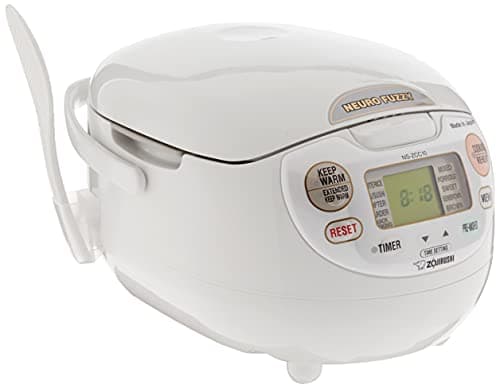
680 W
Zojirushi NS-ZCC10 Neuro Fuzzy Rice Cooker & Warmer, 5.5 Cup
The rice cooker every other one is measured against. Its Neuro Fuzzy microcomputer adjusts heat through the cook rather than running a fixed timer, which is the whole reason a $260 rice cooker cooks rice better than a $30 one. Made in Japan, 680 W, and the settings that matter are all there.
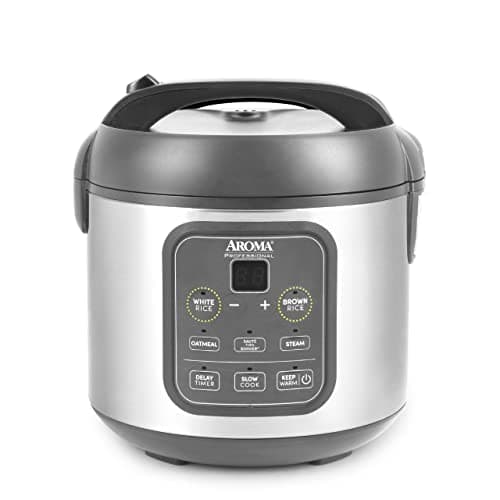
450 W
Aroma Professional ARC-994SG Digital Rice Cooker & Multicooker
The budget pick now, and an honest one. For around forty dollars it cooks white and brown rice, sautés then simmers, slow-cooks for 2 to 10 hours and steams — a genuine little multicooker in a small pot — and Aroma publishes its 450 W draw. What Aroma does not publish is how its 'Sensor Logic' works, and there are only two rice programs, so this is the versatility pick, not the rice-quality one.
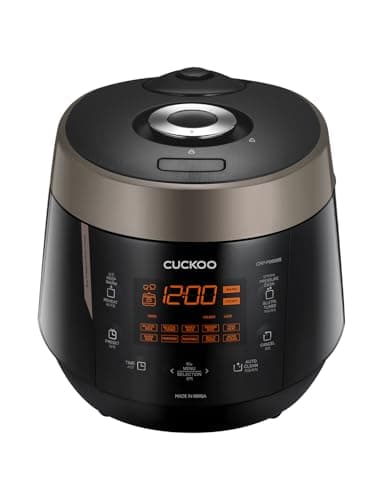
890 W
Cuckoo CRP-P0609S High-Pressure Rice Cooker, 6 Cup
A pressurized rice cooker, which is the Korean approach and a genuinely different one: cooking rice under pressure raises the boiling point and produces a distinctly fluffier, stickier grain, especially for short-grain and mixed rice. 890 W, a 304 stainless pot, and Cuckoo's signature talking interface.
#ad · As an Amazon Associate we earn from qualifying purchases.
Questions
Frequently asked
What size rice cooker should I buy?
What kind of rice cooker should I get?
How much should I spend on a rice cooker?
Keep reading
Related
Receipts
Sources
- Zojirushi — NS-ZCC10 Neuro Fuzzy Rice Cooker product page
- Aroma Housewares — ARC-994SG Digital Rice & Grain Multicooker product page (Overview & Specs)
- Cuckoo CRP-P0609S series manual (specification page)
We have not tested these machines in a lab and we do not pretend to have. Specifications come from the manufacturer's own published documents; electricity rates come from the US Energy Information Administration; prices come from the live Amazon API. Where a figure is not published, the page says “not published” rather than guessing. Read the full method.