HUB 02 · Rice Cookers
How to Cook Quinoa in a Rice Cooker
Quinoa is one of the easiest things to cook in a rice cooker once you know two tricks: rinse it well so it is not bitter, and give it a touch less water than you might expect. Here is the full method — rinse, ratio, setting, rest and fluff — and why a fuzzy-logic cooker makes it more forgiving.
We earn a commission if you buy through our links. It does not change the price you pay, and it does not decide our picks — the scoring rubric is published in full, including what disqualifies a pick. How this works.
Quinoa is a seed, and it cooks like easy rice
Quinoa is technically a seed, not a grain, but it cooks by absorption just like rice — which is why a rice cooker handles it so well. You measure it, add water, press a button and walk away, and the cooker turns it into fluffy, separate little grains with a slight bite and a nutty flavor. There are really only two things that separate good quinoa from disappointing quinoa, and neither is hard: a proper rinse, and getting the water roughly right. Get those two, and the cooker does the rest.
Rinse it well — this is the step people skip
The single most important step is the rinse. Quinoa seeds carry a natural coating of saponins, a slightly soapy, bitter compound that protects the plant — and if you do not wash it off, that bitterness ends up in your bowl. Put the measured quinoa in a fine-mesh strainer (the seeds are small enough to slip through a colander) and rinse under cold running water for 30 seconds to a minute, rubbing it with your fingers, until the water runs clear and stops foaming. Some packaged quinoa is sold “pre-rinsed,” but a quick rinse anyway is cheap insurance against bitterness. Drain it well before it goes in the cooker so the extra water does not throw off your ratio.
The water ratio — a bit under two parts water to one of quinoa
Quinoa wants less water than it first appears to. A useful mental model is roughly one part quinoa to a bit under two parts water— noticeably less than the two-to-one many stovetop recipes quote, because a rice cooker's sealed pot loses less water to evaporation, so too much liquid leaves you with soggy, waterlogged quinoa. But the exact figure depends on your quinoa and your cooker, and we keep the precise numbers for every grain in one place so they stay consistent — see the rice-to-water ratio guide for the working figures. Err slightly on the drier side if you rinsed thoroughly, since the seeds carry a little water in from the rinse. If your first batch comes out a touch wet or a touch firm, adjust the water a little next time and you will quickly dial in your cooker.
Use the white-rice or plain-cook setting
Quinoa cooks in about the same time as white rice, so the white-rice or plain-cook setting is the right one on nearly every cooker. You do not need a special program — just load the rinsed quinoa and water, close the lid, and start a normal white-rice cook. On a Zojirushi NS-TSC10 or any fuzzy-logic cooker, the microcomputer manages the heat as it goes, which suits quinoa well because the seeds are more delicate than rice and benefit from heat that eases off rather than blasting to the end. If your cooker has a steam tray like the Tiger JAX-T10U, you can even steam a portion of vegetables above the quinoa while it cooks. When the cycle ends, do not open the lid straight away — the rest matters, and it is next.
Rest on keep-warm, then fluff
When the cook finishes, leave the quinoa on keep-warm with the lid closed for about 10 minutes before you open it. This rest lets the remaining moisture redistribute and the seeds firm up, which is the difference between fluffy and mushy — open it the second it clicks off and the quinoa at the top is wetter than the bottom. After the rest, fluff it gently with a fork or the cooker's paddle to separate the seeds and let the steam escape. Well-cooked quinoa looks like it has little spiral tails uncurling from each seed and has a light, separate texture. If it is slightly wet, a few minutes more on keep-warm with the lid off helps it dry.
Why fuzzy logic helps with quinoa
Quinoa is more delicate than rice and less forgiving of a heavy hand with the heat, which is exactly where a fuzzy-logic cooker earns its place. Because it senses and adjusts the heat through the cook rather than running one fixed setting until the water is gone, it eases off as the quinoa finishes instead of driving hard heat into a nearly-cooked pot and scorching the bottom. A cheap on/off cooker can absolutely cook quinoa, but it gives you less margin — a little too much water and it stays wet, a little too little and it catches. The fuzzy-logic cooker widens that margin, which is why the same machines that make the best rice tend to make the best quinoa.
A note on cookers locked to a rice-only cycle
Most rice cookers cook quinoa without complaint, but there is one thing to watch: because quinoa is a seed rather than rice, a cooker with a fixed, rice-only cycle that is tuned tightly around rice may run a little long or short for it. In practice this is rarely a problem on a fuzzy-logic cooker, which judges the cook by temperature rather than a rigid timer, so it adapts to the different contents. On a basic timer cooker you may just need to keep an eye on the first batch and adjust the water. Either way, quinoa is one of the most forgiving things you can put in a rice cooker — far more so than brown rice — so do not overthink it. Rinse well, keep the water a touch under two-to-one, rest and fluff, and it is hard to get wrong.
The two rules that matter most: rinse the quinoa until the water runs clear to wash off the bitter saponins, and use a little less water than you would for a soupy stovetop batch — roughly one part quinoa to a bit under two parts water — because the sealed pot keeps more moisture in. Run the white-rice setting, rest for 10 minutes on keep-warm, and fluff. For the exact ratio figures alongside every other grain, see the rice-to-water ratio guide.
The hardware
The cookers this page is about
The cookers referred to above, with prices pulled live from Amazon and dated on every card. Full rankings live in the roundups linked from this page.
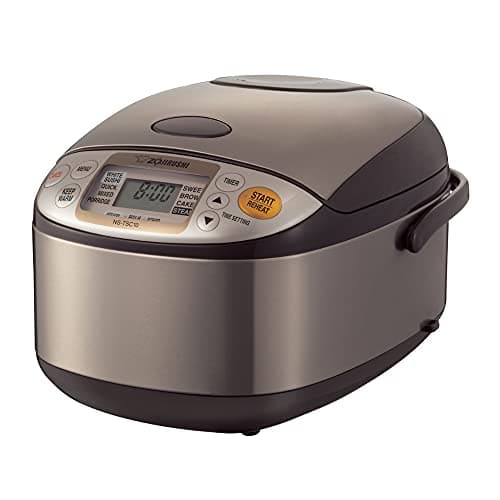
610 W
Zojirushi NS-TSC10 Micom Rice Cooker & Warmer, 5.5 Cup
A Micom fuzzy-logic Zojirushi at meaningfully less than the Neuro Fuzzy, with a couple of trades: it is made in China rather than Japan, and it adds a steam and cake function the NS-ZCC10 lacks. Same fundamental advantage — the microcomputer adjusts heat as it cooks — at 610 W.
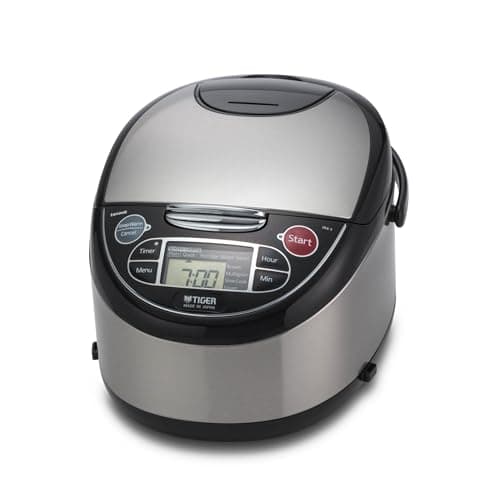
641 W
Tiger JAX-T10U Micom Rice Cooker & Warmer with tacook, 5.5 Cup
Tiger's answer to Zojirushi, with one trick the Zojirushis do not have: the tacook synchronous-cooking tray steams a dish above the rice while it cooks below, from the same 641 W. A Micom fuzzy-logic cooker made in Japan, with a genuinely useful feature the marketing did not invent.
#ad · As an Amazon Associate we earn from qualifying purchases.
Questions
Frequently asked
What is the water ratio for quinoa in a rice cooker?
Do you need to rinse quinoa before cooking it?
What setting do you use for quinoa in a rice cooker?
Keep reading
Related
Receipts
Sources
- Zojirushi — NS-TSC10 Micom Rice Cooker product page
- Tiger Corporation (USA) — JAX-T10U rice cooker product page
We have not tested these machines in a lab and we do not pretend to have. Specifications come from the manufacturer's own published documents; electricity rates come from the US Energy Information Administration; prices come from the live Amazon API. Where a figure is not published, the page says “not published” rather than guessing. Read the full method.