HUB 02 · Rice Cookers
How to Make Sushi Rice in a Rice Cooker
Good sushi rice is short-grain, cooked to a grain that is sticky enough to hold together but still distinct, then seasoned with a warm vinegar dressing. A rice cooker does the hard part for you — here is the rice to buy, how to rinse and cook it, and how to season it so it tastes like the rice under real sushi.
We earn a commission if you buy through our links. It does not change the price you pay, and it does not decide our picks — the scoring rubric is published in full, including what disqualifies a pick. How this works.
Start with the right rice
Sushi rice is a style of rice, not a brand: short-grain (sometimes labeled medium-grain) Japanese rice, the kind that cooks up plump and slightly sticky so it holds together in a nigiri or a roll without being gluey. Long-grain and basmati will not do it — they are bred to cook dry and separate, which is the opposite of what you want here. Look for a bag labeled short-grain, sushi rice, or a Japanese-style rice such as Koshihikari or Calrose. Getting the rice right is more than half the job; no setting or seasoning turns long-grain into proper sushi rice.
Rinse until the water runs clear
Put the measured rice in a bowl or the cooker pot, cover with cold water, swirl with your hand, and pour off the cloudy water. Repeat until the water runs almost clear— three to five changes is usual. This rinses away loose surface starch, which is what makes sushi rice turn gummy and boil over if you leave it on. Do not skip this step for sushi: the whole point is a grain that is sticky in the right way, from the rice's own starch, not slick with surface starch. Drain the rinsed rice well before you cook. (The one exception is rice explicitly labeled “rinse-free,” which is milled to skip this.)
The water ratio — keep it a touch drier than long-grain
Short-grain rice wants noticeably less water than long-grain — often close to equal parts rice and water, roughly 1:1 to about 1:1.1 — so the finished grain is firm and distinct rather than mushy. But the exact figure depends on your rice and your cooker, and it is not worth over-thinking here, because the single most reliable method is to measure the rice with the cup that came with the cooker and fill water to the matching line in the pot, which is calibrated for exactly this. We keep the precise numbers by rice type on one page so they stay consistent — see the rice-to-water ratio guide for the sushi and short-grain figures. If you rinsed thoroughly, err slightly on the drier side, because the grains carry a little water in from the rinse.
Use a Sushi or White setting
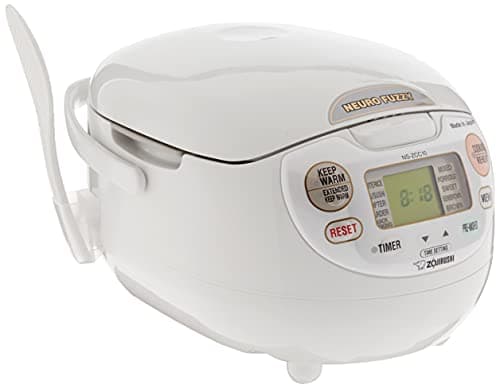
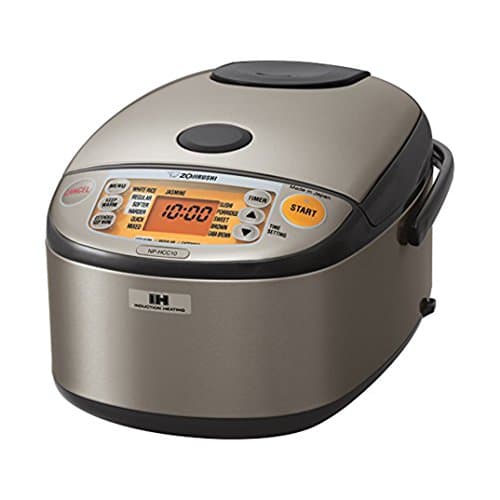
If your cooker has a dedicated Sushi program, use it — it tunes the water uptake and heat curve for exactly this firm-but-sticky short-grain result. The Zojirushi NS-ZCC10 Neuro Fuzzy carries a sushi setting among its menu, and the induction Zojirushi NP-HCC10 has one within the widest program set here. If your cooker has no sushi mode, the plain White setting is completely fine — a good fuzzy-logic cooker adjusts the heat as it goes and cooks excellent short-grain on White. This is where the machine matters: a fuzzy-logic or pressure cooker forgives a slightly-off ratio and nails the texture, where a basic timer cooker leaves less room for error. When the cook finishes, let the rice rest with the lid on for about 10 minutes before you open it, so the moisture settles evenly through the grain.
Why pressure and fuzzy logic help sushi rice most
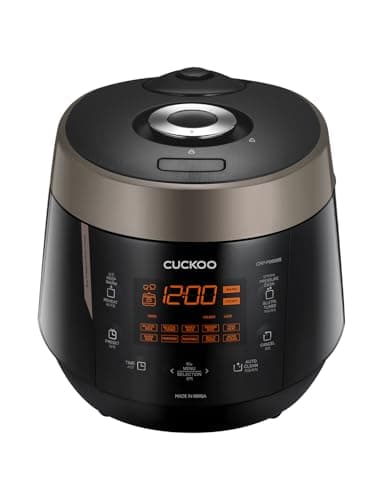
Sushi rice is the exact style where a cooker's technology shows most, because you want a precise stickiness. Pressure drives water into short-grain more completely for the fluffiest, stickiest, most uniform result — which is why the Cuckoo CRP-P0609S tops our best rice cooker for sushi rice roundup. Fuzzy logic senses and adjusts the heat through the cook, so it makes consistent short-grain even without pressure. A $30 timer cooker can make edible sushi rice; the premium cookers make it right, batch after batch. You do not need a special cooker to start — but if sushi rice is something you make often, this is the style that most rewards a better one.
Season it while it is warm
The step that turns cooked short-grain into sushi rice is the vinegar seasoning. The classic dressing is rice vinegar with sugar and salt — warmed gently just until the sugar and salt dissolve (do not boil it), then poured over the hot rice. Turn the rice out into a wide, non-metal bowl, drizzle the seasoning over it, and fold it through with a slicing, cutting motion — never stir or mash, which crushes the grains and turns it pasty. As you fold, fan the rice or wave a plate over it: cooling it quickly as you mix gives sushi rice its characteristic glossy sheen and keeps the grains distinct. Season and cool it while it is still warm; cold rice will not take the dressing evenly.
How much rice to make
Sushi rice roughly doubles in volume as it cooks, and it goes further than people expect once it is seasoned and shaped, so measure conservatively for a first batch. A useful rule of thumb: plan on roughly a cup or so of uncookedshort-grain rice for a modest meal for two, and scale from there — it is easy to make far too much on the first try. Measure the rice with the cup that came with the cooker so the pot's fill lines stay accurate, and remember that a big household batch is exactly what a 5.5- or 6-cup cooker is for. Leftover seasoned rice does not keep well, so it is better to slightly under-make and cook again than to over-make and refrigerate rice that will harden and lose its shine.
The vinegar seasoning, in proportion
The seasoning is rice vinegar, sugar and salt, and the exact proportion is a matter of taste — sweeter and sharper toward some styles, cleaner and saltier toward others — but the reliable starting point is a modest amount of vinegar with rather less sugar and a small pinch of salt, warmed only until the solids dissolve. The ideas matter more than any single number: use enough seasoning to coat the rice without making it wet, scale it up as you scale the rice, and taste a grain before you commit the whole batch. Many cooks keep a jar of pre-mixed seasoned rice vinegar for exactly this, which takes the measuring out of it entirely. If the rice tastes flat, it usually wants a touch more salt; if it tastes harsh, a little more sugar rounds it out.
Common sushi-rice mistakes to avoid
A handful of errors account for most disappointing sushi rice, and all are easy to avoid. The biggest is too much water — sushi rice wants less than long-grain, and an over-wet pot gives you mush that will not hold a shape. Next is skipping the rinse, which leaves surface starch that turns the rice gluey. Third is stirring the seasoning in rather than folding it with a cutting motion, which crushes the grains into paste. Fourth is seasoning cold rice: the dressing only absorbs evenly while the rice is warm. And fifth is using the wrong rice — no amount of technique turns long-grain or basmati into sushi rice. Get those five right and even a modest cooker makes rice good enough to roll.
Why the rinse and the rest are non-negotiable
Two steps do more for sushi rice than any gadget, and both are free. The rinse removes the loose surface starch that would otherwise gum the grains together, which is the difference between rice that separates cleanly into a glossy, distinct-but-sticky bed and rice that clumps into a paste. The 10-minute rest with the lid closed after the cook lets the moisture even out through every grain, so the top is not drier than the bottom — skip it and you fold the seasoning into rice that is still finishing, and the texture suffers. Neither step costs anything but a few minutes, and together they matter as much as which cooker you own. A premium cooker makes both steps more forgiving, but it does not replace them, which is worth remembering before you assume a better machine alone will fix disappointing rice.
Use it at room temperature
Seasoned sushi rice is meant to be used at room temperature, not fridge-cold and not piping hot — cover it with a damp cloth while you prep your fillings so it does not dry out, and use it within a few hours. Do not refrigerate finished sushi rice if you can help it; the cold hardens the grains and the vinegar loses its brightness. If you are dialing in the technique, our how to use a rice cooker guide covers the rinse-cook-rest routine in full, and the ratio guide has the exact water figures for short-grain and sushi rice.
The hardware
The cookers this page is about
The cookers referred to above, with prices pulled live from Amazon and dated on every card. Full rankings live in the roundups linked from this page.
890 W
Cuckoo CRP-P0609S High-Pressure Rice Cooker, 6 Cup
A pressurized rice cooker, which is the Korean approach and a genuinely different one: cooking rice under pressure raises the boiling point and produces a distinctly fluffier, stickier grain, especially for short-grain and mixed rice. 890 W, a 304 stainless pot, and Cuckoo's signature talking interface.
680 W
Zojirushi NS-ZCC10 Neuro Fuzzy Rice Cooker & Warmer, 5.5 Cup
The rice cooker every other one is measured against. Its Neuro Fuzzy microcomputer adjusts heat through the cook rather than running a fixed timer, which is the whole reason a $260 rice cooker cooks rice better than a $30 one. Made in Japan, 680 W, and the settings that matter are all there.
1,230 W
Zojirushi NP-HCC10 Induction Heating Rice Cooker & Warmer, 5.5 Cup
The best rice cooker on this site, and it is not close — for people who eat rice daily. Induction heats the entire pot electromagnetically rather than from a plate underneath, so the heat is more even and more responsive. It draws 1,230 W to do that, roughly double the Micom models, and it costs $420.
#ad · As an Amazon Associate we earn from qualifying purchases.
Questions
Frequently asked
What rice should I use for sushi rice?
Do I need a special setting to make sushi rice?
How do you season sushi rice?
Keep reading
Related
- How to cook sticky rice in a rice cookerGlutinous rice, a different grain and method.
- How to cook jasmine riceThe fragrant long-grain, and how it differs from sushi rice.
- The best rice cookers for sushi riceThe cookers that make short-grain best, ranked.
- Rice-to-water ratioThe exact water figures for sushi and short-grain.
- How to use a rice cookerThe full rinse-cook-rest routine.
Receipts
Sources
- Cuckoo CRP-P0609S series manual (specification page)
- Zojirushi — NS-ZCC10 Neuro Fuzzy Rice Cooker product page
- USDA FoodData Central — rice, cooked (nutrition reference)
We have not tested these machines in a lab and we do not pretend to have. Specifications come from the manufacturer's own published documents; electricity rates come from the US Energy Information Administration; prices come from the live Amazon API. Where a figure is not published, the page says “not published” rather than guessing. Read the full method.