HUB 03 · Sous Vide
Can You Use Ziploc Bags for Sous Vide?
You do not need a vacuum sealer to start cooking sous vide — a good zip-top bag works for most of what people cook. Here's the honest answer on whether that's safe, how to get the air out without a machine, and the few situations where you should reach for a sturdier bag.
We earn a commission if you buy through our links. It does not change the price you pay, and it does not decide our picks — the scoring rubric is published in full, including what disqualifies a pick. How this works.
The honest answer: yes, for most cooking
One of the most reassuring facts for a new sous vide cook is that you do not need a vacuum sealer to start — a good zip-top bag works for the great majority of what people actually cook, and it is the reason sous vide without a vacuum sealer is such a popular starting point. The question people quite rightly ask next is whether it is safeto cook food in a plastic bag in warm water, and the honest, non-alarmist answer is that for typical sous vide, using a sensible bag, it is fine. Let's go through why, and where the limits are.
Why typical sous vide temperatures are gentle
The key fact is that sous vide runs well below boiling. Most cooking happens between roughly 55°C and 90°C (about 130–195°F) — a steak sits around the mid-50s Celsius, chicken in the 60s, vegetables higher — all comfortably under the 100°C of a rolling boil. That matters because the concern people have with plastic and heat scales with temperature, and a gentle warm bath is a very different environment from boiling or frying. Reputable, food-grade polyethylene bags are designed to hold food and are not the same as, say, thin sandwich wrap; used within these gentle temperatures, they are a normal, widely-practiced way to cook. The USDA's own sous vide guidance treats food-grade bags as an accepted method (is sous vide safe covers the food-safety side in full).
Use the right bag
“A Ziploc bag” is not one thing, so choose sensibly. Use a freezer-grade, food-safe zip-top bag rather than the thinnest sandwich bags — freezer bags are thicker, more durable and less likely to leak or fail at a seam over a long cook. Look for bags made from polyethylene (most name-brand freezer bags are), and if you want to sidestep the question entirely, reusable silicone sous vide bags or purpose-made sous vide pouches are inexpensive, sturdier and reusable. What you should avoid is cheap, unbranded, unknown-plastic bags, and any bag that is visibly thin or flimsy. A good freezer bag from a reputable brand, used within normal sous vide temperatures, is the sensible everyday choice; a silicone bag is the upgrade if you cook sous vide often.
Get the air out: the water-displacement method
The reason a vacuum sealer helps is not the plastic — it is removing air, because air makes a bag float and insulates the food from the water. You can do the same thing with a zip-top bag and no machine using the water-displacement method: put the food in the bag, seal it almost all the way leaving a small gap, and slowly lower the bag into the water bath. The water pressure pushes the air up and out through the gap; when the water reaches the seal line, close the last bit and lift it out. You are left with a tight, essentially air-free bag that sinks and hugs the food — exactly what you want. It takes ten seconds and is the single technique that makes bag-based sous vide work as well as it does. A bag that still floats afterward has trapped air, which is its own fixable problem — see how to keep a sous vide bag from floating.
When to reach for something sturdier
There are a few cases where a zip-top bag is not the right tool. For very long cooks — tough cuts held for 24, 48 or 72 hours — the seal on a zip-top bag is more likely to slowly fail or leak than a proper vacuum seal or a silicone bag, so those long cooks are where a vacuum sealer earns its keep. The same goes for the hotter end of the range and for anything where a leak would be a real problem. And for the record, sous vide bags are for the bath, not for reheating in a microwave or boiling — different heat, different question. For everyday steaks, chicken, fish and vegetables at normal temperatures and times, a good freezer bag with the air displaced out is genuinely all you need, which is why so many great sous vide cooks never buy a sealer at all.
The rule: for most everyday sous vide, a freezer-grade, food-safe zip-top bag is fine — the bath runs well below boiling, and reputable polyethylene bags are made for food. Remove the air with the water-displacement method so the bag sinks. Step up to a vacuum sealer or a reusable silicone bag for very long or hotter cooks, and skip cheap, thin, unknown-plastic bags.
The hardware
The cookers this page is about
The cookers referred to above, with prices pulled live from Amazon and dated on every card. Full rankings live in the roundups linked from this page.
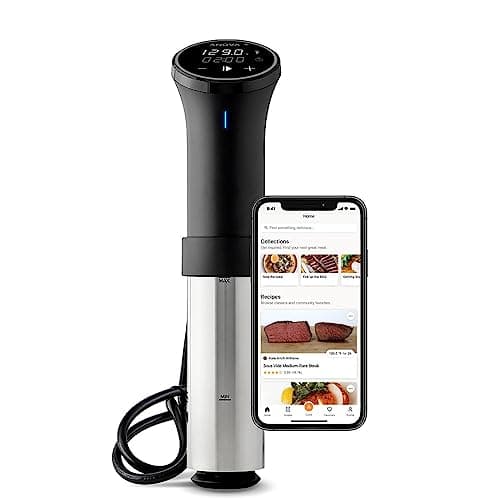
1,100 W
Anova Precision Cooker 3.0 (WiFi), 1100 W
The sous vide circulator most people should buy. Anova publishes the full specification — 1,100 W, a 0–92°C range, ±0.1°C accuracy, an 8 L/min pump — and backs it with a two-year warranty, the longest here. It has an on-device screen so it works without the app, which the Joule does not.
- PickNo image
800 W
Monoprice Strata Home Sous Vide Immersion Cooker, 800 W
The cheapest way to find out whether you actually like sous vide. Physical controls only, an 800 W element, a factory-calibrated sensor you can recalibrate yourself, and a directional pump cap that is a genuinely thoughtful touch at the price. Monoprice publishes the full spec in the manual, which the price does not lead you to expect.
#ad · As an Amazon Associate we earn from qualifying purchases.
Questions
Frequently asked
Are Ziploc bags safe for sous vide?
How do you get the air out of a Ziploc bag for sous vide?
When should you use a vacuum sealer instead of a Ziploc bag?
Keep reading
Related
Receipts
Sources
- USDA FSIS — cooking safely with time and temperature (pasteurization basics)
- Monoprice — Strata Home Sous Vide (21594, 800W) user manual [PDF]
We have not tested these machines in a lab and we do not pretend to have. Specifications come from the manufacturer's own published documents; electricity rates come from the US Energy Information Administration; prices come from the live Amazon API. Where a figure is not published, the page says “not published” rather than guessing. Read the full method.