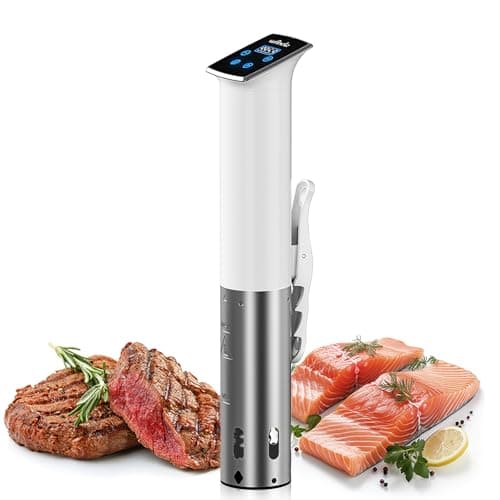
The verdict
Buy it to find out whether sous vide is for you.The Wancle 820 is the lowest-priced circulator we would point anyone at, and the reason it clears the bar is documentation rather than price: Wancle publishes the wattage (1,100 W), the temperature range (25–90 °C / 77–194 °F), the timer range (one minute to 99 hours 59 minutes), the maximum bath (20 L) and the minimum water depth (4.5 cm), plus an IPX7 water-resistance rating, all on its own product page. That is a fuller spec sheet than Breville prints for the Joule. The two things it does not give youare a verified accuracy figure — the ±0.1 °C is Wancle's own claim, with nothing independent behind it — and a warranty, which Wancle does not state anywhere in its own materials. You are buying on the retailer's return window.
What you get for the money
1,100 W is the headline, and it is not a token number. Wattage is what decides how fast a bath comes up to temperature and how quickly it recovers when you drop a cold bag of steak into it, and 1,100 W is the same rating Anova publishes for the full-size Precision Cooker 3.0 and Breville for the Joule Turbo. It is more heating power than the 850 W Anova Nano and the 1,000 W Inkbird, both of which cost more. On a 12-quart container that difference is visible in minutes rather than seconds, and it is the one spec where the cheapest machine here genuinely is not the weakest.
IPX7 is the other spec worth paying attention to, because it changes how you live with the machine. An IPX7 body can be rinsed under a running tap rather than wiped around, which on a device that spends its working life standing in water is a real convenience — starch, fat and bag leakage all end up on the skirt sooner or later. Our cleaning and care guide covers descaling and the impeller, which is the maintenance that actually determines how long a circulator lasts.
The timer deserves a mention precisely because it sounds like filler. A range that runs to 99 hours 59 minutes is not a marketing number in this category: tough cuts are where sous vide is most transformative, and brisket and chuck roastare 24- to 48-hour cooks. A circulator that cannot be set past 24 hours cannot do them. This one can.
The 90 °C ceiling, and whether it matters
Wancle publishes a top temperature of 90 °C (194 °F), which is lower than the 99 °C Inkbird publishes and below the 100 °C the discontinued Monoprice reached. In practice this is close to a non-issue: sous vide cooking lives between about 50 °C and 85 °C, and the hottest things anyone actually does in a bath — vegetables at 83–85 °C, custards far below that — sit under the ceiling. Our temperature guidelists the whole range by food, and nothing on it requires more than 85 °C.
Where the ceiling does bite is the uses that are not really sous vide: holding a near-boiling bath for blanching, or sterilizing jars. If that is on your list, buy the Inkbird instead. For steak, eggs, salmon and pork chops, 90 °C is more headroom than you will ever use.
The accuracy claim, treated as a claim
Wancle states ±0.1 °C. So do Anova and Inkbird. The difference is not the number, it is what stands behind it: Anova is a brand with a two-year warranty and a service operation, and if its circulators drifted systematically the internet would have said so at volume by now. Wancle is a low-cost manufacturer with no published warranty, and nobody independent has measured one. We have not measured one either — this site has no test kitchen and says so plainly— so the honest treatment is to report the figure as the manufacturer's own and tell you it is unverified.
How much that should worry you depends entirely on what you cook. For a steak held at 54 °C, half a degree of drift is invisible; the method's whole appeal is that the window is wide. For an egg, where the difference between 63 and 65 °C is the difference between two textures, a machine you cannot trust to a degree is a machine you will end up second-guessing. And for food safety the relevant thing is not the tenths but the pasteurization time-and-temperature combination, which the safety pageworks through against the USDA's guidance. If you want certainty rather than a claim, an inexpensive instant-read thermometer in the bath settles it on day one — and that is advice we would give a buyer of any circulator, not just this one.
No published warranty, which is the real cost
This is the line that keeps the Wancle out of first place on any list where longevity matters. Wancle publishes no warranty term in its own materials. Inkbird publishes one year. Anova publishes two, on both the Precision Cooker and the Nano. A circulator is a sealed unit containing a heater, a thermistor, an impeller and a control board, living in hot water — things do fail, and when they do the question is who pays. With no stated warranty, the answer is the retailer's return window and then you.
That is a legitimate thing to accept at this price, and it is a bad thing to accept by accident. The way we would frame it: the Wancle is the right purchase if you are genuinely unsure whether you will still be cooking this way in a year, because it costs about a third of what certainty costs and it does the same physics. It is the wrong purchase if you have already decided sous vide is how you cook, because then you are buying a machine for the long run and the brand that will replace it matters more than the price that bought it. Is sous vide worth it is the page for the first question.
Wancle against the machines you are actually choosing between
Published figures only, each from the manufacturer's own specification page. Price is deliberately absent — see the live figure on the card above. | Wancle 820 | Inkbird ISV-100W | Anova Nano 3.0 |
|---|
| Rated power | 1,100 W | 1,000 W | 850 W |
|---|
| Temperature range | 25–90 °C | 25–99 °C | 0–92 °C |
|---|
| Stated accuracy | ±0.1 °C (unverified) | ±0.1 °C | ±0.1 °C |
|---|
| Connectivity | None — on-device controls only | WiFi (2.4 GHz) + app | Dual-band WiFi + app |
|---|
| Published warranty | None stated | 1 year | 2 years |
|---|
Read that table as three prices for the same physics. The Wancle has the most heating power and the least accountability. The Inkbird adds WiFi, a higher ceiling and a year of warranty for a modest step up, and it is the machine we would actually recommend to someone who already knows they want to cook this way on a budget. The Anova Nanohas the least power of the three and the most behind it — two years of warranty, a published pump flow and a brand that will still be here. Those three trades are the entire budget end of this category, and the best budget sous vide machines ranks them against each other.
What it does not have
No WiFi and no app, which we count as close to neutral — a circulator with on-device controls works when your phone is dead and your router is rebooting, and the Joule's app-only design is the opposite bet. No published pump flow rate, which Anova gives (8 L/min full-size, 7 L/min Nano) and which matters in a deep container. No magnetic foot, no clip-on rack, no container. And no containeris a real consideration at this price point: the 20 L maximum bath and 4.5 cm minimum depth Wancle publishes are the numbers that tell you whether the stockpot in your cupboard will do, and usually it will.
You will also need bags, and you do not need a vacuum sealer: sous vide without a vacuum sealer covers the water-displacement method that makes a box of zip-top bags sufficient, and whether Ziploc bags are safe answers the question that follows. Budgeting for a sealer on top of a budget circulator is the most common way people spend more than they needed to on starting this.
Who should buy it
Buy the Wancleif the honest answer to “will I still be doing this in a year?” is “no idea”. It has the power, the range and the timer to cook everything on this site properly, it is the cheapest entry to the method by a clear margin, and if it dies in eighteen months you will not feel robbed. Buy the Inkbird insteadif you want a year of warranty, a 99 °C ceiling and WiFi for a small step up. Buy the Anova Precision Cooker 3.0if you have decided this is how you cook and you want the two-year warranty, the published pump flow and the service operation — the best sous vide machines is where that case is made. And if you are starting from scratch, the beginner roundup and how to choose a sous vide machine are the two pages to read before you spend anything.