HUB 02 · Rice Cookers
Are Rice Cookers Worth It?
Yes for most people, and here is the honest version of why — plus the harder question hiding inside it: is an expensive one worth it over a cheap one? The answer is a clean split based on how often you actually cook rice.
We earn a commission if you buy through our links. It does not change the price you pay, and it does not decide our picks — the scoring rubric is published in full, including what disqualifies a pick. How this works.
What a rice cooker actually does better than a pot
Two things: consistency and attention. A rice cooker senses when the water is gone and stops automatically, so you get the same result every time and you never stand over it or drain a scorched pot. That is genuinely worth it for anyone who eats rice regularly — not because rice is hard on the stove, but because a rice cooker makes it a non-event. Set it, walk away, and it holds the rice warm and fresh for hours — and it does that for cents, as do rice cookers use a lot of electricity works out from every published wattage we can cite.
The real question: cheap or expensive?
This is where the honest answer lives, and it is a clean split:
- You cook rice a few times a week or less: a budget cooker (~$40) like the Aroma is all you need. It makes genuinely good rice, and it throws in slow-cook and steam functions. Spending $260 here is spending on a difference you will rarely notice.
- You eat rice most days, or you care about texture: a fuzzy-logic or induction cooker (Zojirushi, Tiger, Cuckoo) earns its price. The heat control produces more even, better-textured rice batch after batch, and it handles brown rice, sushi rice and mixed grains far better.
What you are actually paying for at the top
Not gimmicks — heat control and build. The premium cookers adjust the heat continuously through the cook (fuzzy logic) or heat the whole pot at once (induction), and the pots are thicker and more precisely made. The difference is real and it is incremental: the step from a $30 cooker to a $130 fuzzy-logic one is bigger than the step from $130 to $420. If you are unsure, the middle is the safe place to land.
The honest summary
A rice cooker is worth it for almost anyone who eats rice regularly — the hands-off consistency alone justifies it. An expensive rice cooker is worth it if you eat rice most days or care about the texture; if you cook it occasionally, buy the budget one and put the difference somewhere you will feel it. Both ends of the range are ranked here.
The hardware
The cookers this page is about
The cookers referred to above, with prices pulled live from Amazon and dated on every card. Full rankings live in the roundups linked from this page.
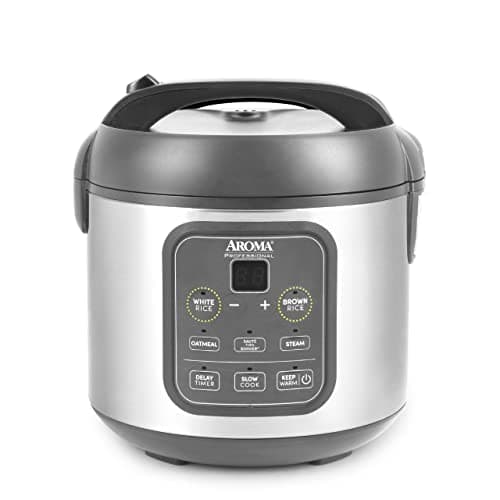
450 W
Aroma Professional ARC-994SG Digital Rice Cooker & Multicooker
The budget pick now, and an honest one. For around forty dollars it cooks white and brown rice, sautés then simmers, slow-cooks for 2 to 10 hours and steams — a genuine little multicooker in a small pot — and Aroma publishes its 450 W draw. What Aroma does not publish is how its 'Sensor Logic' works, and there are only two rice programs, so this is the versatility pick, not the rice-quality one.
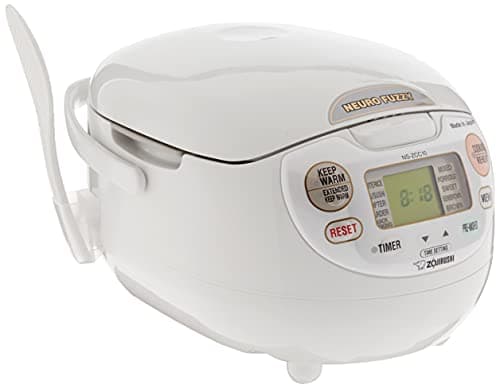
680 W
Zojirushi NS-ZCC10 Neuro Fuzzy Rice Cooker & Warmer, 5.5 Cup
The rice cooker every other one is measured against. Its Neuro Fuzzy microcomputer adjusts heat through the cook rather than running a fixed timer, which is the whole reason a $260 rice cooker cooks rice better than a $30 one. Made in Japan, 680 W, and the settings that matter are all there.
#ad · As an Amazon Associate we earn from qualifying purchases.
Questions
Frequently asked
Do I really need a rice cooker?
Is a $30 rice cooker good enough?
Why would anyone spend $400 on a rice cooker?
Keep reading
Related
Receipts
Sources
- Aroma Housewares — ARC-994SG Digital Rice & Grain Multicooker product page (Overview & Specs)
- Zojirushi — NS-ZCC10 Neuro Fuzzy Rice Cooker product page
We have not tested these machines in a lab and we do not pretend to have. Specifications come from the manufacturer's own published documents; electricity rates come from the US Energy Information Administration; prices come from the live Amazon API. Where a figure is not published, the page says “not published” rather than guessing. Read the full method.