The short answer
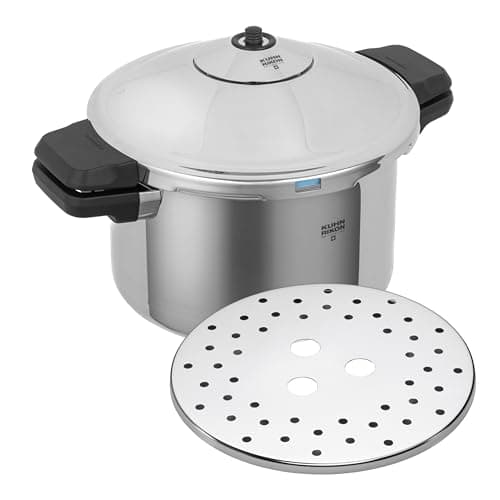
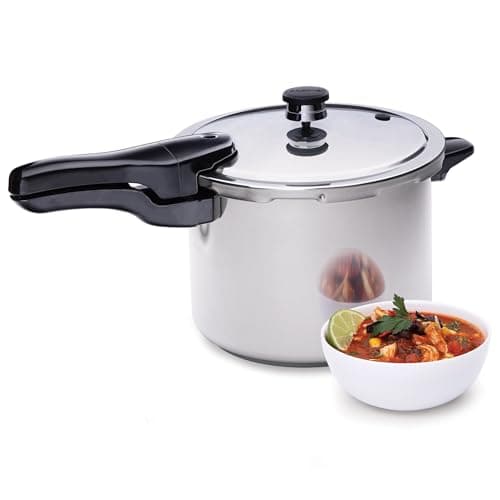
Buy the Presto 01362 unless the quiet is worth the money to you.It publishes its operating pressure (Presto's regulator holds “the ideal cooking pressure — usually 15 pounds”), it is listed for induction, it is stainless with a tri-clad base, and the warranty is an extended twelve years — longer than Kuhn Rikon's ten, on a cooker costing roughly a third as much. Buy the Kuhn Rikon Duromatic 5.0 L if you cook under pressure often enough that a hissing, rattling pot in a small kitchen is a daily irritation: the spring valve holds pressure silently and vents almost nothing, the body is 18/10 stainless made in Switzerland, and every hob type is listed. What it does not do is publish a pressure figure at all, which on this site is a real mark against it.
The two mechanisms, and why they feel different
A weighted rocking regulator — the Presto design, and the one almost everyone picturing a pressure cooker has in mind — is a calibrated weight sitting over the vent pipe. Steam pressure lifts it, steam escapes, pressure drops, the weight falls back. It oscillates, which is the rocking you hear, and the pressure is held by that oscillation. The feedback is the point: when the weight rocks gently every few seconds, the pressure is right, and you adjust the burner to keep it doing that. It is self-evidently correct and needs no instrument. It also hisses continuously and vents a measurable amount of your cooking liquid as steam.
A spring-loaded valve — the Kuhn Rikon design — holds a sealed valve closed against a calibrated spring. Below the set pressure nothing moves at all; above it, the valve lifts just enough to bleed off the excess. There is no oscillation and almost no venting in normal operation, so the pot is quiet and loses very little liquid. The cost is that you cannot hear whether it is working: you read a visual indicator instead, and a first-time user has to learn to trust it.
What each publishes
Published specifications only. Neither cooker has an element of its own, so neither carries a wattage on this site. | Presto 01362 | Kuhn Rikon Duromatic 5.0 L |
|---|
| Capacity | 6-Quart liquid capacity (5.7 L) | 5.0 L |
|---|
| Material | Stainless steel, tri-clad base | 18/10 stainless steel |
|---|
| Operating pressure | Regulator holds the ideal pressure, usually 15 pounds | Not published |
|---|
| Hobs | Gas, electric, smooth-top, induction | All hobs: induction, gas, Ceran, cast, electric, halogen |
|---|
| Diameter | Not published | 22 cm (8.66 in) |
|---|
| Made in | Not published | Switzerland |
|---|
| Warranty | Extended 12-year limited | 10 years guarantee |
|---|
Note which way the documentation gap runs. Kuhn Rikon tells you more about the object — diameter, alloy grade, country of manufacture, every hob type — and Presto tells you more about what it does. For a pressure cooker, the pressure is the function, and a premium cooker that will not state it is the harder omission to defend. We have not measured either pot and we are not going to imply we have; this is a comparison of what the two companies are willing to put in writing.
Capacity is not equal, and the numbers mislead
Five litres against six quarts looks close. Six US quarts is 5.7 litres, so the Presto is about fourteen percent larger, and on anything subject to the half-full rule — beans, grains, stock — that difference compounds. If you were choosing between them for bean cooking, the Presto gives you roughly three quarts of usable space against the Kuhn Rikon's two and a half. For braising two or three portions, neither is limiting.
Where the Kuhn Rikon genuinely earns it
Three places, and they are all real. First, the noise: if your kitchen is open-plan or you cook under pressure several times a week, a pot that does not hiss for forty minutes is a materially nicer object to live with, and no amount of specification captures that. Second, liquid retention: the spring valve vents far less steam, so a braise finishes with more of its sauce and less of it on the extractor hood. Third, build: 18/10 stainless and Swiss manufacture are not marketing words here, and a Duromatic is the kind of pot that gets handed down.
What it does not earn is a recommendation on specs, and our published method ranks on specs. One of the five metrics is Documentation — whether the manufacturer will tell you what its cooker does — and a pot with no published pressure figure loses points for exactly the reason a buyer should care: you cannot work out cooking times from first principles, and you cannot check whether a recipe written for 15 pounds applies.
And the third option on this page
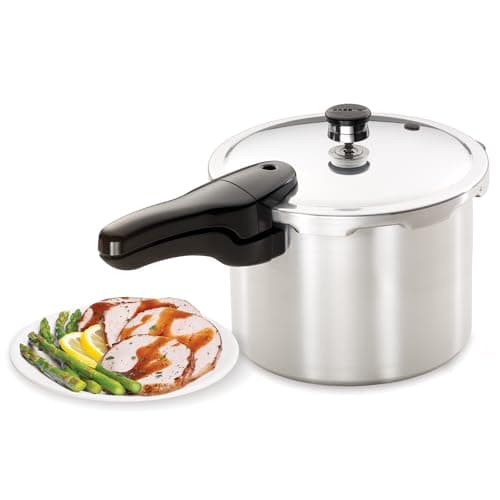
The aluminum Presto 01264 is here because it is the honest floor of the category and it reframes the whole comparison. It holds the same roughly 15 pounds, carries the same 12-year warranty, and costs a small fraction of the Kuhn Rikon. The price of that is explicit: Presto does not list it for induction, aluminum reacts with acidic foods over long contact, and it stains. If you have a gas or radiant hob and you want to find out whether stovetop pressure cooking suits you before spending real money, buy that one first — the budget bracket makes the same argument across electrics too.
How to choose, in one paragraph
If this is your first stovetop pressure cooker, buy the Presto — the audible feedback is a genuine teaching aid, the pressure is documented so recipes transfer, and twelve years of warranty means a mistake is cheap. If you already know you like cooking this way, cook under pressure weekly, and the hiss bothers you, the Duromatic is the upgrade and the quiet is what you are buying. And if what you actually want is to put food in a pot and leave the room, neither of these is the answer and you want an electric cooker instead. How to use a pressure cooker covers the technique either way.