HUB 02 · Rice Cookers
Why Is My Rice Cooker Not Working?
Most rice-cooker faults are one of a handful of simple things: no power reaching the element, a dirty or blocked thermal sensor, a warped inner pot, or a water ratio that was off. Here is how to tell which one you have, in the order worth checking.
We earn a commission if you buy through our links. It does not change the price you pay, and it does not decide our picks — the scoring rubric is published in full, including what disqualifies a pick. How this works.
Start with the symptom
“Not working” covers several different faults, and each points somewhere different. Work through them by what you are actually seeing— won't power on, won't switch off Cook, under- or overcooks, or shows an error — and most turn out to be a five-minute fix rather than a dead machine. Many “broken cooker” complaints are really a ratio or a cleaning problem in disguise.
It won't turn on at all
Check the obvious first: the cord is fully seated at both ends (many cookers have a detachable cord), the outlet works (try another), and the pot is properly closed. If there is still nothing, many rice cookers have a thermal cut-off fusethat trips if the unit ever ran dry or overheated — a safety feature, but usually not user-resettable, which for an inexpensive cooker often means replacement. Before concluding that, though, rule out the cord and outlet, since a loose detachable cord is the single most common “dead” cooker.
It won't switch to Keep Warm (keeps cooking, or clicks off early)
A rice cooker knows the rice is done by sensing the temperature of the pot rising past boiling once the water is gone (more on that in how a rice cooker knows when it's done). If it never switches to Keep Warm, or trips off too soon, the usual culprit is the thermal sensor platein the center of the base: if food, a grain of rice or scale is stuck on it, or on the bottom of the inner pot, it cannot read the temperature correctly. Wipe both the center sensor and the base of the inner pot clean and dry — how to clean a rice cookercovers it — and make sure nothing is holding the pot up off the plate.
It undercooks, overcooks, or the rice is wrong
If the cooker runs a full cycle but the rice is bad, the machine is probably fine. The three usual causes are a wrong water ratio (see the rice-to-water ratio chart), a warped or dented inner potthat no longer sits flush against the heating plate (common after the pot has been dropped or run through a dishwasher it wasn't rated for), or that same dirty thermal plate cutting the cycle short. A pot that won't make even contact heats unevenly, which reads exactly like a broken element even though the cooker is healthy.
It shows an error code (fuzzy-logic models)
Micom and fuzzy-logic cookers like the Zojirushi Micom can display an error code (often an Efollowed by a number). Those flag an internal sensor or circuit fault, and the meaning is model-specific — check your manual's error list. First, though, unplug the cooker for a minute and try again; a one-off code after a very full or unusual batch sometimes clears. If a code returns every time, that is a genuine hardware fault, and a cooker still under warranty is worth a manufacturer contact rather than another attempt. If none of the above fixes a basic cooker that has simply worn out, our roundups — from budget picksup — cover the replacements.
The hardware
The cookers this page is about
The cookers referred to above, with prices pulled live from Amazon and dated on every card. Full rankings live in the roundups linked from this page.
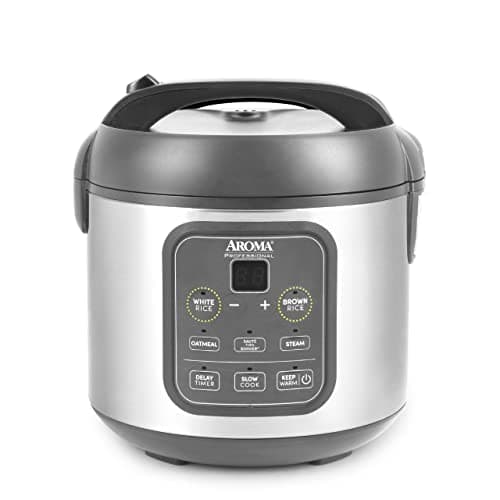
450 W
Aroma Professional ARC-994SG Digital Rice Cooker & Multicooker
The budget pick now, and an honest one. For around forty dollars it cooks white and brown rice, sautés then simmers, slow-cooks for 2 to 10 hours and steams — a genuine little multicooker in a small pot — and Aroma publishes its 450 W draw. What Aroma does not publish is how its 'Sensor Logic' works, and there are only two rice programs, so this is the versatility pick, not the rice-quality one.
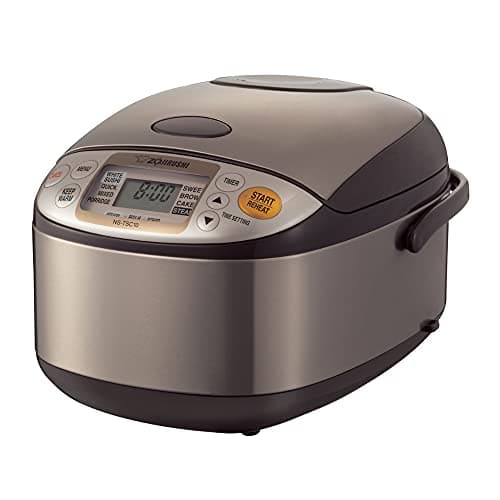
610 W
Zojirushi NS-TSC10 Micom Rice Cooker & Warmer, 5.5 Cup
A Micom fuzzy-logic Zojirushi at meaningfully less than the Neuro Fuzzy, with a couple of trades: it is made in China rather than Japan, and it adds a steam and cake function the NS-ZCC10 lacks. Same fundamental advantage — the microcomputer adjusts heat as it cooks — at 610 W.
#ad · As an Amazon Associate we earn from qualifying purchases.
Questions
Frequently asked
Why won't my rice cooker turn on?
Why does my rice cooker keep cooking and not switch to warm?
My rice cooker runs but the rice comes out bad - is it broken?
Keep reading