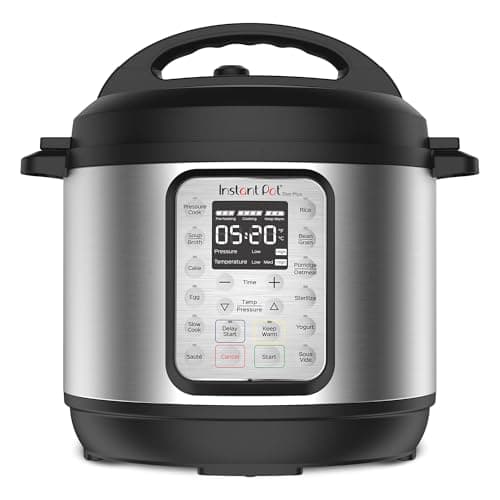
What the Duo Plus adds over the Duo
The Duo Plus is not a new cooker so much as the Duo with the two additions most people wish the Duo had: a sous vide program and a sterilize function, taking it from 7-in-1 to 9-in-1 with 25 presets. Underneath, it is the same machine — Instant Brands publishes the same 1,000 W rating, the same 6-quart 18/8 stainless tri-ply pot, and, unusually for the range, the same 10.2–11.6 psi working-pressure figure on the manual. You are not buying better cooking; you are buying two more things it can do and a quieter way of letting the steam out.
The WhisperQuiet release is the real quality-of-life change
The upgrade people notice day to day is not sous vide — it is the WhisperQuiet steam release. The plain Duo vents through a manual toggle that hisses hard; the Duo Plus diffuses that release so it is markedly quieter, which genuinely matters if your kitchen opens onto a bedroom or a sleeping baby's room. It ships with a steam rack and two spare sealing rings as well, which is the accessory every Instant Pot owner ends up buying anyway once the first ring takes on the smell of last week's chili. None of this changes how the food comes out, but it is a real improvement in living with the machine.
Sous vide on a pressure cooker: useful, not a circulator
The sous vide program is worth being honest about. It holds a water temperature well enough for a steak or a batch of eggs, and if you are curious about the technique it is a genuine way in without buying a second appliance. But it holds temperature less tightly than a dedicated immersion circulator with a pump moving the water, so the bath is warmer at the element and cooler at the far wall. For an occasional sous vide cook it is a real bonus; if precise doneness becomes the thing you chase, a budget circulator is the honest next step. We say the same thing on the Pro, which has the identical sous vide caveat.
Build and documentation
This is where the Duo Plus quietly holds its value: it keeps the Duo's 18/8 stainless, tri-ply-base inner pot with no nonstick layer to fail, and Instant Brands documents it as completely as the Duo — wattage on the product page, working pressure on the manual. On this site's Documentation metric, which scores whether a manufacturer will tell you what its cooker draws and at what pressure it runs, the Duo Plus rates among the highest of any multicooker here, and you can check every figure against the linked sources rather than take it on faith.
The awkward middle
Here is the catch, and it is the reason we do not lead most buyers to this model. The Duo Plus sits close enough to the Pro's price that the Pro is frequently the better buy: the Pro adds an auto-sealing lid that removes the most common first-week mistake, five programmable buttons, and grab-and-go pot handles, on top of the same sous vide. The Duo Plus's one advantage over the Pro is a lower list price — and discounts on the Pro erase it often. So the Duo Plus is genuinely good and genuinely well-documented, but it is squeezed from below by the Duo (cheaper, if you do not need sous vide) and from above by the Pro (better interface, if you do). Where it makes sense is a narrow, real band: you specifically want sous vide and sterilize, and the Pro is not on sale.
Who should skip it
Skip the Duo Plus if you do not care about sous vide or sterilize — the plain Duo cooks identically for less. And skip it if the Pro is only a little more where you are shopping, because the Pro's auto-sealing lid and programmable buttons are worth that gap. Buy the Duo Plus in the specific case that you want sous vide and a quieter release, the Pro is at full price, and the middle is where the value actually lands that week. For the full ladder from Duo to Pro to Duo Crisp, see which Instant Pot to buy, and the direct Duo vs Duo Plus comparison.
How we picked
Machines we claim to have tested: 0
Everyone in this category tells you they tested twenty cookers. We have tested none, and we say so. Here is what we do instead: read the manufacturer's manual and spec page, record the published wattage, capacity, pressure or temperature figure and warranty term, work out what the machine costs to run per hour, show the arithmetic so you can redo it with your own electricity rate, and cite all of it. Where a brand publishes no wattage, we print no running cost rather than borrowing a number from a similar model. Prices come live from Amazon's API and disappear rather than go stale.
The scores above are judgments from that documented research — not test results. One of the five metrics is Documentation: whether the manufacturer will tell you what its cooker draws at all. The full rubric, including what disqualifies a pick, is published in full.