The short answer
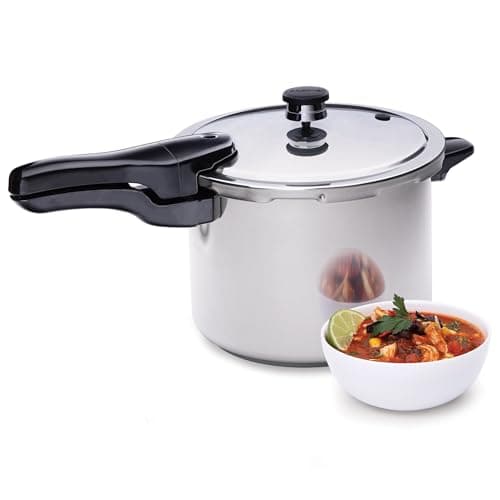
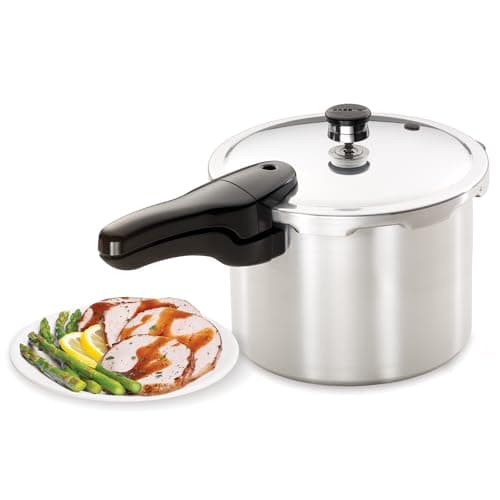
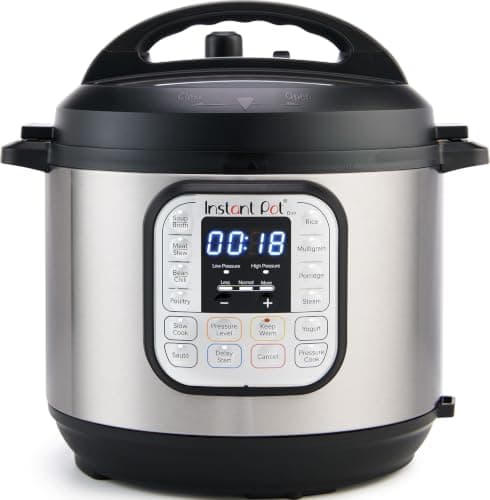
Buy the Instant Pot Duo if you want a cooker you can start and leave. That is not a small thing: the timer, the thirteen programs and the automatic pressure hold are the entire reason this category exists, and the Duo does them at 1,000 W on an 18/8 stainless pot with the wattage, the working pressure and the pot material all published. Buy the Presto 01362 if you want more pressure for less moneyand do not mind standing at the stove: roughly 15 pounds against the Duo's 10.2–11.6 psi, a tri-clad stainless body that works on induction, and an extended 12-year limited warranty against Instant Brands' one year. The aluminum Presto 01264 is the same mechanism for less again, on the hard condition that your hob is not induction.
The numbers, side by side
Published figures only. Stovetop cookers have no element of their own, so a wattage for them would be invented — they draw whatever the burner under them draws. | Instant Pot Duo, 6 qt | Presto 01362, 6 qt |
|---|
| Working pressure | 10.2–11.6 psi (70–80 kPa) high | Regulator holds the ideal pressure, usually 15 pounds |
|---|
| Rated power | 1,000 W, 120 V / 60 Hz | None of its own |
|---|
| Capacity | 6 Qt / 5.7 L | 6-Quart liquid capacity (5.7 L) |
|---|
| Body / pot | 18/8 stainless inner pot, tri-ply base | Stainless steel, tri-clad base |
|---|
| Induction hob | Not applicable — countertop appliance | Listed for gas, electric, smooth-top and induction |
|---|
| Automation | 7-in-1, 13 programs, timer, keep-warm | None. You hold the burner |
|---|
| Warranty | One year limited | Extended 12-year limited |
|---|
What the pressure difference actually buys
Pressure raises the boiling point, and the boiling point sets the cooking temperature. At the roughly 11 psi Instant Brands publishes, water in a sealed pot boils somewhere near 240 °F; at the 15 pounds Presto's regulator holds, nearer 250. Three or four percent more absolute temperature does not sound like much, but reaction rates in cooking climb steeply with temperature, so the practical gap is more like ten to twenty percent off a long cook. Dried beans, chickpeas, shanks, oxtail and stock all show it. A chicken breast does not, because it was never time-limited in the first place.
This is also why recipes do not transfer cleanly in either direction, and why people complain that their grandmother's whistle-counting method gives mush in an Instant Pot or raw beans the other way round. The recipe-conversion guide has the adjustment, and the Instant Pot time table is the electric-side reference.
What the Instant Pot buys that no Presto can
Unattended cooking, and it is the whole product. An electric cooker brings itself up to pressure, holds the set pressure by cycling its own element, counts the time, releases on a schedule and switches to keep-warm. You can put a pot roast in and go out. A stovetop cooker cannot do any of that: you bring it up on high heat, watch for the regulator to start rocking, drop the burner to the lowest setting that keeps it rocking gently, and stay near it, because if the burner is too low the pressure falls out of band and the cook stops happening without any obvious sign.
The Duo also does things that are not pressure cooking at all: slow cook, sauté, steam, yogurt, keep warm. Most of those are the same element at different set points — the what is a multicookerpage is blunt about how little of an “N-in-1” count is real hardware — but a slow-cook mode and a yogurt program genuinely are useful, and a Presto has neither. Slow cooking in an Instant Pot covers how well that particular substitution works.
Durability, and the warranty gap
This is where Presto wins on something more than preference. An electric pressure cooker is a sealed pot plus an element, a pressure sensor, a circuit board and a control panel. Any of those can fail, and Instant Brands warrants the machine for one year. A stovetop Presto is a pot, a lid, a gasket and a weighted regulator; the only wear part is the sealing ring and the over-pressure plug, both of which are cheap consumables. Presto warrants it for twelve years.
That is not a marketing asymmetry, it is a reflection of what each thing is. If you want one pressure cooker that your children will still be using, it is the Presto, and nothing electric on this site is close. If you want the machine that gets used four times a week because it is easy, the honest answer is that it is the Instant Pot — and how long Instant Pots actually last is where we have gathered what is knowable about that.
Which Presto, if Presto
Three in our catalog, and the choice is almost entirely about your hob and your batch size. The 01362 is the one to buy: stainless, tri-clad, induction-listed, and the only one that can take acidic food for long periods without reacting. The 01264 is the same 6-quart capacity in heavy-gauge aluminum for considerably less — Presto does not list it for induction, and aluminum reacts with acidic food over long contact, so no storing tomato-heavy leftovers in the pot. The 01282 is the 8-quart aluminum version, which is the cheapest large-batch pressure cooker on this site and carries the same induction caveat. All three hold the same roughly 15 pounds and all three carry the 12-year warranty. The stovetop roundup ranks them in full, and the induction question has the compatibility table if that is your constraint.
Which Instant Pot, if Instant Pot
The Duo is the default and the one we compare here, because it is the cheapest genuinely well-documented electric cooker in the catalog. Step up only for a specific reason: the Duo Plus for sous vide and a quieter steam release, the Pro for the full program set and the better lid, the current RIO 6-quart if the Duo is out of stock, or the 8-quart Duo Plus if you batch-cook. The side-by-side on the two most-confused models is Duo vs Duo Plus.
The honest recommendation
Most people should buy the Instant Pot, and most people who buy the Presto will be happier cooks. Those are not contradictory. The Instant Pot is the machine that gets used, because convenience decides what comes out of the cupboard on a Wednesday. The Presto is the better pressure cooker — faster, more durable, cheaper, repairable, warranted for a decade — and it asks for twenty minutes of your attention every time. Decide which of those two sentences describes you, not which pot has the better specification, because on the specification the Presto wins and that is not the question.