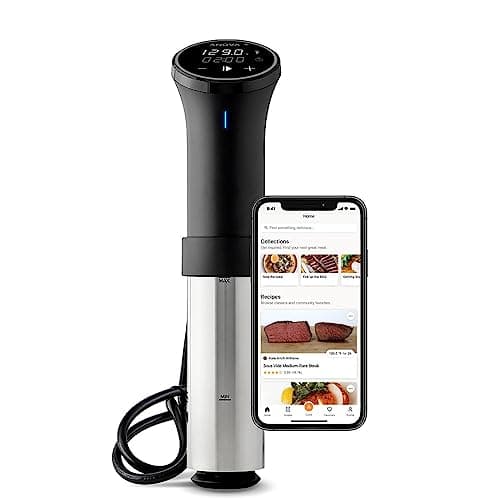
Premium default vs the cheapest way in
This is a match-up between two honest extremes. The Anova Precision Cooker 3.0is the machine most people should buy — fully specified, well documented and backed by the longest warranty here — while the Monoprice Strata is the floor of the category, the cheapest way to find out whether you even like cooking this way. We have cooked on neither; this is a read of the published specs and the design choices, the way our methodology lays out, not a test-kitchen result. Both genuinely work. The real question is whether you want the premium default or the cheapest way in, and the honest answer turns on how seriously you already know you cook.
Control precision: ±0.1°C vs ±1%
This is the difference that matters most, so start here. The Anova publishes a ±0.1°C accuracy figure; the Monoprice quotes a looser ±1% temperature stabilityinstead — a different kind of spec, and a looser one. On a steak held at a set point for a couple of hours, you will not see the difference: a fraction of a degree of drift is a shade of medium-rare nobody notices. Where it shows up is on long, low cooks and delicate foods — a twelve-hour tough cut, or eggsheld right at a set point, where egg proteins set across such a narrow band that a degree or two decides a runny yolk from a set one. If precision cooking is the reason you want a circulator, the Anova's tighter number earns its keep. If you mostly picture steaks and chicken, the Monoprice's looser control is genuinely fine.
Power and heat-up
On paper the two split the difference in an interesting way. The Anova draws 1,100 W against the Monoprice's 800 W, so it heats a large bath faster — the extra power is real, and you feel it most when you fill a big, deep container with cold water and want to get cooking. But the Monoprice answers with pump flow: it moves a rated 8.5 L/min through a clever directional cap, a touch more than the Anova's 8 L/min, and circulation is what keeps the whole bath at one even temperature. So the premium machine heats faster and the budget machine actually rates slightly higher flow — and for the portion sizes home cooks really do, a steak or two in a pot, both have all the muscle they need. The temperature ranges differ too (the Anova's 0–92°Creaches lower, the Monoprice's 5–100°C reaches higher toward a boil), but neither limit bites for ordinary sous vide.
Connectivity and controls
Here the gap is wide, and it is a real preference rather than a quality gap. The Anova has an on-device screen plus dual-band WiFi and an app, so you can set a cook at the machine and also start or check it from your phone in another room or from work. The Monoprice has physical controls only and no connectivity at all— you set temperature and time on the unit, stand it up, and walk away. If remote start and monitoring sound useful, the Anova gives you that and the Monoprice cannot. If an app sounds like friction you would never use, the Monoprice's simplicity is a feature: nothing to pair, update or have fail. Neither is app-only, so both work fully at the machine — the Anova simply adds a connected layer on top.
Warranty and documentation
Two honest points close the spec sheet. The Anova carries a two-year warranty, the longest of any sous vide machine on this site; Monoprice does not publish a warranty termin the manual at all, which is a genuine gap when you are deciding how long a machine should last. On documentation the two are closer than the price suggests — both actually publish a full specification, which is more than some pricier rivals manage, and it is exactly the kind of thing our Documentation metric rewards. The difference is that the Anova publishes a tighter accuracy figure and a warranty, while the Monoprice publishes neither of those two, and is still unusually forthcoming for its price.
Who each is for
Put simply: the Anova is the machine you buy if you already know sous vide is part of how you cook, and the Monoprice is the one you buy to find out. Buying the Anova first is never a mistake — it is the category default for a reason — but it is more machine than a curious beginner strictly needs. Buying the Monoprice first is the low-risk way in, with the honest caveat that if you fall for the technique you may well want the tighter control later. Neither choice is wrong; they answer different questions about how committed you already are.
The one-line rule:if precision cooking — eggs, long low cooks, delicate fish — is why you want a circulator, the Anova's ±0.1°C control, dual-band WiFi and two-year warranty make it the safe default. If you mainly want to try sous vide cheaply and are not yet sure it will stick, the 800 W Monoprice, with its looser ±1% stability and no published warranty, is the honest floor to start on. Sous vide safety, by the way, comes from time and temperature together— holding food long enough at temperature to pasteurize it — not from either machine's accuracy number; see the temperature guide for exact targets.
The decision rule
Think of it as one question with a follow-up. First: do you already know you love sous vide? If yes, buy the Anova Precision Cooker 3.0and stop reading — the fullest published spec, an on-device screen, dual-band WiFi and the longest warranty here make it the category default, and it is the one you will not outgrow. If you are not sure, the follow-up is: how much do you want to risk on finding out? The Monoprice Stratais the least you can spend and still cook properly — a capable 800 W machine with a genuinely thoughtful directional pump cap — and if the technique sticks, you will know exactly what to upgrade to.
Buy the Anova if precision, connectivity and a two-year warranty matter and you cook often enough to use them. The Monoprice is discontinued, so if the goal is the cheapest honest way to try sous vide, and you can live with looser ±1% control and no published warranty. If the Monoprice tempts you but the ±0.1°C control does too, the middle path is the WiFi-and-screen Inkbird — weighed against the Monoprice in Inkbird vs Monoprice. See where the Anova lands in the best sous vide machines and the Monoprice in the budget picks.
How we picked
Machines we claim to have tested: 0
Everyone in this category tells you they tested twenty cookers. We have tested none, and we say so. Here is what we do instead: read the manufacturer's manual and spec page, record the published wattage, capacity, pressure or temperature figure and warranty term, work out what the machine costs to run per hour, show the arithmetic so you can redo it with your own electricity rate, and cite all of it. Where a brand publishes no wattage, we print no running cost rather than borrowing a number from a similar model. Prices come live from Amazon's API and disappear rather than go stale.
The scores above are judgments from that documented research — not test results. One of the five metrics is Documentation: whether the manufacturer will tell you what its cooker draws at all. The full rubric, including what disqualifies a pick, is published in full.