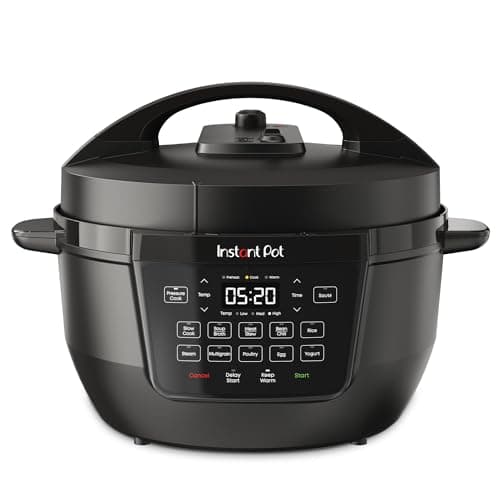
What the RIO name actually is
Start with the confusing part: RIO is the Duo, renamed. Instant Brands rebranded its core pressure-cooker line RIO, so the RIO Wide is the descendant of the Duo you already know — the same 7-in-1 function set, the same 18/8 stainless tri-ply pot, the same manual steam toggle. What is new on the Wide is the shape: a 7.5-quart pot with a wider, shallower base than the tall 6-quart cookers. That one change is the whole reason to consider it.
The wide base is a real improvement
More of the pot bottom touches the heating element, so Instant Brands claims roughly 35% more searing surface than a standard pot. In practice that means you can brown more meat in a single batch before you pressurize, and it browns more evenly, because you are not crowding cubes of beef into a narrow tall pot where half of them steam instead of sear. The sear-then-pressure workflow is where a lot of pressure-cooker flavor actually comes from, and a wide base makes that step less fiddly. For anyone who browns before every braise, this is a genuine ergonomic win, not a spec-sheet line.
7.5 quarts is a real capacity step
The Wide is also simply bigger. At 7.5 quarts it cooks for a larger household or a batch-cooking weekend — a bigger roast, a full pot of stock, double the beans — where the 6-quart pots start to feel tight. If you routinely cook for four or more, or you meal-prep in volume, the extra capacity is worth having, and it pairs with the wide base so the bigger batches also brown properly. It is the natural pick in our large multicooker roundup for exactly this reason.
What you give up: width and watts
The trades are honest ones. A wider pot takes more counter than a tall 6-quart cooker for the same 7-in-1 feature set, so in a small kitchen the Wide's whole advantage becomes a liability. And it draws 1,200 Wrather than the standard Duo's 1,000, so it costs marginally more per minute to run — a difference measured in a few cents a cook, but real, and worth doing the arithmetic on if you cook most days. There is also no sous vide and no air fry here: this is the plain, wide pressure cooker, nothing more.
Documentation and build
The Wide keeps the Duo line's two structural strengths. The 18/8 stainless anti-spin inner pot has no coating to scratch off and stays put while you stir, so it outlives the nonstick pots in cookers a tier up. And Instant Brands publishes the 1,200 W rating on its own RIO Wide product page, so the running-cost figure on this site is traceable to the manufacturer rather than guessed — the whole point of how we rank.
Who should skip it
Skip the RIO Wide if counter space is tight or you cook for one or two — the width is its entire advantage, and if you do not need it you are giving up counter for nothing while paying a little more to run it. The standard Duo is the same idea, narrower and cheaper. Buy the Wide if you cook for a crowd, brown a lot of meat before you braise, or batch-cook on weekends — the bigger, wider base is a real, usable upgrade for that kitchen. See where it ranks in the best large multicookers, or size it against your household in what size Instant Pot to buy.
How we picked
Machines we claim to have tested: 0
Everyone in this category tells you they tested twenty cookers. We have tested none, and we say so. Here is what we do instead: read the manufacturer's manual and spec page, record the published wattage, capacity, pressure or temperature figure and warranty term, work out what the machine costs to run per hour, show the arithmetic so you can redo it with your own electricity rate, and cite all of it. Where a brand publishes no wattage, we print no running cost rather than borrowing a number from a similar model. Prices come live from Amazon's API and disappear rather than go stale.
The scores above are judgments from that documented research — not test results. One of the five metrics is Documentation: whether the manufacturer will tell you what its cooker draws at all. The full rubric, including what disqualifies a pick, is published in full.