Skip to content
DD

HUB 03 · Sous Vide

Greater Goods vs Inkbird

Two of the best-value circulators here, pulling in opposite directions. The Inkbird gives you WiFi, an on-device screen and a published accuracy spec; the Greater Goods gives you a genuinely silent motor and refuses to involve your phone. Here is which trade fits you.

By Stephen V.Updated How we rank
#ad

We earn a commission if you buy through our links. It does not change the price you pay, and it does not decide our picks — the scoring rubric is published in full, including what disqualifies a pick. How this works.

The short answer

Quick picks

#CookerBest forScorePrice
01
Inkbird Inkbird ISV-100W WiFi Sous Vide, 1000 W
Inkbird ISV-100W WiFi Sous Vide, 1000 W

WiFi and a screen for under $100

1,000 W
8.8
$76.78Amazon
021,100 W
8.1
$89.99Amazon

#ad · Prices pulled live from the Amazon Product API, last checked Aug 5, 2026. Where we have no verified live price we show none — we would rather leave a gap than print a number that has gone stale. The wattage column is what the manufacturer publishes; “not published” means exactly that, and we have not estimated one. Scores are ours, compiled from published specifications, and are not test results.

Same price bracket, opposite priorities

These two land close on price and are both genuinely good, which is what makes the comparison useful: you are choosing philosophies, not tiers. The Inkbird ISV-100W is the connected, fully specified option — WiFi, a screen, and a published number for nearly everything. The Greater Goods is the quiet, disconnected option — a silent motor, a dial and a screen, and no phone anywhere in the process. Neither is better in the abstract; they are built for different temperaments.

The Inkbird case: WiFi and a spec sheet that holds up

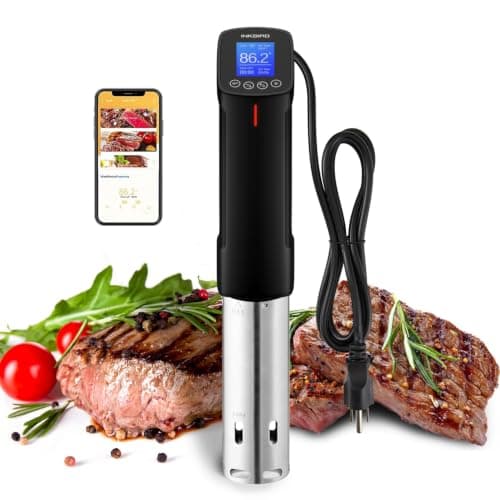
The Inkbird's argument is that you give up almost nothing on paper. It publishes the full specification — 1,000 W, a 25–99°C range, ±0.1°C accuracy, 15 L capacity — at a price where most rivals publish nothing, and it has both an on-device dot-matrix screen and WiFi, so it works with or without the app. Its ±0.1°C on paper matches the Anova for less than half the money. The honest weak points: a one-year warranty, a functional-not-great app, 2.4 GHz WiFi only, and a slightly less polished spec presentation.

The Greater Goods case: silence and no setup

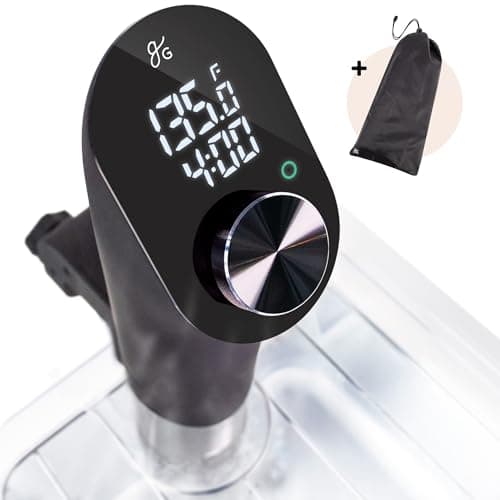
The Greater Goods answers with two things the Inkbird cannot match: a genuinely silent brushless motor, rated for 99 hours of continuous running, that is noticeably quieter on a long overnight cook; and the absence of any app to set up, fail or update. It draws 1,100 W across a 20–95°Crange. Its weakness is the mirror image of the Inkbird's strength: it does not publish an accuracy figure or a warranty term, so where the Inkbird hands you a full spec sheet, the Greater Goods asks a little more trust.

How to actually choose

It comes down to two questions. Do you want to control the cook from your phone? If yes, the Inkbird is the only one of the two that can, and its published accuracy spec is reassuring besides. Do you do long overnight cooks and value a quiet kitchen, with no interest in an app?If yes, the Greater Goods' silent motor is the feature you will actually notice, every time. For most buyers the Inkbird's connectivity-plus-spec is the more broadly useful package at the price — but the Greater Goods is the better answer for the specific cook who wants silence and simplicity over features.

The decision rule

Buy the Inkbird if you want WiFi, an on-device screen and a fully published spec — it is the more flexible machine and the safer default at this price. Buy the Greater Goods if a silent motor for long cooks and a no-app, no-setup experience matter more to you than connectivity, and you are comfortable with a thinner spec sheet. Both are strong picks in the best budget sous vide machines; the choice is which trade you would rather live with.

In detail

The picks, in full

01
Inkbird Inkbird ISV-100W WiFi Sous Vide, 1000 W

WiFi and a screen for under $100

Inkbird ISV-100W WiFi Sous Vide, 1000 W

Fully specified under $100On-device screen + WiFi
8.8/10

The value pick that does not feel like one. Under $100, and Inkbird still publishes the full specification: 1,000 W, a 25–99°C range, ±0.1°C accuracy, 15 L capacity, WiFi and an on-device dot-matrix screen. It undercuts the Anova by more than half and gives up remarkably little on paper.

Capability
9
Capacity
8.5
Documentation
9.5
Build
7.5
Value
9.5

What it gets right

  • Publishes the complete specification — wattage, range, accuracy, capacity — at a price where most rivals publish nothing
  • An on-device dot-matrix screen and WiFi both, so it works with or without the app
  • ±0.1°C accuracy on paper matches the Anova, for less than half the money

What it doesn't

  • A one-year warranty against the Anova's two
  • The listed weight figure on Inkbird's own page is internally inconsistent — a small sign the documentation is less polished than Anova's
  • The app is functional rather than good, and the WiFi is 2.4 GHz only

What it costs to run

About 18.8¢ an hour at full rated draw, at the US average of 18.83¢ per kWh.

1,000 W ÷ 1000 × 1 h × 18.83¢ = 18.8¢

1000 W, published on Inkbird's own ISV-100W product page alongside the range, accuracy and capacity. This is an upper bound: the element only draws full power while it is heating up or pressurizing, then cycles off to hold temperature, and no manufacturer publishes a duty cycle — so we compute at full rated draw rather than invent a correction factor. The full method is published.

Skip this if…

you want the longest warranty and the most refined app — that is the Anova, and it costs the difference. On the cooking specification itself, this gives up very little.

$76.78on Amazon

$95.9920% off

Price last checked Aug 5, 2026. Prices move constantly — Amazon's at checkout is the one that counts.

#ad · we may earn a commission from this link to Inkbird ISV-100W WiFi Sous Vide, 1000 W

02
Greater Goods Greater Goods Sous Vide Precision Cooker, 1100 W

Quiet, simple, no app

Greater Goods Sous Vide Precision Cooker, 1100 W

Silent brushless motorWarranty length not published
8.1/10

The circulator for people who want none of the connectivity. No WiFi, no app, no phone — a dial, a screen and a silent brushless motor rated to run 99 hours straight. 1,100 W, a 20–95°C range, and a build that is quieter than anything else here.

Capability
8
Capacity
8.5
Documentation
7
Build
8.5
Value
8.5

What it gets right

  • A silent brushless motor genuinely is quieter than the geared pumps in most rivals — noticeable on a long overnight cook
  • No app and no WiFi to set up, fail or update: a dial, a screen, done
  • Rated for 99 hours of continuous running, which covers the longest sous vide cooks there are

What it doesn't

  • Greater Goods does not publish a temperature-accuracy figure or a warranty duration on its product page
  • No connectivity at all, which is a genuine loss if you wanted to start a cook from work
  • The specification is otherwise thinner than the Anova's or Inkbird's

What it costs to run

About 20.7¢ an hour at full rated draw, at the US average of 18.83¢ per kWh.

1,100 W ÷ 1000 × 1 h × 18.83¢ = 20.7¢

1100 W, published on Greater Goods' own product page alongside the temperature range and motor rating. This is an upper bound: the element only draws full power while it is heating up or pressurizing, then cycles off to hold temperature, and no manufacturer publishes a duty cycle — so we compute at full rated draw rather than invent a correction factor. The full method is published.

Skip this if…

you want to control or monitor a cook from your phone — this model has no connectivity by design. If remote start matters, the Inkbird gives you WiFi for a similar price.

$89.99on Amazon

Price last checked Aug 5, 2026. Prices move constantly — Amazon's at checkout is the one that counts.

#ad · we may earn a commission from this link to Greater Goods Sous Vide Precision Cooker, 1100 W

How we picked

Machines we claim to have tested: 0

Everyone in this category tells you they tested twenty cookers. We have tested none, and we say so. Here is what we do instead: read the manufacturer's manual and spec page, record the published wattage, capacity, pressure or temperature figure and warranty term, work out what the machine costs to run per hour, show the arithmetic so you can redo it with your own electricity rate, and cite all of it. Where a brand publishes no wattage, we print no running cost rather than borrowing a number from a similar model. Prices come live from Amazon's API and disappear rather than go stale.

The scores above are judgments from that documented research — not test results. One of the five metrics is Documentation: whether the manufacturer will tell you what its cooker draws at all. The full rubric, including what disqualifies a pick, is published in full.

Questions

Frequently asked

Is the Inkbird or Greater Goods sous vide better?
Neither in the abstract. The Inkbird has WiFi, an on-device screen and a published ±0.1°C accuracy spec; the Greater Goods has a genuinely silent motor and no app at all. Choose the Inkbird for connectivity and a full spec sheet, the Greater Goods for a quiet kitchen and no setup.
Which is quieter, the Inkbird or Greater Goods?
The Greater Goods, clearly — its silent brushless motor is noticeably quieter than the Inkbird's pump, which matters most on a long overnight cook. If a quiet kitchen is a priority, that is the Greater Goods' standout feature. See the full review.
Does the Greater Goods sous vide have WiFi like the Inkbird?
No. The Inkbird has WiFi and an on-device screen, so you can control a cook from your phone or the machine itself. The Greater Goods has no connectivity at all by design. If remote control matters, the Inkbird is the one of the two that offers it.

Keep reading

Receipts

Sources

We have not tested these machines in a lab and we do not pretend to have. Specifications come from the manufacturer's own published documents; electricity rates come from the US Energy Information Administration; prices come from the live Amazon API. Where a figure is not published, the page says “not published” rather than guessing. Read the full method.